Which iPhone Lacks eSIM? A Guide for Pre-XS Models
Identify which iPhone models lack eSIM, from iPhone 7 and earlier, and learn how eSIM emerged in the XS/XR era, with regional differences, and practical steps to check compatibility.


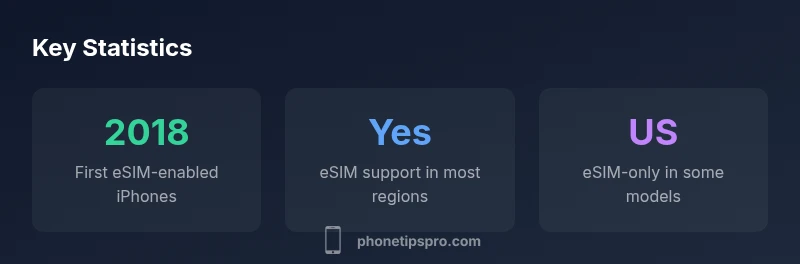
The iPhone models that do not have eSIM are iPhone 7 and earlier. Since the iPhone XS/XR era (2018), Apple added eSIM support in most regions, with newer US models often eSIM-only. If you own a 7 or older, you won't have eSIM capability.
which iphone does not have esim
According to Phone Tips Pro, the phrase which iphone does not have esim helps readers quickly identify devices that lack eSIM hardware entirely. Older iPhone generations rely solely on physical SIM cards. In practice, iPhone 7 and earlier do not support eSIM in any region. This distinction matters most for travelers, multi-line users, and those switching carriers. If your goal is to minimize carrier steps or avoid QR code provisioning, knowing this baseline prevents post-purchase confusion. For context, Apple introduced eSIM with the XS/XR family in 2018, and most newer devices support eSIM, though carriers and countries vary.
How eSIM works on iPhone: a quick primer
eSIM stands for embedded SIM, a digital SIM that lets you activate cellular service without a physical SIM card. On iPhone, eSIM is managed in Settings and can be added via a QR code or carrier app. This means you can have multiple profiles, switch carriers, or travel internationally with ease. The impact on everyday use is notable: dual-SIM configurations, faster carrier provisioning, and fewer plastic parts. Phone Tips Pro emphasizes testing eSIM before traveling or negotiating carrier plans, so you avoid last-minute surprises. In short, eSIM simplifies mobility, but your model and region determine availability.
Pre-XS era: models without eSIM
Before iPhone XS, Apple did not include eSIM hardware in its devices. That means iPhone 7 and older models are all physical-SIM-only. If you own one of these phones, you’ll rely on traditional SIM cards, and you won’t see an Add Cellular Plan option in Settings. This limitation can affect international travel, carrier switching, and long-term device planning. Phone Tips Pro notes that many users underestimate how quickly the ecosystem changed after 2018, when eSIM began to appear in flagship lines.
XS/XR era: introduction of eSIM and regional differences
The XS/XR family marked the pivotal shift toward eSIM-capable iPhones. In many markets, these models support both a nano-SIM and an eSIM, enabling dual-SIM configurations. However, regional variations exist: some regions may still rely more on physical SIMs in certain carriers, while others move toward eSIM provisioning as default. For travelers, this means you can pre-load an eSIM profile for your destination, but you should verify local carrier support before departure. Phone Tips Pro’s analysis highlights that the transition was gradual and varies by country.
US market shift: from physical SIM to eSIM-only
In the United States, recent generations have nudged toward eSIM-first experiences. The iPhone 14 family and later models increasingly ship with strong eSIM support and, in many cases, a SIM tray removal for US variants. This shift reduces dependence on physical cards, simplifies carrier provisioning, and aligns with broader digital identity trends. However, not all regions share the same timeline—some international models still offer nano-SIM slots. Phone Tips Pro notes that consumers should confirm local hardware options and carrier capabilities when upgrading.
How to check if your iPhone supports eSIM
To verify, open Settings > Cellular or Mobile Data > Add Cellular Plan. If you see Add Cellular Plan, your device supports eSIM. If not, your model likely predates the XS/XR era or is restricted by regional hardware. You can also check in About > Model Name and compare with Apple’s official specifications. If you’re unsure, contact your carrier or refer to Apple Support for model-by-model confirmation. Phone Tips Pro recommends confirming eSIM support before purchasing a new device or negotiating a plan.
How to switch from SIM to eSIM or maintain dual SIM
If your iPhone supports eSIM, you can add a plan via QR code, carrier app, or automatic provisioning. A typical path is Settings > Cellular > Add Cellular Plan, then scan the QR code provided by your carrier. If you’re switching from a physical SIM, power off, insert or remove the SIM as instructed, and complete activation using the on-screen prompts. Some regions enable dual-SIM operation, combining nano-SIM with eSIM, while others may require a full switch to eSIM-only. Phone Tips Pro suggests backing up your data and testing connectivity after provisioning.
Real-world tips for travelers and carriers
When traveling, loading an eSIM profile before departure minimizes delays at borders. Carriers benefit from faster provisioning and fewer physical replacements. If you run into issues activating an eSIM, verify carrier support, check for software updates, and ensure you’re using a compatible iPhone model. Phone Tips Pro’s guidance emphasizes keeping one physical SIM-ready as a fallback where allowed by your region, especially if you frequently cross borders or have multiple carriers.
eSIM availability by iPhone generation
| Model Series | eSIM Support | Notes |
|---|---|---|
| iPhone 7 and earlier | No | No eSIM in any region |
| iPhone 8–iPhone X | Yes (regional) | eSIM available in many markets alongside physical SIM |
| iPhone XS, XR, 11–13 | Yes | First widely available eSIM-capable line; dual-SIM in many regions |
| iPhone 14 (US) and newer | Yes | US models often eSIM-only; regional variation exists |
FAQ
Do all iPhone models support eSIM?
No. Only iPhone XS and newer include eSIM in many regions; older models lack eSIM entirely.
Not all iPhones support eSIM; older models don't, while newer generations generally do.
Which iPhone models do not have eSIM?
iPhone 7 and earlier do not have eSIM. These devices rely solely on physical SIM cards.
iPhone 7 and older do not support eSIM.
Can I use a nano-SIM on an iPhone that supports eSIM?
Yes in many regions; you can often use dual SIM with nano-SIM plus eSIM depending on the model and carrier.
In many models you can use both a SIM and an eSIM at the same time.
Is my iPhone 14 US model eSIM-only?
US iPhone 14 models are commonly eSIM-only; no physical SIM slot in those variants.
In the US, iPhone 14-series is typically eSIM-only.
How can I check if my iPhone supports eSIM?
Open Settings > Cellular > Add Cellular Plan. If you see Add Cellular Plan, your device supports eSIM.
Go to Settings, tap Cellular, then Add Cellular Plan to see if you can activate eSIM.
Will future iPhones drop physical SIM entirely?
Apple has moved toward eSIM in many markets, but some regions may still offer nano-SIM; there’s no universal confirmation yet.
Apple is moving toward eSIM, but it varies by country.
“eSIM adoption in the iPhone lineup has steadily increased since 2018, and understanding your model's capabilities helps avoid carrier surprises.”
Quick Summary
- Identify your model year to know eSIM availability
- Older iPhones up to iPhone 7 lack eSIM entirely
- Most models since 2018 support eSIM in many regions
- US models have shifted toward eSIM-only in newer generations
- Check Settings to confirm eSIM availability for your carrier