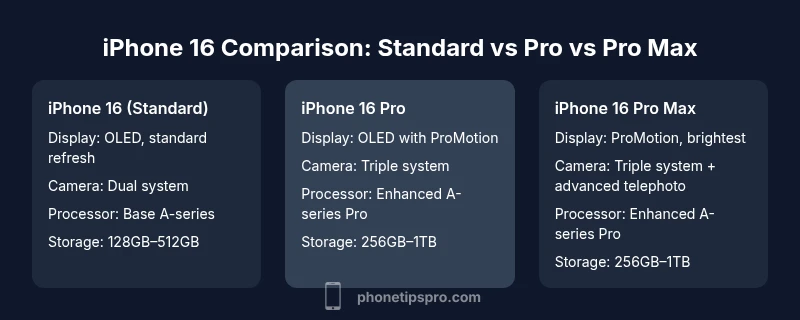
iPhone 16 Comparison Chart: Specs, Cameras, and Value
Explore a detailed iPhone 16 comparison chart across standard, Pro, and Pro Max models. Compare displays, cameras, processors, battery life, storage options, and ecosystem features to pick the right model with guidance from Phone Tips Pro.


According to Phone Tips Pro, the iPhone 16 comparison chart clarifies the lineup's trade-offs. The standard iPhone 16 delivers a balanced mix of performance and value, while the Pro and Pro Max prioritize camera and display enhancements. This article compares display tech, processor, camera systems, battery life, storage tiers, and ecosystem features to help you decide.
How to read the iphone 16 comparison chart
The iphone 16 comparison chart is built to help you quickly see where each model diverges on core capabilities. Start with the display section to understand screening technology and refresh rates, then move to the camera column to gauge imaging features across the lineup. The chart also aligns processors, battery expectations, and storage options so you can judge total value. For readers of the Phone Tips Pro analysis, this chart is designed to make trade-offs tangible, not abstract. When you search for the best fit, consider both your daily needs and potential future use-cases as you scan the columns. This approach is especially important given how ecosystems and accessory availability influence long-term satisfaction. The iphone 16 comparison chart helps translate specs into real-world choices, emphasizing practical gaps rather than marketing claims.
Core lineup overview
The iPhone 16 family expands the familiar core options into a tiered lineup. The standard model typically emphasizes balance—solid performance, reliable cameras, and a price point that makes sense for most buyers. The Pro model generally raises the bar with enhanced imaging systems, brighter displays, and more capable processors. The Pro Max, where offered, compounds those strengths with the largest display, additional camera capabilities, and even longer battery life. In this 2026 frame, the chart reflects where the gaps are most meaningful, and where the benefits may come at a premium. Phone Tips Pro’s evaluation highlights how the Pro family targets power users and creators, while the standard model stays accessible for everyday tasks and longevity.
Display and design considerations
Display quality often drives perceived value. The base iPhone 16 tends to feature a high-quality OLED panel suitable for daily use, while the Pro and Pro Max models introduce ProMotion technology for smoother scrolling and improved responsiveness. Brightness, color accuracy, and HDR performance are common differentiators, especially for photography, video editing, and outdoor viewing. Design remains consistent, but the premium variants may adopt slightly different finishes and materials. For most users, display clarity and touch response matter more than headline resolution, so the chart emphasizes how each model performs in real-world tasks like reading, gaming, and photo editing.
Camera system and imaging capabilities
Camera performance is a frequent deciding factor in the iphone 16 comparison chart. The standard model typically offers a robust dual-camera setup suitable for everyday photography and video. The Pro models usually add additional lenses, enhanced optical zoom, and advanced computational photography features. In practice, day-to-day shots—portraits, landscapes, and low-light scenes—benefit from the Pro’s enhanced processing and sensor improvements. The Pro Max, when available, often showcases the strongest overall imaging toolkit with improved stabilization and telephoto performance. This section focuses on how lens count, sensor size, and software features translate into tangible photo and video outcomes.
Performance and software readiness
Processor performance directly affects app launch times, multitasking ability, and long-term software support. The standard iPhone 16 uses a capable chip adequate for most current apps, while the Pro variants deploy higher-tier silicon with more GPU cores and better power efficiency for demanding tasks like 3D rendering and AR experiences. Software optimizations in iOS across models are designed to keep even older devices responsive for several years, but the Pro line often benefits from longer-term updates and feature availability. Battery management, heat dissipation, and memory bandwidth are practical considerations when evaluating performance for gaming, video editing, and professional workflows.
Battery life, charging, and longevity
Battery life is frequently a top concern for buyers evaluating the iphone 16 comparison chart. The standard model offers reliable all-day endurance under typical usage, while Pro models tend to deliver longer battery life thanks to efficiency gains and larger batteries in some configurations. Charging speeds and accessory compatibility are important too; some models may support faster wired charging and wireless charging capabilities, along with updates that improve battery health monitoring. Longevity matters as much as initial performance, so the chart highlights how long you can expect software support and hardware resilience to carry through the device lifecycle.
Storage options and value proposition
Storage is a straightforward but crucial decision element in any iphone 16 comparison chart. Standard configurations usually begin at a base level with options scaling up to more spacious tiers. The Pro and Pro Max typically provide higher base storage and more room for apps, media, and professional assets. The value proposition hinges on how quickly you hit storage limits with your typical usage: photos, 4K video, large apps, or offline media. The chart helps you decide whether paying extra upfront for higher capacity translates into meaningful long-term value or if you can upgrade later through cloud storage or external options.
Ecosystem, accessories, and future-proofing
Beyond core specs, ecosystem compatibility matters. The iPhone 16 family works with a vast array of accessories, from MagSafe components to camera lenses and third-party cases. Pro models may justify higher costs with advanced camera features that unlock certain accessories and workflows, appealing to creators and professionals. The chart also notes software longevity—how many generations of iOS a model is expected to receive and how that aligns with your planned device lifespan. This perspective helps you gauge future-proofing and overall compatibility with your existing tools.
Practical decision framework: who should buy which model
To translate the chart into action, consider your primary use case. If you mainly text, browse, and stream, the standard iPhone 16 offers excellent value and reliable performance. If photo quality, mobile videography, or demanding apps are core to your routine, the Pro is a more prudent choice for most scenarios. If you value the largest display, the strongest camera system, and want maximum longevity and status, the Pro Max—where available—might be worth the premium. Use the chart to map your daily tasks onto the feature set that delivers the best balance of value and capability for your life.
Price ranges and value milestones
Price perception informs your decision in the iphone 16 comparison chart. The standard model generally sits at a middle tier, while Pro variants command higher prices reflecting added capabilities. The Pro Max sits at the top end, with the strongest feature set and, typically, the longest upgrade horizon. When evaluating value, weigh storage choices, camera capabilities, and display technology against the price delta. Consider trade-in options and bundled accessories that can improve total ownership value over the device lifecycle.
Common pitfalls when reading a spec sheet
Beware of assuming that more megapixels automatically equal better photos, or that brighter screens alone guarantee a better viewing experience. Many specs matter only in context—for example, a higher-end processor’s advantage is most noticeable with peak multitasking or professional apps, not casual use. The iphone 16 comparison chart is most effective when you compare like-for-like configurations and assess real-world performance rather than relying on a single feature. Cross-check ports, charging speeds, and software support timelines to avoid misaligned expectations.
Feature Comparison
| Feature | iPhone 16 (standard) | iPhone 16 Pro | iPhone 16 Pro Max |
|---|---|---|---|
| Display technology | OLED, standard refresh | OLED with ProMotion 120Hz | OLED with ProMotion 120Hz, brightest |
| Processor | Base A-series chip | Enhanced A-series Pro chip | Enhanced A-series Pro chip with higher GPU cores |
| Camera system | Dual-camera system | Triple-camera system with telephoto | Triple-camera system + enhanced telephoto |
| Battery life | Standard endurance | Improved endurance | Longest endurance in lineup |
| Storage options | 128GB–512GB | 256GB–1TB | 256GB–1TB |
| Price range | Mid-range | High-end | Premium |
| Best for | Everyday use | Power users & creators | Pro enthusiasts |
Positives
- Clear differentiation between models to fit varied budgets
- Wide range of storage options across the lineup
- Strong ecosystem compatibility supports accessories and services
- Improved camera and display features on higher-end models
- Good resale value and long-term software support
Weaknesses
- Higher upfront cost for Pro/Max models
- Potential buyer confusion from tiered features across models
- Standard model may lack premium imaging or display enhancements
Standard iPhone 16 hits the best balance for most buyers; Pro models serve enthusiasts and professionals.
If you value value and practical everyday performance, the standard model is the clear choice. Choose Pro for top-tier imaging and display capabilities, and Pro Max if you want the most screen real estate and longevity.
FAQ
What differentiates the iPhone 16 standard from the Pro models?
The standard model focuses on balanced performance and value, while Pro variants offer enhanced cameras, display tech, and processing power. The Pro Max typically adds even more display and camera capabilities where available.
The Pro models boost camera and display capabilities; the standard model stays more budget-friendly without those premium features.
Is the Pro Max worth the upgrade for most users?
For most everyday users, the Pro Max is only worth it if you prize the largest display and strongest camera system for photography or video work. If you don’t need those capabilities, the Pro offers a strong balance of features.
Only go Pro Max if you want the biggest screen and best camera setup for serious work or media consumption.
Do all iPhone 16 models support the same software updates?
Apple typically provides multi-year software updates for all models in a generation, with higher-end models sometimes receiving longer-term support. The chart notes update timelines to help you plan longevity.
All models should get updates for several years, but the exact duration can vary by model and iOS version.
How should I decide on storage capacity?
Assess your media needs and app usage. If you shoot lots of 4K video or store large apps and offline content, higher storage is worth the upfront cost. Otherwise, you can rely on cloud options to manage space.
Think about how much space your photos, videos, and apps will take and choose a tier that minimizes future upgrades.
What should I consider about ecosystem compatibility?
Ecosystem compatibility includes accessories, charging standards, and app availability. Pro models often unlock advanced workflows with creators and professionals, while the standard covers most daily tasks smoothly.
Consider accessories and workflows you rely on; higher-end models align better with professional tools.
Quick Summary
- Choose the standard model for best value and balanced features
- Opt for Pro if photo/video quality and display smoothness matter
- Pro Max is best for display size, camera versatility, and longevity
- Storage capacity matters more than you might think for media-heavy use
- Ecosystem and software longevity amplify long-term value