How to Make a GIF on iPhone: A Complete Step-by-Step Guide
Learn how to make a GIF on iPhone using Live Photos, Shortcuts, and top apps. A clear, step-by-step guide with tips for quality, sharing, and troubleshooting.


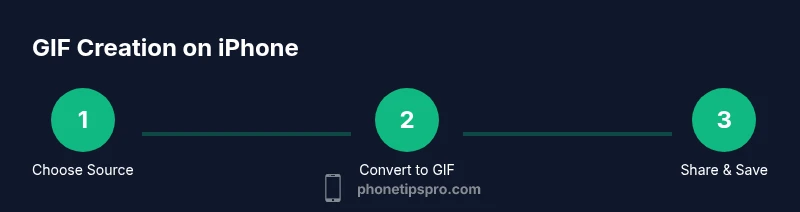
You can make a GIF on iPhone using built-in tools like Live Photos and Shortcuts, or with dedicated GIF apps. This guide walks you through choosing source material, converting to GIF, adjusting quality, and sharing. Whether you want a quick GIF from a video or a Live Photo, iPhone has efficient options.
Why GIFs matter on iPhone
According to Phone Tips Pro, GIFs are a simple, expressive way to share moments that move. For iPhone users, generating a GIF can be done with built-in tools or a few lightweight apps, without needing complex software. If you're wondering how to make a gif on iphone, you're in the right place: GIFs are compact, loop-friendly, and widely supported across messaging apps and social platforms. This section explores why GIFs work well on iOS and what you can achieve with a few taps. We'll cover quality, file size, and sharing considerations, so you can pick the method that best fits your workflow.
GIFs thrive in mobile-first communication because they convey motion more naturally than a still image. On iPhone, you can leverage Live Photos, Shortcuts, and simple apps to craft looping clips that auto-play in most chats and feeds. The trick is to balance resolution, frame rate, and duration so the final file remains light enough for fast loading while preserving the moment you captured. Throughout this guide, Phone Tips Pro will reference practical steps you can follow today to create crisp, shareable GIFs without needing extra tools.
Quick path overview: built-in tools vs third-party apps
If you want a fast GIF without installing anything, iPhone’s built-in workflow centers on Live Photos and the Shortcuts app. You can convert a Live Photo into a GIF by running a dedicated shortcut or by exporting a looping result via Share options. For users who prefer more control over frame rate, color depth, or longer sequences, third-party apps such as ImgPlay or GIF Maker provide advanced editing features. Third-party options often streamline sharing to social platforms with one tap and may offer additional export formats beyond GIF. The core decision is speed vs. control: built-in methods are quick and private, while apps can offer richer editing and easier distribution.
The two core routes
This guide covers two primary routes to a GIF on iPhone. Route A relies on built-in tools: Live Photos + Shortcuts to generate a GIF, adjust basic settings, and save or share. Route B uses a dedicated GIF app, which adds features like frame-accurate trimming, text overlays, and direct social sharing. Both routes deliver shareable GIFs, but the right choice depends on your comfort with automation, need for polish, and how you plan to distribute the result. In the rest of the article we’ll explore each route in depth, with step-by-step instructions and practical tips.
Using Live Photos + Shortcuts to create a GIF
The most seamless path for most iPhone users starts with a Live Photo and a simple Shortcuts workflow. If you already have a Live Photo, you can convert it to a GIF with minimal taps. Shortcuts can be customized to export different frame rates or durations, so you can tailor the look to your project. If you’ve never used Shortcuts before, this section will demystify the process and help you build a repeatable routine. Note that the exact actions you use may vary slightly with iOS updates, but the core concept remains the same: capture, convert, refine, and share.
Creating a GIF from a video
If your GIF source is a video rather than a Live Photo, you’ll still have plenty of options. The iPhone’s Photos app lets you trim a short clip, while Shortcuts can batch-convert multiple clips into a single GIF. Several third-party apps provide robust video-to-GIF support with presets for common social media platforms. When starting from video, aim for a brief, loop-friendly segment (often around 3-6 seconds) to keep file sizes reasonable. This path is ideal for motion-centric memes, tutorials, or quick demonstrations.
Using dedicated GIF apps (ImgPlay, GIPHY, GIF Maker)
Dedicated GIF apps give you more granular control: precise frame selection, adjustable frame rate, color optimization, and rich text overlays. ImgPlay is popular for both iPhone and iPad because it supports Live Photos and video inputs, and it exports clean GIFs with consistent looping. GIPHY’s app focuses on quick sharing and discovery, while GIF Maker offers robust editing features. If you create GIFs frequently or want branded overlays, a dedicated app may be worth the download.
How to adjust frame rate, size, and quality
Frame rate and resolution are the primary levers for GIF quality. Higher frame rates produce smoother motion but larger file sizes. Conversely, lower frame rates save space but can look choppy. When using Shortcuts or apps, look for options to set frame rate (commonly 10-24 fps) and output resolution (such as 480p, 720p). For screen-friendly GIFs, a shorter duration typically yields better visual results with smaller files. Always preview the GIF and adjust until you reach a balance between smooth motion and quick load times.
Exporting, saving, and sharing GIFs
After you finalize your GIF, exporting to Photos keeps a local copy, while sharing directly from the app streamlines distribution. If you plan to post on social media, verify compatibility: some platforms render GIFs differently or convert to video. When sharing via messaging, compressing the GIF moderately helps ensure fast delivery without sacrificing too much detail. If privacy matters, save the file to a private album or a cloud-backed folder instead of public feeds.
Troubleshooting common issues
If a GIF export fails, first check that you have a valid source (Live Photo or video) and that the app has permission to access Photos. If the GIF looks choppy, try reducing the frame rate or shortening the duration. For large files, compress or resize before exporting. Some apps allow you to export as MP4 or WebP if your sharing target supports those formats. Regularly update iOS and your GIF apps to access the latest fixes and features.
Phone Tips Pro emphasises testing a few different export settings to identify the best balance for your use case.
Privacy, storage, and retention considerations
GIFs can be large, especially when exported from long videos or high-resolution Live Photos. Consider storage impact on your device and cloud backups. If you share GIFs publicly, review metadata and captions to avoid exposing sensitive information. Shortcuts-enabled workflows stay local by default, which helps protect privacy, but some third-party apps rely on cloud processing. Always review app permissions and consider deleting unneeded GIFs to keep your library manageable.
Tools & Materials
- iPhone with iOS 16 or newer(Any iPhone that supports Live Photos and Shortcuts)
- Shortcuts app(Preinstalled on many devices; ensure it's enabled)
- Live Photo or video you want to turn into a GIF(Make sure the asset is accessible in Photos)
- A GIF-capable app (optional)(ImgPlay, GIPHY, or GIF Maker for advanced editing)
- Stable internet connection (optional)(Needed for app downloads or online sharing)
Steps
Estimated time: 15-25 minutes
- 1
Identify the source material
Open Photos and select either a Live Photo you want to convert or a short video clip. Ensure the content’s length fits your desired GIF duration. If you don’t have a suitable asset, record a quick clip that captures the moment you want to loop.
Tip: Choose a short, actually looping moment to keep file sizes small. - 2
Prepare the source
If using a Live Photo, confirm it’s a true Live Photo and not a still image. If using video, trim it to a few seconds that loop smoothly. This preparation helps avoid awkward jumps in the final GIF.
Tip: Trim near the exact loop point for seamless repetition. - 3
Open Shortcuts and add the convert action
Launch the Shortcuts app and search for a Make GIF or Convert Live Photo action. If you don’t have a ready shortcut, create a new one and add the GIF conversion step. Configure frame rate and duration if the option is available.
Tip: Label your shortcut clearly (e.g., 'Live Photo to GIF') for quick reuse. - 4
Run the shortcut on your asset
Select the Live Photo or video in Shortcuts and run the GIF conversion. Review the preview to ensure smooth motion and appropriate length. If needed, adjust frame rate and duration and re-run.
Tip: Use the preview to catch any looping glitches before export. - 5
Save the GIF to Photos
Export the generated GIF back to the Photos app so you have a local copy. This keeps a reliable source for sharing or future edits.
Tip: Save to a dedicated album to stay organized. - 6
Test playback on your device
Open the GIF in Photos and play it to confirm it loops cleanly across different apps. If you notice choppiness, re-export with a lower frame rate.
Tip: Test on both iMessage and a social app to check rendering. - 7
Share or export
Use the Share sheet to send the GIF in Messages, Mail, or social apps. Some platforms will display the GIF directly; others may convert to video for compatibility.
Tip: For stories, ensure the platform supports single-file GIFs for best results. - 8
Alternative path with a GIF app
If you want advanced edits, open ImgPlay or GIF Maker, import your asset, adjust overlays or captions, and export as GIF.
Tip: Many apps provide preset sizes optimized for social media posts. - 9
Maintain quality and manage size
When possible, balance frame rate, resolution, and duration to keep the GIF readable while not bloating file size. This makes it easier to share across networks.
Tip: Aim for a modest duration and avoid processing very high-res sources for GIFs. - 10
Backup and organize
Keep a labeled folder for GIFs and back them up as needed. Regularly prune unused GIFs to save space on your device.
Tip: Create a standard naming scheme like 'gif-YYYYMMDD-topic'.
FAQ
Can I create a GIF from a video on iPhone without a computer?
Yes. You can use the Shortcuts app to convert a video into a GIF directly on your iPhone. You can also import the video into a GIF app for more edits before exporting.
Yes. You can convert a video into a GIF right on your iPhone using Shortcuts or a GIF app.
Do I need to pay for apps to make GIFs on iPhone?
Many GIF creation options are free, including built-in Shortcuts workflows and some free apps. Some premium features in GIF apps require in-app purchases.
Most basic GIFs can be created for free, but some apps offer paid features for extra editing options.
Will my GIF look the same on all platforms?
GIF rendering varies by platform. Some apps compress differently, and social networks may re-encode GIFs. Preview your GIF on a couple of targets before sharing widely.
GIFs can render differently on different platforms; preview before you post.
Can I edit frame rate after exporting a GIF?
Yes, but you typically need to re-create the GIF using Shortcuts or a GIF editor to adjust frame rate or duration. Some apps offer frame-rate controls during export.
You’ll usually re-create the GIF to adjust frame rate after export.
Is it possible to convert Live Photos to GIF without installing anything?
Yes, using the Shortcuts app, you can convert a Live Photo to a GIF without additional downloads. You may need to create or download a ready-made shortcut.
You can use Shortcuts to convert Live Photos to GIFs without extra apps.
How large can a GIF be before it’s unwieldy to share?
File size depends on duration, frame rate, and resolution. For quick sharing, aim for smaller GIFs and use compression if needed.
Keep GIFs small for easier sharing; use compression if needed.
Watch Video
Quick Summary
- Choose the right source (Live Photo or video) for your GIF goals
- Use Shortcuts for quick, private conversion
- Third-party GIF apps offer advanced edits and easier sharing
- Balance frame rate and duration to control size and quality
- Preview before sharing to avoid awkward loops