Do Samsung and iPhone Use the Same Charger? Practical Guide
Explore whether Samsung and iPhone devices share chargers, focusing on connectors, fast-charging standards, safety, and real-world use. Learn how to pick a single USB-C PD charger for mixed-device setups and what to consider when legacy Lightning cables remain in your ecosystem.


In short, many modern Samsung and iPhone models can share a charger, especially when both use USB-C and a USB-C PD charger. The key is ensuring the charger supports USB Power Delivery (PD) and, for the fastest gains, PPS compatibility. If your iPhone is still using Lightning, you’ll need an appropriate cable or adapter. In practice, a single USB-C PD charger is often sufficient for a mixed-device setup.
Why this question matters
In exploring do samsung and iphone use the same charger, the practical concern isn’t just about a physical plug. It’s about compatibility, charging speed, safety, and convenience for households that own both brands. The universal connector trend—most modern Samsung devices and iPhones released since around 2020-2024—has moved toward USB-C. This shift opens up the possibility of sharing a single charger across devices, reducing clutter and e-waste. According to Phone Tips Pro, the most important factor for cross-brand charging is not the brand, but the supported charging standards and the quality of the cable. A single USB-C PD charger paired with certified cables can cover many common scenarios for do samsung and iphone use the same charger, but there are caveats for legacy hardware and PPS-enabled fast charging.
Physical connectors and what they mean for compatibility
The two most relevant physical connectors in today’s landscape are USB-C and Lightning. USB-C is now the common denominator for many devices, including most recent Samsung phones and the latest iPhones. Lightning remains in older iPhone models or specific accessories. The important takeaway is that if you want true cross-brand compatibility, you should standardize on USB-C and high-quality USB-C cables. The transition away from Lightning reduces the number of separate chargers, but it also means you need to ensure your cables and adapters are certified (e.g., USB-IF or Apple MFi for Lightning). When do samsung and iphone use the same charger, that common ground is USB-C in the majority of current ecosystems.
Understanding charging standards: PD, PPS, and what matters here
USB Power Delivery (PD) is the backbone for fast charging across many brands. PPS (programmable power supply) is an enhancement used by some devices to optimize charging efficiency and heat. iPhones that use USB-C with PD can negotiate higher voltages safely with compatible chargers, while Samsung devices similarly negotiate PD with PPS-capable adapters for faster charging. If you want a single charger for both, prioritize a USB-C PD charger that also supports PPS, and pair it with properly certified USB-C to USB-C cables for Samsung devices and USB-C to Lightning or USB-C cables for iPhone, depending on your model. This is where the real cross-brand compatibility lives: the charger and cable must speak the same language as the device, not just the same plug.
Real-world expectations: everyday charging with mixed devices
In daily use, a shared charger often means slower peak charging if you don’t have PPS-enabled hardware on the charger or if devices negotiate at conservative power levels. If you own newer iPhones (with USB-C) and recent Samsung flagships, you can expect robust performance from a modern USB-C PD charger. However, for the fastest possible charges, you want PPS-capable hardware and cables that support higher wattage, with the caveat that actual charging speed depends on device battery health, temperature, and background activity. In practice, you’ll likely notice similar speeds when charging two devices in sequence, rather than simultaneously, on a mid- to high-end USB-C PD charger.
Safety and cable quality: avoid safety hazards and degraded performance
Cable quality matters as much as the charger. Cheap or non-certified USB-C cables can overheat or fail to negotiate proper PD settings, leading to slower charging or safety risks. Always use certified cables and chargers from reputable brands. If you’re using adapters to connect iPhone Lightning cables to USB-C chargers, ensure the adapter is Apple-certified to minimize compatibility issues. Phone Tips Pro emphasizes buying a charger with multiple protections (overcurrent, overvoltage, and short-circuit protection) and ensuring the cable meets USB-C standard requirements. Safe charging is a cornerstone of any mixed-brand setup.
How to pick a charger for a mixed-device household
When choosing a charger for a household with both Samsung and iPhone devices, prioritize USB-C PD with PPS support as the baseline. Look for a charger with at least two USB-C ports so you can charge both devices at once when needed. Use cables that match each device’s connector needs: USB-C to USB-C for Samsung devices and USB-C to USB-C or USB-C to Lightning for iPhone, depending on the model. Avoid single-port, underpowered options that bottleneck performance. Consider chargers with foldable plugs or compact form factors for travel, and verify that the charger supports safe charging features and has solid thermal management to handle prolonged use.
Car and travel charging: staying compatible on the road
On the road, USB-C PD chargers in cars and portable banks are common. For Samsung and iPhone users, a single robust USB-C PD car charger can handle regular daily charging, provided you use appropriate cables. If you’re a frequent traveler, investing in a single high-quality USB-C PD charger and a small selection of cables reduces the need to carry multiple bricks. In vehicles, charge rates may vary due to the car’s electrical system and the device’s negotiations, but the PD protocol remains the driving factor behind efficient charging in transit.
Common myths: separate chargers are always better for each brand
A frequent misconception is that you must own brand-specific chargers for each device. In reality, with USB-C and PD PPS, one charger can serve both Samsung and iPhone devices effectively. The caveat is that a Lightning-based iPhone still requires an appropriate Lightning cable or adapter when using non-Lightning ports. The key is ensuring proper cables and a PD-capable wall charger. Brand-agnostic charging strategies reduce clutter and support eco-friendly choices, as long as safety standards are met.
Practical tips for 2026 users: optimizing a mixed-device setup
- Favor USB-C PD chargers with PPS for best cross-brand performance.
- Use certified cables; avoid third-party cables without safety certifications.
- If you still rely on Lightning, keep a compact Lightning-to-USB-C adapter handy for emergencies.
- Check device temperatures during charging; excessive heat reduces efficiency and battery longevity.
- Inspect cable connectors regularly for wear and tear, and replace damaged cables promptly to maintain safe charging.
What the future holds: trends in universal charging
The industry trend is toward broader USB-C adoption as a universal connector, driven by regulatory and environmental considerations. As more devices from Apple and Samsung align with USB-C PD, the practical reality is that most households can rely on a single charger for daily charging needs. This convergence reduces accessory duplication and simplifies travel setup, while still requiring attention to PPS support and cable quality for optimal performance.
Comparison
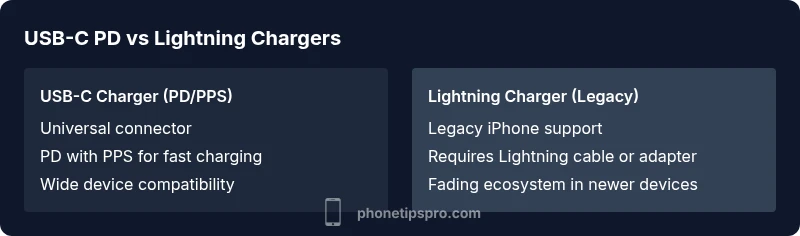
| Feature | USB-C Charger (PD/PPS) | Lightning Charger (Legacy) |
|---|---|---|
| Connector Type | USB-C | Lightning |
| Fast-Charging Standards | USB Power Delivery (PD) with PPS support | Apple Fast Charging via PD in Lightning era |
| Cross-Platform Compatibility | Works with most devices when using USB-C cables | Primarily for iPhone; Samsung requires adapters or USB-C cables |
| Cable/Accessory Availability | Widely available USB-C cables and PD chargers | Lightning cables are less common in newer ecosystems |
| Future-Proofing | Strong ecosystem support across brands | Lightning is declining in new devices |
Positives
- One charger for multiple devices
- Supports modern USB-C devices and PD standards
- Better future-proofing with USB-C ecosystem
- Widely available chargers and cables
Weaknesses
- Legacy Lightning devices may require adapters or special cables
- Not all PD chargers support PPS; fast charging may vary
- Some setups require extra cables/adapters for full compatibility
- Quality cables matter for safety and performance
USB-C chargers offer the best overall compatibility for mixed-device households
For households with both Samsung and iPhone devices, a USB-C PD charger is the most versatile option. Ensure PPS support and use certified cables to maximize charging performance and safety across brands.
FAQ
Do all iPhones now use USB-C?
Most recent iPhones use USB-C, but legacy models may still rely on Lightning. Check your specific model to determine the appropriate cable. If your iPhone supports USB-C, you can charge it with USB-C PD chargers.
Yes, most new iPhones use USB-C, so a USB-C charger and cable will work. If you have an older iPhone with Lightning, you’ll need an adapter or a Lightning cable.
Can I charge a Samsung phone with an iPhone charger?
Yes, if you have a USB-C PD charger and a USB-C cable. The key is compatibility of the connector and PD negotiation, not the brand. A USB-C charger with proper cables will usually charge Samsung devices.
Yes, using a USB-C PD charger with the right cable will typically charge Samsung phones.
Will using a non-PD charger affect charging speed?
Non-PD chargers can still charge devices, but you may miss fast-charging benefits. For the fastest charging, use a PD charger with PPS support and a cable that matches the device.
A non-PD charger may charge slowly; PD chargers give faster, negotiated speeds.
Do I need separate cables for iPhone and Samsung?
Not necessarily. USB-C cables can work for Samsung and iPhone if the iPhone uses USB-C. If you still have Lightning, you’ll need a Lightning cable or adapter. Certified cables ensure safe and reliable charging.
If your iPhone uses USB-C, one USB-C cable can cover both brands; Lightning requires its own cable.
Is it safe to charge both devices at once on a single charger?
It’s generally safe if you use a charger with multiple ports and adequate total power. Monitor device temperatures and avoid cheap, underpowered adapters to maintain safety and battery health.
Yes, use a capable multi-port USB-C PD charger and watch temperatures.
Quick Summary
- Choose USB-C PD chargers for cross-brand use
- Prioritize PPS support for faster charging on compatible devices
- Always use certified cables to ensure safety and performance
- Lightning remains for legacy iPhone models; adapters are needed for cross-brand use
- Expect USB-C to become the universal standard across most brands