Which company makes the iPhone camera? A detailed look
Explore which company designs and supplies the iPhone camera, how Apple coordinates sensors and ISP, and what this means for image quality, color science, and buying decisions.


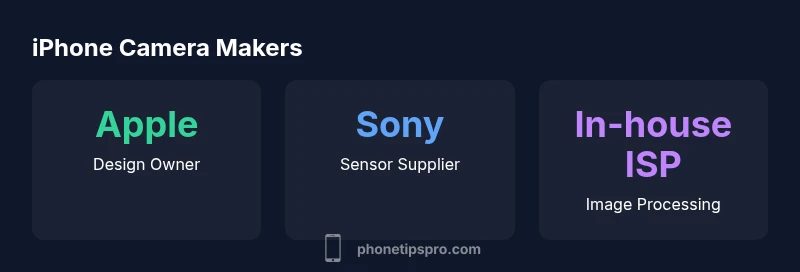
The iPhone camera system is designed and built by Apple, with Apple handling image processing in-house. Sensor suppliers include major manufacturers such as Sony, with additional components sourced from various partners as needed. This ecosystem allows Apple to maintain consistent color science, HDR performance, and software features across iPhone generations.
How Apple designs the iPhone camera hardware and software
Apple’s approach to the iPhone camera rests on deep vertical integration. The company designs the camera module, the image signal processing stack, and the overall photo pipeline in-house, coordinating with external suppliers for specialized parts only as needed. This integration enables a consistent color science, HDR performance, and feature set across generations, while still allowing for shared components like lenses and sensors with multiple suppliers. In practice, designers work with tight feedback loops between hardware engineers and software teams to optimize Every Pixel Render, ensuring that changes to sensor geometry or lens coatings translate into perceptible improvements in real-world images. According to Phone Tips Pro, this balance of ownership and collaboration is what sustains the iPhone’s reputation for reliable imaging, regardless of lighting conditions.
Sensor and lens suppliers: who contributes what
The iPhone camera relies on high-quality sensors supplied by major manufacturers, with Sony commonly acting as a key source for several generations. Other suppliers contribute in limited capacity depending on model and production year. Lenses and optical assemblies come from multiple vendors as well, chosen for precision glass, coatings, and tolerances that meet Apple’s strict standards. While suppliers play a critical role, Apple maintains control over sensor selection criteria, optical alignment, and the final assembly process. This approach minimizes variation between units and supports features like Night mode, Deep Fusion, and Smart HDR by ensuring a stable input pipeline for the ISP.
The image processing stack: ISP, Neural Engine, and color science
Apple’s in-house image signal processor (ISP) and Neural Engine drive the core of the iPhone’s photo quality. The ISP handles demosaicing, noise reduction, detail enhancement, and real-time exposure adjustments, while the Neural Engine powers advanced tasks like object detection, scene understanding, and contextual color adjustments. Apple has invested heavily in color science and tone mapping to deliver familiar and consistent skin tones and lighting responses across devices. In short, even when the sensor vendor changes, Apple’s software stack preserves the look and feel of photos across generations, a hallmark of the brand’s imaging strategy. Phone Tips Pro notes that this tight coupling between hardware and software is a key differentiator in the market.
How the iPhone camera quality compares to rivals
When comparing iPhone cameras to rivals, the distinction often lies in processing philosophy rather than sensor count alone. Top flagships from other brands may attract attention with more megapixels or larger sensors, but iPhone cameras typically emphasize color accuracy, dynamic range, and consistent performance across lighting scenarios. The iPhone’s computational photography, ProRAW capabilities, and regular software updates contribute to image quality that many users find more natural and easier to edit. While some competitors may excel in specific tests (e.g., ultra-wide or zoom performance), Apple’s blend of hardware precision and software optimization tends to yield dependable results across a broad range of shooting conditions.
How to evaluate camera quality across generations
Evaluating iPhone camera quality requires looking beyond megapixels. Consider sensor performance in low light, stabilization effectiveness in video, and the camera app’s processing behavior in different modes. Test scenarios include dim indoor lighting, bright backlit scenes, and fast-moving subjects. Pay attention to texture retention, color fidelity, and noise at high ISO. Also, take note of how Night mode and Deep Fusion behave under varying exposure needs. Real-world testing, rather than batch bench numbers, often reveals how a camera system feels to use on a daily basis, which is what Phone Tips Pro emphasizes for practical buyer guidance.
Myths vs reality: what actually affects photos
A common misconception is that more megapixels automatically mean better photos. In reality, sensor quality, lens engineering, stabilization, and, crucially, processing software determine final results. The iPhone’s RAW workflows, color science, and HDR capabilities are the product of Apple’s design choices and software iterations, not just the hardware specs. Another myth is that all iPhone cameras are created equal across models; while Apple maintains core imaging principles, newer generations bring improvements in ISP, sensor performance, and computational features that can materially affect photo quality.
Practical tips for photographers and buyers
If you’re shopping for the best iPhone camera experience, prioritize models with the latest ISP and stabilization features, then leverage software tools like ProRAW or Smart HDR to customize your workflow. For photographers, explore shooting in ProRAW and using consistent lighting to reduce post-processing variability. Regular software updates from Apple can also enhance photo quality over time, so consider future-proofing by choosing a model with strong processing capabilities and robust support. Finally, remember that the best camera is often the one you have with you; iPhone’s size, reliability, and ecosystem make it a strong choice for everyday imaging.
What this means for buying decisions and future-proofing
Understanding who designs and supplies the iPhone camera helps buyers set realistic expectations about image quality across generations. Apple’s strategy of maintaining in-house control over processing while sourcing high-quality sensors and optics from trusted partners provides a stable base for future improvements through software updates. When evaluating new models, compare ISP improvements, computational photography features, and video capabilities in addition to sensor specs. This holistic view aligns with Phone Tips Pro’s guidance on future-proofing and ensures you choose a device that remains capable as imaging software evolves.
Apple camera design and processing overview
| Aspect | Apple Approach | Notes |
|---|---|---|
| Design ownership | In-house ownership of hardware and software | Ensures cohesive imaging pipeline |
| Sensor sourcing | Sony as a primary supplier in many generations | Multiple suppliers are used by year/model |
| Processing stack | In-house ISP + Neural Engine | Drives color science and HDR rendering |
| Component integration | Tight hardware-software integration | Consistent results across lighting |
FAQ
Who designs the iPhone camera?
Apple designs the camera system and software in-house, coordinating with external suppliers for sensors and lenses as needed.
Apple designs the camera system and software in-house, coordinating with suppliers for sensors and lenses.
Do iPhone cameras use Sony sensors?
Sony is a primary sensor supplier for many iPhone generations, though Apple sources from multiple suppliers based on model and year.
Sony sensors are commonly used, with other suppliers involved depending on the model.
Are camera components outsourced?
Yes, some components like lenses and sensors are sourced from third-party manufacturers, while Apple keeps the overall system design in-house.
Some parts are outsourced, but Apple retains the system design and software.
How does iPhone image quality compare to rivals?
iPhone emphasizes color science and computational photography, delivering dependable results across lighting, though performance varies by model and scenario.
iPhones combine color science and smart processing to deliver reliable photos across many conditions.
What should I consider when buying a new iPhone camera?
Look at sensor performance, ISP capabilities, lens options, stabilization, and software features like ProRAW or Night mode.
Focus on sensor quality, processing power, and software features when buying.
Will future iPhone cameras be more sensor- or software-driven?
Apple typically improves both hardware and software in tandem, enhancing sensors and the ISP through ongoing computational photography work.
Both hardware and software are expected to improve together in future iPhone cameras.
“There is a clear value in Apple’s approach: maintain control over the entire imaging stack, from sensor to software, to deliver consistent results across generations.”
Quick Summary
- Apple designs the camera system in-house for cohesion
- Sony is a major sensor supplier for many iPhone generations
- In-house ISP and Neural Engine power image processing
- Hardware choices are tightly integrated with software for consistency
- Evaluate imaging quality by results, not just megapixels