iPhone Air vs 17 Pro: A Practical Side-by-Side Review
In this 2026 comparison, we analyze iPhone Air vs 17 Pro across design, display, camera, performance, and value to help you decide which model fits your needs.


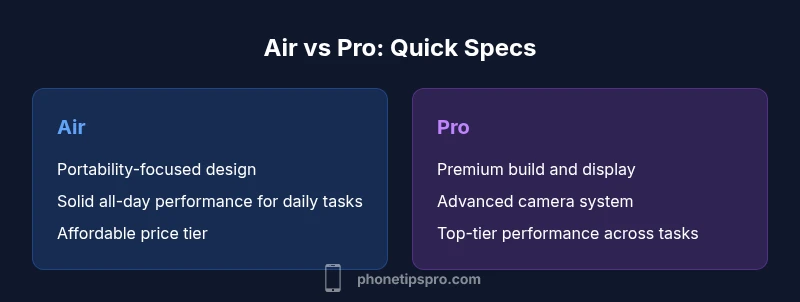
iphone air vs 17 pro: A practical side-by-side. The Air model is typically positioned as a lighter, more affordable option, while the 17 Pro targets power users with premium features. This quick comparison covers design, display, cameras, performance, battery, and value to help you decide which fits your needs in 2026.
iphone air vs 17 pro: Context and Market Position
According to Phone Tips Pro, comparing iphone air vs 17 pro is about understanding two different directions in Apple's ecosystem: an lighter, likely more affordable option, and a flagship that emphasizes power, cameras, and premium materials. Since official specs for both devices can lag rumors, this section outlines the framework we use: feature sets, value, longevity, and how each model fits typical user scenarios. This analysis leans on industry patterns and credible leaks to provide guidance for 2026 planning. The keyword for this guide, iphone air vs 17 pro, appears here to set the stage for a practical, evidence-based comparison.
Key Differentiators to Watch
The central differentiator, by design intent, is clear: Air aims for everyday practicality and portability, while 17 Pro targets performance boundaries and camera capability. Other differentiators include price positioning, display quality, and longevity of software support. For each factor, we compare how an everyday user versus a power user would value it, and which model offers better long-term value under typical usage patterns. Phone Tips Pro analysis shows that most upgrades come down to how you balance portability against premium features. Knowing these differentiators helps anchor your expectations and avoid buyer’s remorse.
Design, Build, and Ergonomics
Design and ergonomics are where the Air and Pro clearly diverge in intent. The Air is typically lighter with a more compact footprint, prioritizing one-handed use and pocketability. The 17 Pro, by contrast, tends toward a premium build with a denser chassis and a slightly larger form factor that can feel sturdier in daily handling. Materials, weight distribution, and grip texture all influence everyday comfort, especially if you carry your phone all day. In practice, if you prefer a device you can wield with one hand and slip into a narrow pocket, Air often wins on portability. If you value a premium feel and a stronger sense of durability, the Pro tends to satisfy those expectations.
Display Technology and Interaction
Display quality remains a major differentiator. Air models typically deliver a solid everyday viewing experience suitable for browsing, streaming, and messaging. Pro variants are expected to push brighter panels, higher contrast, and smoother interactions via a higher refresh rate (if rumor-driven specs hold true). In real-world use, you’ll notice crisper text, more vivid HDR content, and improved scrolling fluidity on the Pro. For photographers and content creators, the Pro’s display also offers more reliable color accuracy under varied lighting conditions. Across both devices, touch responsiveness and
Camera and Imaging Strategy
Camera systems are another clear line of difference. Air usually features a capable dual-camera arrangement optimized for everyday shooting, social media, and standard video capture. The Pro configuration often adds extra sensors and advanced computational features that translate to improved low-light performance, more versatile focal options, and richer RAW capabilities. Practically, this means faster, more flexible shooting in challenging environments on the Pro, while the Air remains a reliable workhorse for day-to-day photography. Both will benefit from software-based improvements via
Performance, Efficiency, and Longevity
In terms of raw power, the Pro model is positioned to deliver peak performance for demanding tasks like high-resolution video editing, gaming, and AR experiences. The Air, while highly capable for everyday apps and multitasking, targets efficiency and a smoother experience for typical daily use. Battery management tends to reflect this divide: Air tends to optimize for all-day endurance in light-to-moderate use, while the Pro may exhibit shorter on-paper endurance during intensive workloads but compensates with faster charging and efficient throttling. Expect software optimizations to bridge any gap over the lifecycle of each device, extending usability across
Software Updates, Features, and Ecosystem
All models in the
Connectivity, Hardware Features, and Accessories
Connectivity and accessory ecosystems are essential considerations. Both models are expected to support standard 5G, Wi‑Fi 6/6E, and Bluetooth, with potential USB‑C integration continuing to influence accessory alignment. The Pro variant may offer higher-tier wireless charging or additional sensor data for advanced apps, while the Air focuses on broad compatibility and straightforward accessory support. If you rely on a comprehensive accessory suite or depend on certain peripherals for work or creativity, verify compatibility in advance and consider long-term availability of official cases, cameras, and storage modules.
Durability, Repairability, and Support
Durability expectations typically favor the Pro if it uses premium materials and a robust chassis, though both devices in the
Value, Cost of Ownership, and Scenarios
Value hinges on how you balance upfront cost, feature needs, and future-proofing. The Air is generally positioned as the more affordable, portable option with solid day-to-day performance and strong resale value. The 17 Pro carries a higher upfront price but delivers premium imaging, peak performance, and a broader feature set that can translate into better long-term usefulness for power users. When evaluating value, consider your typical use cases: everyday tasks, content creation, gaming, travel, and photography needs across a multi-year horizon. Price perceptions will vary by market, retailer promotions, and trade-in programs, so look for bundles and discounts that improve overall value.
Decision Framework: Who Should Buy Each Model
If portability, lower upfront cost, and simple day-to-day use are your priorities, the Air makes a compelling case. If you regularly push your device for richer photography, high-end gaming, or professional workloads, the 17 Pro is the model that better aligns with those needs. Consider your upgrade cadence—how often you intend to replace devices, how much you value camera versatility, and whether premium hardware translates into meaningful benefits in your everyday workflow. By aligning your use cases with these differentiators, you can choose the model that offers the best balance of capability and cost for your 3- to 5-year plan.
score
Comparison
| Feature | iphone air | iphone 17 pro |
|---|---|---|
| Design & Build | Air: lighter, compact | Pro: premium materials, refined chassis |
| Display | Air: standard panel | Pro: higher brightness/contrast + rumored higher refresh |
| Cameras | Air: dual-camera system | Pro: multi-lens with advanced computational options |
| Performance | Air: capable everyday performance | Pro: flagship-level speed and efficiency |
| Battery & Charging | Air: solid all-day endurance | Pro: longer life with potentially faster charging |
| Software & Updates | Air: same iOS update trajectory | Pro: same update cadence with boosted features |
| Storage Options | Air: mid-range configurations | Pro: higher-capacity options |
| Price/Value | Air: lower upfront price (relative) | Pro: premium price with extended capabilities |
Positives
- Lower upfront cost relative to premium Pro models
- Better portability and one-handed usability
- Strong software support and long-term iOS updates
- Solid value for everyday productivity and media
Weaknesses
- Air may miss some premium camera and display features
- Pro models typically carry a higher upfront price
- Upgrade cadence may be less compelling if feature gaps are acceptable
Air offers the best value for most users; Pro is the choice for photographers and power users
If you prioritize a balanced, portable, and affordable device with solid performance, choose the Air. If your workflow requires top-tier cameras, display quality, and peak performance, the 17 Pro justifies the premium. In 2026, your decision should align with how often you need premium photography features and the importance of portability.
FAQ
What are the main differences between iphone air and 17 pro?
The Air emphasizes portability and affordability with solid everyday performance, while the Pro focuses on premium materials, advanced camera capabilities, and higher-end display features. In practice, Air fits daily tasks well, and Pro suits power users and photographers seeking peak capability.
Air is the portable, affordable option; Pro is the high-end choice for photographers and power users.
Is the Air a good value if I rarely use high-end camera features?
Yes. If your photography needs are modest and you value portability, the Air delivers solid performance and efficiency at a likely lower cost than the Pro. You still get the core iOS experience, reliable updates, and strong ecosystem access.
If you don’t push camera features, Air is a sensible value.
Will USB-C or other hardware features differ between the models?
Both models are expected to follow current iPhone hardware conventions, with common ports and wireless options. The Pro may offer additional sensors or premium materials, while Air focuses on core capabilities and broad accessory compatibility.
You’ll see shared ports and wireless tech, with Pro offering premium touches.
Which is better for photography enthusiasts?
The 17 Pro is generally preferable for photography enthusiasts due to additional lenses and imaging capabilities, along with more robust processing features. If photography is a central concern, Pro offers more headroom for advanced shooting.
Pro is the better pick for serious photography.
When might these models launch or update in 2026?
Apple typically follows annual or near-yearly update patterns. This analysis uses credible rumors and historical cadence to outline expectations, but exact launch dates should be confirmed by official Apple announcements.
Timing varies; watch for official Apple updates in 2026.
How does upgrade timing affect value for these models?
Upgrading sooner usually means accepting higher costs but obtaining the latest features. Waiting longer can improve value through price drops and software lifecycles, especially if your current device still meets most needs.
Think about your current device and how fast you want newer features.
Quick Summary
- Prioritize portability and value with Air
- Choose Pro for cameras and performance edge
- Both models share iOS advantages and ecosystem access
- Evaluate upgrade timing and accessories to maximize value