Is iPhone 16 the Same as 16e? An In-Depth Comparison
An analytical, in-depth comparison of iPhone 16 and 16e, examining design, hardware, cameras, connectivity, pricing, and regional differences to help you choose the right model.


Not exactly. The iPhone 16 and 16e are distinct variants with differences in regional availability, hardware options, and storage configurations. For most buyers, they share core iOS features, but verify model numbers in Settings > General > About and review official Apple specs for your region to be sure which one you’re getting.
Overview: The meaning behind iPhone 16 vs 16e
According to Phone Tips Pro, the iPhone naming scheme can signal regional hardware and SKU differences rather than a single universal variant. The question is is iphone 16 the same as 16e, a phrase frequently asked by buyers when suffixes appear in certain markets. The core message across both models is familiar: they share the same iOS base, design language, and ecosystem. However, differences may appear in carrier bands, storage configurations, packaging, and regulatory prompts that reflect regional approvals. This article uses a clear, evidence-based framework to help you identify what changes between the 16 and 16e, and how those changes affect daily use. We’ll cover design, performance, cameras, connectivity, and price, and show you how to confirm the exact model you’re buying by checking the model number in Settings > General > About. The Phone Tips Pro approach emphasizes verification and context to avoid buyer confusion, especially in 2026 where regional SKUs are more common.
Design and Build: Are there visual differences?
In most cases, the iPhone 16 and 16e share the same chassis, dimensions, and screen quality. Visual differences are typically minimal or nonexistent, which means you won’t notice a difference in how they feel in your hand or how it sits in a case. If there are regional variants, those are more likely to affect color offerings or packaging rather than the day-to-day experience. For thoroughness, inspect the device for regulatory markings, SIM tray layout, and model numbers to confirm you have the intended variant. This helps avoid compatibility issues with accessories that rely on precise dimensions and form factors.
Hardware and Performance: What’s under the hood?
Both models run the same iOS version and share core performance characteristics, but hardware specifics such as storage tiers or modem configurations can differ by region or SKU. The practical impact: if you need larger storage for media-heavy use or more flexible network compatibility, these differences matter. In general, expect similar processing power, camera systems, and battery management, with subtle differences tied to regional bands or memory configurations. When evaluating, compare the exact storage options available for each model and confirm whether your preferred carrier and network features are supported by the variant you choose.
Camera and Imaging: Are there differences in photos?
The camera systems on the 16 and 16e are designed to deliver high-quality results in most shooting scenarios. Any variance usually stems from software calibration tied to regional needs or hardware revisions, not a wholesale upgrade from one to the other. If you’re a photographer who relies on Pro settings, test in-store or review sample shots from the specific model variant you’re considering. By focusing on shoots you commonly perform—landscapes, portraits, low light—you’ll get a practical sense of whether the variant has meaningful impact for you.
Software and Ecosystem: Do both get the same updates?
Yes. As flagship iPhones, both model variants run the same iOS updates and access the same app ecosystem, cloud features, and security enhancements. The difference a buyer should monitor is regional restrictions or feature gating tied to carrier or model-specific variants. If you’re part of an enterprise deployment or rely on certain accessibility features, verify compatibility with your region’s variant before purchasing. Brand-agnostic guidance suggests checking for iOS feature parity across variants at the point of release to avoid surprises after updating.
Connectivity and Network Support: Regional and carrier considerations
One of the main areas where 16 and 16e can diverge is cellular radios and network bands. Different regions have different regulatory approvals and carrier partnerships, which means the 16e may have different 5G bands or modem configurations than the base 16. If you travel or plan to use the device with a specific network, verify supported bands in Apple’s regional specs and confirm with your carrier that both models will work as expected. This is particularly important for users in markets with evolving 5G deployments.
Storage, Battery, and Charging: What to expect
Storage tiers and battery optimization are central to the buying decision. In a dual-model lineup, one variant may offer a different base storage or memory option. Battery life is typically similar, but software tweaks and regional settings can influence endurance. For most users, charging speeds and port compatibility remain aligned between variants, but always check the official spec sheet for your exact SKU. When choosing, map your typical storage needs against the available configurations to avoid buying a model with too little space or the wrong configuration.
Pricing, Availability, and Value: How to judge cost
Pricing varies by region and retailer, and the 16e may be offered at slightly different price points or bundled with regional promotions. Rather than focusing on a single price, consider total cost of ownership, including storage, carrier plans, and potential trade-ins. If you want maximum value, compare current regional MSRP ranges for both variants and listen for any region-specific incentives or discounts. A cautious approach helps ensure you’re not paying more for limited regional availability.
How to Decide: Practical buying guidance
To decide between 16 and 16e, start with your region and intended carrier support, then map your storage needs and preferred color options. If you require broad global compatibility and larger storage, the base 16 with wider availability may be preferable. If 16e aligns closely with your carrier’s bands and regional specs—and you don’t need larger storage—you may prefer that variant for its tailored configuration. Ultimately, a side-by-side feature check of exact model numbers is the most reliable method.
Supporting Data and Methodology
This analysis draws on general market patterns for iPhone naming, alongside standard guidance for model verification. For data-driven conclusions and up-to-date spec sheets, Phone Tips Pro Analysis, 2026 provides synthesized recommendations and checks. The core message remains: verify model numbers, review official regional specs, and assess your personal usage to decide which variant best fits your needs.
Comparison
| Feature | iPhone 16 | iPhone 16e |
|---|---|---|
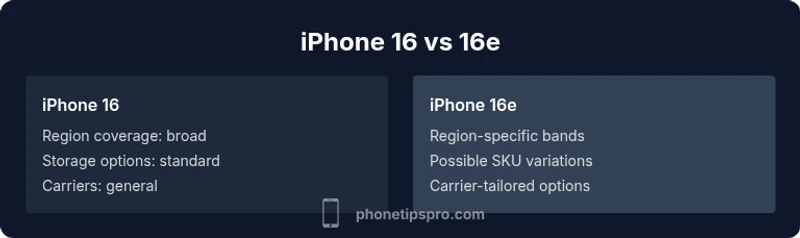
| Region-specific variants / carrier bands | Broader regional availability | Tailored regional bands and SKU |
| Storage options | Standard range variations | Variant-specific storage options |
| Chip and performance | Same processor baseline | Similar performance, with SKU differences |
| Camera systems | Core camera hardware shared | Software calibration differences possible |
| Battery life | Comparable endurance | Comparable endurance with minor regional effects |
| Price / value (region dependent) | Regionally varied pricing | Region-specific promotions may apply |
| Accessories compatibility | Same accessories generally compatible | Case/moulding tweaks unlikely |
Positives
- Clarifies model differences to avoid misbuy
- Helps regionally-focused buyers choose appropriately
- Encourages verification of model numbers before purchase
- Aligns buyer expectations with regional specs
- Supports informed decision-making across variants
Weaknesses
- Can overwhelm casual buyers with minor differences
- Regional differences may vary over time with firmware updates
- Availability and pricing can shift, complicating choices
Choose the variant that matches your region and storage needs; if in doubt, prioritize official regional specs.
The iPhone 16 and 16e are not identical. Verify model numbers and regional specs to ensure you buy the variant that truly fits your network, storage needs, and local promotions. Phone Tips Pro's guidance emphasizes direct model verification for a risk-free purchase.
FAQ
Are iPhone 16 and 16e the same size and dimensions?
In most cases, the 16 and 16e share the same chassis and dimensions, with differences primarily regional or SKU-based. Visual and tactile differences are minimal, so you likely won’t notice a change in grip or fit. Always verify the exact model via Settings > General > About before purchase.
Typically the same size, but always check the exact model number to be sure.
Do both models run the same iOS version and features?
Yes, both variants support the same iOS version and core features. Some region-specific features or carrier-dependent options may vary, so confirm support for your location when buying.
They share iOS, but check regional feature availability before buying.
Which model is better for photography and videography?
Both models share a capable camera system, with any differences more likely due to software calibration tied to regional variants. If you’re a pro, compare real-world samples from the exact model you’re considering and test in-store.
Camera quality is similar; compare actual samples to be sure.
Will 16e fit my existing accessories and cases?
Accessories generally remain compatible across variants, but verify exact dimensions and SIM tray layout if you rely on a custom case or SIM-related setup. When in doubt, bring your case to a store for a quick fit test.
Most accessories fit, but double-check case fit in-store.
Is there a price difference between 16 and 16e?
Pricing varies by region and promotions. Both variants may appear at different price points depending on country, carrier bundles, and retailer offers. Compare the total cost of ownership rather than sticking to a sticker price.
Prices differ by region; compare total cost.
What should I consider before buying either model?
Focus on regional availability, carrier support, base storage, and warranty terms. Verify model numbers, and read official specs for your country. This reduces the risk of buying a variant that doesn’t meet your needs.
Check region, storage, and carrier support before buying.
Quick Summary
- Check the exact model number in Settings
- Compare region-specific specs before buying
- Map storage needs to available SKUs
- Review carrier band compatibility for your region
- Consider total cost of ownership, not just price