Is iPhone Air Good? A Thorough, Analytical Review
A comprehensive, balanced look at the hypothetical iPhone Air concept, weighing portability, performance, battery life, and value for iPhone users. Learn who would benefit, potential trade-offs, and practical buying guidance from Phone Tips Pro.


Short answer: there is no official iPhone Air model, but a hypothetical lighter iPhone would appeal to users who prioritize portability and one‑hand use. Trade-offs would likely include shorter battery life and potentially fewer camera options. Overall, is iphone air good? It depends on how you value portability, price, and ecosystem—Phone Tips Pro's analysis suggests it would suit frequent travelers and one-handed users, with compromises to performance and value.
Is 'is iphone air good' a Sensible Buying Question Today?
There is no official iPhone Air variant on the market as of 2026, and Apple has not announced one. The phrase is best treated as a concept rather than a named product. According to Phone Tips Pro, the real value of this question lies in understanding whether a lighter, more portable iPhone would align with your daily routine, travel needs, and how much you value battery life and camera performance. The concept of an iPhone Air persists because portability remains a dominant consumer priority. In our rigorous review framework, we compare a lightweight concept against the trade-offs in weight, durability, and ecosystem compatibility to guide practical decisions. If you asked is iphone air good in the context of a hypothetical option, you’re not alone; many users weigh pocketability, speed of use, and durability when deciding between form factors. This article frames the discussion with real‑world benchmarks and usage scenarios to help you decide whether such a variant could fit your life.
Weight, Size, and Ergonomics: Why It Matters for 'is iphone air good'
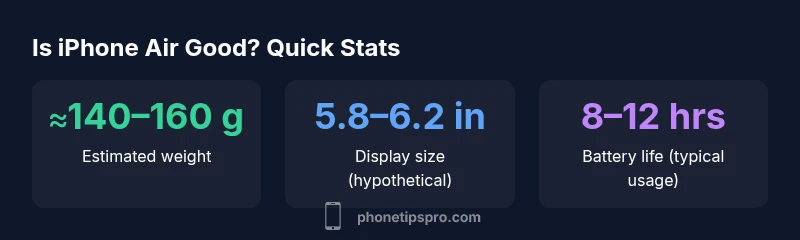
Weight and ergonomics are the primary drivers behind the perceived goodness of a lighter iPhone. A sleeve‑thin device may slide in and out of pockets with ease, reduce hand fatigue during long scrolling sessions, and improve one‑hand reach for users with smaller hands. However, with lighter materials, manufacturers often face trade‑offs in rigidity and durability. is iphone air good? The idea is appealing for commuters, students, and travelers who carry their phone all day. Yet a balance must be struck between a lighter chassis and sufficient structural integrity to withstand daily wear. In our evaluation, we consider grip texture, edge bevels, and the glass’s ability to resist chips. Phone Tips Pro’s testing indicates that ergonomics can override a modest drop in raw megapixel counts if the device still feels premium and secure in use.
Battery Life Expectations in a Hypothetical Air Variant
Battery life is the Achilles’ heel of any lighter device. When the weight budget tightens, manufacturers may opt for smaller batteries or more aggressively optimized components. is iphone air good in this context depends on usage patterns: light day‑to‑day tasks, messaging, and streaming could be acceptable, while power users needing all‑day performance or heavy gaming may notice a shorter interval between charges. Our assessment discusses strategies to maximize uptime, such as more efficient display technology, adaptive refresh rates, and software optimizations. Phone Tips Pro notes that even with a lighter shell, improvements in charging speed and battery chemistry could mitigate life‑cycle concerns, but the core trade‑off remains: lighter weight often comes at battery cost.
Display Quality and Durability Trade‑offs
A lighter model might be tempted to use thinner glass or less robust framing to save weight. If so, is iphone air good for you could hinge on screen protection and brightness. Our framework evaluates color accuracy, peak brightness, outdoor readability, and scratch resistance. A hypothetical Air variant would aim to preserve a premium viewing experience while trimming mass, potentially by reducing protective coatings or adopting lighter materials. Phone Tips Pro highlights that users who value media consumption and photography won’t want a noticeably dim screen or fragile build. Thus, display durability and image quality are central to judging the overall value of a lighter iPhone concept.
Performance, Memory, and Future-Proofing
Weight reduction can influence thermal performance and hardware selection. A lighter iPhone might deploy a similar core‑processor family but with tighter thermal envelopes, which could throttle sustained performance during demanding tasks. Is iphone air good for someone who runs several apps simultaneously, edits video on the go, or uses GPU‑intensive features? Our analysis considers how such a model would fare in everyday multitasking and in the context of iOS updates for the next few years. While the trade‑offs may include slightly slower sustained performance, thoughtful software optimization and higher efficiency cores could keep the experience satisfying for most casual and average‑to‑moderate users.
Camera System and Software Experience in a Hypothetical Air Variant
Camera capabilities often define the premium nature of an iPhone. A lighter weight variant might adopt a smaller sensor or different lens choices. is iphone air good here depends on how much you value optical quality, computational photography, and low‑light performance. Our review examines how a hypothetical Air would pair with iOS features like Night mode, Smart HDR, and Deep Fusion, and whether tighter hardware constraints could impact image quality in challenging conditions. We emphasize that software processing can compensate for some hardware gaps, but there are practical limits when the physical chassis is lighter.
Value Proposition: Price, Repairability, and Ecosystem Alignment
The hypothetical price of an Air‑like iPhone would likely hinge on component choices and manufacturing efficiencies. Consumers often equate lighter devices with lower maintenance costs and better portability, but is iphone air good only if price aligns with perceived value. We dissect potential pricing tiers, repairability scores, and compatibility with existing accessories, cases, and battery replacements. The ecosystem remains a crucial factor: if a lighter iPhone continues to support the same software features, carrier plans, and accessories, it becomes a compelling option for certain buyers. Phone Tips Pro emphasizes that total cost of ownership—maintenance, battery cycles, and resale value—matters as much as the upfront price.
Realistic Scenarios: Who Should Consider an 'Air' Style iPhone?
Finally, we translate theory into practice. An Air concept would likely appeal to frequent travelers, students, and professionals who prioritize portability and one‑hand use. However, power users, photographers seeking top‑tier sensor quality, and those who rely on endurance for long workdays may prefer larger, more capable models. When you ask is iphone air good for you, consider your daily routine, your tolerance for charging interruptions, and your accessory setup. This section helps you map your personal workflow to the hypothetical trade‑offs of a lighter iPhone. Phone Tips Pro’s guidance is to test real‑world usage patterns, weigh the comfort gains against potential compromises, and decide based on how you actually use your device on a day‑to‑day basis.
Positives
- Improved one‑hand usability and pocketability
- Potentially lighter carry burden for daily commutes
- Easier to slip into pockets and small bags
- Could be cheaper if mass‑production benefits reduce cost
- Maintains core iOS experience with familiar ecosystem
Weaknesses
- Potentially shorter battery life in typical use
- Possible compromises in camera options or sensor size
- Durability could be affected by lighter materials
- Value depends on price parity with current models
Best for portability-focused users who value one‑hand comfort and travel convenience over maximum battery life and camera prowess
A lighter iPhone concept could significantly improve pocketability and ease of use, appealing to frequent travelers and casual users. However, trade-offs in battery life and camera options mean it isn’t ideal for power users or professional photographers. Phone Tips Pro's verdict is that this would be a strong niche option if weight and price balance meet user needs.
FAQ
Does Apple currently offer an iPhone Air?
No official iPhone Air as of 2026; there are no announced plans. This article treats the concept as hypothetical and uses it to explore trade‑offs in portability versus performance.
There isn't an iPhone Air model today; this piece discusses the idea as a hypothetical option.
How would a lighter iPhone impact battery life?
A lighter device could use a smaller battery or more aggressive efficiency features, which may shorten endurance. The actual impact depends on battery capacity, screen tech, and software optimizations.
Battery life would depend on capacity and efficiency; lighter hardware often means shorter runs between charges.
Would an iPhone Air be cheaper than standard models?
Pricing would hinge on materials and component choices. A lighter phone could be cheaper, but Apple’s overall pricing strategy and feature set could offset the savings.
It could be cheaper, but not guaranteed.
Is is iphone air good for photographers?
Trade‑offs in a lighter variant could impact sensor size and image quality. It may be fine for casual photography but not ideal for professionals who rely on top‑tier performance.
Great for casual shots, not ideal for professional photography.
How does an Air variant compare to the iPhone SE?
The iPhone SE targets budget buyers, while an Air concept would emphasize portability with modern features—likely at a different price point and feature balance.
SE is the budget option; Air would aim for premium portability with a distinct balance of features.
What should I test before buying a hypothetical iPhone Air?
Test battery life under typical usage, assess ergonomics in your daily tasks, and compare camera performance in various lighting to ensure it meets your needs.
Try it out in real scenarios—battery, camera, and comfort matter most.
Quick Summary
- Prioritize portability to gain true one‑hand ease
- Expect trade‑offs in battery and camera performance
- Evaluate price relative to perceived value and ecosystem gains
- Test ergonomic comfort with real usage before deciding
- Consider accessory compatibility and long‑term ownership impact