Difference Between iPhone and iPhone Air: A Practical Comparison
Explore the difference between iPhone and iPhone Air (rumored) focusing on design, display, performance, battery, camera, price, and ecosystem. A practical, analytical guide to help you evaluate portability vs capability in 2026.


According to Phone Tips Pro, there is no official iPhone Air as of 2026, so the difference between iPhone and a rumored Air would hinge on portability, display size, and battery trade-offs. In practice, expect the Air variant to prioritize a lighter form factor and lower weight, potentially with a smaller display and more affordable price, while the standard iPhone emphasizes battery life and feature parity.
Overview: framing the iPhone and the hypothetical Air concept
The phrase difference between iphone and iphone air surfaces frequently in rumors and tech commentary, often alongside questions about size, weight, and value. This article treats iPhone and the hypothetical iPhone Air as two ends of a portability vs. capability spectrum. According to Phone Tips Pro, buyers should evaluate core trade-offs rather than chase speculative features. We’ll examine design, display, performance, battery, camera, and ecosystem implications, providing a clear framework for decision-making even when rumors swirl. The goal is to help you assess how a lighter, Air-branded variant would affect daily usage, accessory compatibility, and long-term ownership. While the Air concept is not yet an official product line, the analysis here remains grounded in observable patterns from past iPhone releases and common industry strategies. By the end, you’ll be equipped to compare any potential Air option against current iPhone models with logic, not hype.
Design and ergonomics: portability vs. grip
When comparing a standard iPhone to a hypothetical Air, the first tangible difference would likely be in weight and size. A lighter device generally improves one-handed use and pocketability but may trade off some rigidity and perceived premium feel. The design language could still prioritize durability and premium materials, but the Air variant might adopt a slightly slimmer chassis or redesigned internals to shave weight. Ergonomics matter for long sessions, scrolling, and gaming, so the Air would be attractive to power users who prioritize comfort during daily tasks. In this section we consider grip, edge curvature, and how materials influence the sense of quality without relying on assumptions about specific model numbers. The takeaway: portability is a defining factor, but it must be balanced against build feel and steadiness in hand.
Display and visuals: size, brightness, and readability
Display size and brightness are central to the perceived value of any iPhone, and an Air variant would almost certainly aim for a different balance than the standard model. A lighter device might justify either a slightly smaller or similarly sized panel with minimalist bezels, preserving usable screen real estate while reducing weight. Display technology (OLED vs. LCD, color accuracy, brightness peaks) influences everything from photo editing to video streaming and gaming. In our assessment, we focus on how display size interacts with ergonomics, pixel density, heat management, and outdoor readability. Regardless of rumors, readers should prioritize resolution and color fidelity for the tasks that matter most to them, such as photography, media consumption, or productivity.
Performance and battery life: what actually matters
A core uncertainty in any Air hypothesis is processor choice and energy efficiency. Historically, Apple aligns two lines with shared chip architectures but varies power envelopes and thermal solutions. If an Air were to exist, it would likely target improved power efficiency and lighter battery capacity, resulting in different endurance characteristics compared to the standard iPhone. Our framework emphasizes real-world usage: screen-on time, peak brightness during HDR content, and background task efficiency. We discuss how software optimizations, battery health, and charging habits influence day-to-day reliability, and how to interpret manufacturer claims in light of typical usage patterns.
Camera and software experience: parity or distinction?
Cameras are a major differentiator across iPhone lines, and an Air variant would need to justify its place in the lineup through sensor quality, lens options, image processing, and video capabilities. Historically, Air variants in other product families emphasize core imaging capabilities with some trade-offs in hardware specialization. Here we examine practical expectations for the Air’s camera systems, such as potential differences in sensor size, stabilization, and computational photography features. We also explore how iOS updates, app compatibility, and ecosystem features (AirDrop, Find My, iCloud) may shape the user experience regardless of hardware parity.
Storage, memory, and network features: what stays constant, what changes
Even if the Air model exists, memory configurations and storage tiers often mirror the standard line, providing familiar upgrade paths. Network features like 5G support, Wi-Fi standards, and accessory compatibility tend to stay aligned within a generation. However, expectations around thermal behavior, RAM capacity, and storage pricing can diverge between a mainline model and a lighter variant. We outline practical guidance for choosing storage tiers based on photo libraries, video content, game data, and professional apps, while noting that future Air devices could simplify options to streamline decision-making for casual users.
Price positioning and ecosystem considerations: value in context
Price is a central factor when weighing an iPhone against an Air concept. An Air variant is typically positioned as a lower-cost entry point within the lineup, potentially attracting buyers seeking portability without flagship-class performance. We discuss how price intersects with the ecosystem—accessories, cases, MagSafe compatibility, and service plans—so you can estimate total cost of ownership. Regardless of whether an Air option becomes a real product, understanding its potential value proposition helps in making informed decisions about upgrading now or waiting for a future release.
How to evaluate rumors and plan your purchase strategy
Rumor-driven decisions demand a disciplined approach. We propose a decision framework: map your priorities (portability, battery life, camera quality, or price), check current model capabilities, and set expectations for a hypothetical Air variant. If you encounter credible leaks, compare them to existing iPhone models using a consistent metric set (display quality, battery endurance, camera performance, software support). Finally, we provide practical steps for testing devices in-store, reading independent reviews, and timing purchases to maximize value as the market evolves in 2026.
Real-world decision guide: who should consider which option?
For users who value screen real estate, battery longevity, and premium camera features, the standard iPhone line typically remains the strongest all-around choice. For those who prioritize portability, travel-friendly form factors, and potentially lower price points, an Air-inspired option could be appealing if it delivers adequate performance and quality. The decision should hinge on real usage patterns, device reliability, and the specific models available at purchase time, rather than on speculative features alone. Phone Tips Pro emphasizes practicality and hands-on testing as the most reliable path to the right pick.
Comparison
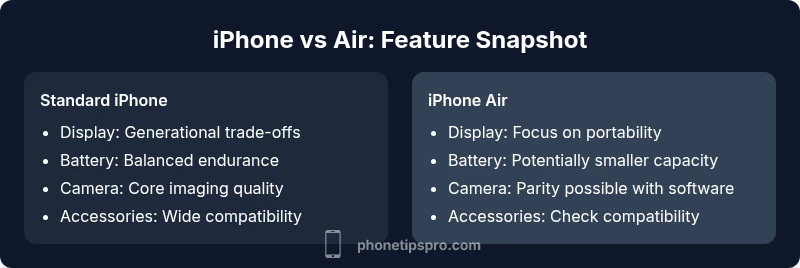
| Feature | Standard iPhone | iPhone Air |
|---|---|---|
| Display size | Similar diagonal size (model-dependent) | Potentially smaller or slim-bezel variant |
| Weight | Typical weight range for mainstream models | Lower weight to enhance portability |
| Battery life | Competitive endurance for the generation | Trade-off with lighter battery capacity |
| Processor and performance | Same generation chip options across lines | Air may use a slightly different power envelope |
| Cameras | Parità l sensor options with software optimizations | Air could feature parity in core imaging with some limitations |
| Storage options | Broad range aligned with model tier | Air could share core tiers but with emphasis on affordability |
| Price range | Aligned with mid-to-premium tier for the market | Positioned as a more affordable option within the lineup |
| Best for | Users who want the best display, battery, and features | Users who prioritize portability and value |
Positives
- Lighter and more portable for everyday carry
- Potentially lower price point within the iPhone lineup
- Easier one-handed use and pocketability
- Maintains familiarity with iOS and ecosystem
- Simplified choice for travelers and students
Weaknesses
- Possible shorter battery life due to smaller capacity
- Fewer premium features or camera capabilities in some configurations
- Limited storage or configuration options compared to flagship lines
- Ambiguity around official support and resale value if Air is rumored only
Standard iPhone generally offers better overall value unless portability is the primary priority.
If you prioritize display, battery life, and feature parity, the standard iPhone wins. If portability and potentially lower upfront cost drive your decision, an Air-style option could be appealing, but only with confirmed specs and availability.
FAQ
Is there an official iPhone Air model released by Apple?
As of 2026, there is no official iPhone Air model released by Apple. The term often appears in rumors and media speculation but has not been confirmed as a product line. Consumers should rely on confirmed specs and official announcements when making a purchase decision.
No official iPhone Air has been released as of 2026; treat it as rumor until Apple confirms details.
How would the Air variant differ in size and weight?
An Air variant would typically emphasize a lighter form factor and possibly a smaller footprint. The trade-off could include a different balance of screen size and battery capacity. Always verify the exact dimensions and weight from official specs once announced.
Air would likely be lighter with a different size balance; check specs when announced.
Will an Air model have the same processor as standard iPhone?
In rumors and early analyses, an Air variant might share the same generation chip or use a slightly different power envelope. Performance parity is not guaranteed and depends on thermal design and marketing strategy. Look for official confirmation to know for sure.
It may use the same chip in some cases, but not guaranteed.
Should I wait for an Air release before buying?
Waiting for a rumored Air could delay a needed upgrade. If your current device meets your needs, assess your priorities, test rumored specs when credible leaks emerge, and consider timing around annual Apple product cycles for best value.
Wait only if you can tolerate potential delays and if rumors seem credible.
What questions should I ask when evaluating rumors about Air?
Ask about official confirmation, confirmed specs, expected release window, price positioning, and how the Air would affect accessories and ecosystem compatibility. Compare those details against current iPhone models to avoid hype-driven decisions.
Ask for official specs and release timing, then compare to current models.
Will Air accessories fit standard iPhone cases and MagSafe?
Accessory compatibility depends on dimensions and mounting points. If the Air shares core chassis dimensions, many cases and MagSafe accessories could fit, but confirmation is essential. Until an official spec sheet is available, assume potential incompatibilities.
Assume possible compatibility only after official specs are announced.
Quick Summary
- Understand Air as a rumored concept, not a confirmed model
- Portability often trades off battery and premium features
- Compare devices using standardized criteria you actually use
- Consider total cost of ownership beyond sticker price
- Test devices in-store when possible to verify real-world feel