What is good iPhone 13 or 14? A thorough comparison
An analytical, side-by-side look at iPhone 13 vs iPhone 14 to answer what is good iphone 13 or 14. Compare design, performance, camera, safety features, software longevity, and value to guide your buying decision.


What is good iphone 13 or 14? For most buyers, the iPhone 14 offers a more complete package thanks to enhanced safety features, a longer software support window, and a modest camera performance boost. The iPhone 13 remains a strong value if you want solid performance at a more affordable price. Choose 14 for the latest safety features and longevity; choose 13 if price matters more and you can live with slightly fewer updates.
Framing the decision: what matters when choosing between iPhone 13 and iPhone 14
What is good iphone 13 or 14 is a common question among iPhone buyers who want a practical, no-nonsense answer. According to Phone Tips Pro, the best choice hinges on how you weigh safety features, software longevity, and total cost of ownership. This section sets the frame for a rigorous comparison, focusing on real-world usage rather than marketing hype. We will translate spec minutiae into actionable guidance, so you can align the model you pick with your daily needs, lifestyle, and budget. The goal is to help you maximize value over several years, not just the first few months after purchase.
Hardware and design: form factor, durability, and everyday usability
The iPhone 13 and iPhone 14 share a familiar 6.1-inch OLED design with a premium aluminum frame and Ceramic Shield front. In day-to-day terms, most users can’t reliably distinguish the two by feel or edge-to-edge comfort alone. Where differences emerge is in niche durability aspects, color availability, and subtle changes to weight distribution. The 14 retains the same general silhouette but benefits from small refinements that improve grip feel and scratch resistance in certain finishes. If you rely on a compact, single-hand experience, both models remain comfortable; if you value slight improvements in grip and finish choice, the 14 offers a marginal edge.
Performance and efficiency: chip, GPU, and the everyday feel of speed
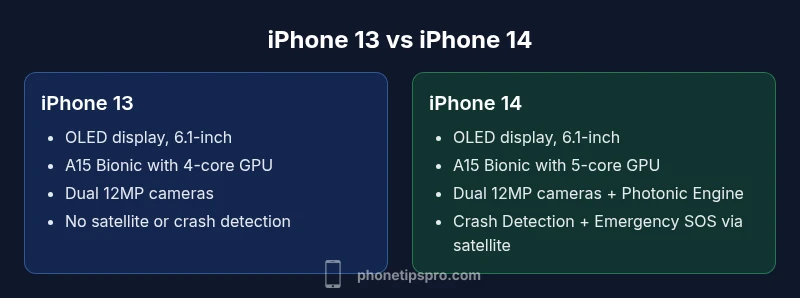
Under the hood, both devices belong to Apple’s A-series generation family, sharing strong performance for most tasks. The iPhone 13 runs on an A15 Bionic with a 4-core GPU; the iPhone 14 uses a very similar A15 Bionic but with a 5-core GPU, giving a modest graphics uplift in graphics-intensive apps and games. In everyday use—opening apps, navigating maps, editing photos—the difference is noticeable but not dramatic for typical light-to-moderate users. Bothphones handle multitasking smoothly, but the 14 provides a smoother margin for future iOS updates and demanding applications as software evolves.
Camera and imaging: sensor size, processing, and low-light advantages
Camera quality remains a central driver in choosing between generations. Both phones sport dual 12MP rear cameras (wide and ultra-wide) with strong daylight performance. The iPhone 14 introduces Photonic Engine processing that enhances low-light detail, particularly in mid-to-high ISO ranges, and it adds autofocus to the front camera for improved portrait selfies and video calls. For everyday photography, the 14 yields crisper night photos and more reliable focusing in dim environments. If you mainly shoot in good lighting, the camera experience is already excellent on the 13, but the 14 delivers noticeable improvements where light is scarce.
Battery life and charging: real-world endurance
Battery life is a practical, day-to-day concern for most users. In typical usage, the iPhone 14 offers a modest improvement in endurance over the iPhone 13, driven by slight hardware efficiencies and software optimizations. In real-world terms, most people can get through a full day with either model, even with heavy social media, streaming, and navigation. Charging behavior remains consistent across both devices, using the same Lightning connector and wired/wireless charging ecosystems. If you routinely push a phone toward the end of the day, the 14’s incremental stamina boost can feel meaningful, especially when you’re away from a charger.
Safety features and reliability: what’s new and why it matters
One of the clearest differentiators is safety-related technology. The iPhone 14 adds Crash Detection, a feature that can recognize severe impacts and prompt help. It also introduces Emergency SOS via satellite in supported regions, letting you contact emergency services even without cellular coverage. The iPhone 13 lacks these satellite and crash-detection capabilities. For users who value emergency connectivity and automatic fall-prone scenarios, the 14 offers a compelling practicality upgrade. For others who primarily use their device for everyday tasks, these features may be less critical but provide long-term peace of mind.
Software updates and longevity: how long each model stays current
Software support duration is a long-term consideration that many shoppers overlook in the moment of purchase. Both devices receive iOS updates for many years, but the newer hardware of the iPhone 14 generally translates into a longer update horizon. In practice, this means the 14 is more likely to stay current with new features, security improvements, and app compatibility further into the future. If you prioritize “future-proofing” your purchase and plan to keep the device beyond four or five years, the 14 is the smarter bet. If you expect to upgrade more frequently or on a tighter budget, the 13 still delivers an excellent software experience today.
Value, resale, and total cost of ownership: where to invest your money
Price dynamics matter as you weigh value. The iPhone 13 launched at the same price as the iPhone 14 at release, but over time the 13 often appears at lower prices on resale platforms. If you buy new, the 14 may command a premium during initial months, while the 13 becomes an attractive discounted option, especially during sales. In terms of long-term value, the 14 tends to hold resale value better due to its newer hardware and added features. If your budget is flexible, the 14 aligns more closely with long-term ownership goals; if you need to stretch dollars now, the 13 can still deliver a strong ownership experience at a lower initial outlay.
Real-world scenarios: who should consider each model and why
Consider your priorities and typical usage patterns. If you rely on advanced emergency features, value the best possible camera performance in low light, and plan to keep the device for several years, the iPhone 14 is likely the better fit. If you want a dependable iPhone with robust performance and a lower upfront price, and you’re comfortable trading some newer safety features for savings, the iPhone 13 remains a compelling choice. For students and budget-conscious buyers who still demand credible quality, the 13 offers substantial value; for professionals and early adopters seeking longevity and peace of mind, the 14 secures the better overall proposition.
How to decide: a practical checklist you can use today
Use this quick checklist to decide between iPhone 13 and iPhone 14:
- Prioritize safety features? If yes, lean toward iPhone 14.
- Want the longest software support window? Choose iPhone 14.
- Is price the deciding factor? If you need to save now, iPhone 13 is often the better value.
- Do you care about camera improvements in low light? iPhone 14 provides a noticeable edge.
- Will you keep the phone for many years? The 14 offers greater long-term flexibility and resilience.
Remember, the best model is the one that matches your daily routines and budget, not the model with the most buzz. Phone Tips Pro’s approach emphasizes practical outcomes over spec-by-spec comparisons, guiding you toward a decision that feels sensible in real life.
mainTopicQuery2NoteOnlyForSchemaNotShownInTextInJSONStyleHereOnlyForWikidataLookup
Comparison
| Feature | iPhone 13 | iPhone 14 | ||
|---|---|---|---|---|
| Display and Design | OLED Super Retina XDR, 6.1-inch, similar chassis and feel | OLED Super Retina XDR, 6.1-inch, similar chassis and feel | ||
| Performance and GPU | A15 Bionic with 4-core GPU | A15 Bionic with 5-core GPU (better graphics)}]},{ | feature1 | values1 |
Positives
- Clear upgrade path with longer software support
- Safer emergency features improve peace of mind
- Improved camera processing in low light
- Strong all-around performance with good battery efficiency
- Solid resale value for the newer model
Weaknesses
- Higher upfront cost for the newer model
- Older hardware on the 13 means slightly fewer future-proof features
- No USB-C or major design overhaul on either model
- Both models still rely on Lightning, limiting future-proof connectors
iPhone 14 is the better pick for most buyers, especially if you value safety features and longer software support.
The Phone Tips Pro team recommends the iPhone 14 for users who want the most future-proof options and enhanced safety features. If price is the primary concern and current camera performance suffices, the iPhone 13 remains a strong value. Overall, the 14 offers better long-term value for the majority of users.
FAQ
Should I upgrade from iPhone 13 to iPhone 14?
If you value advanced safety features, better low-light photography, and a longer update horizon, upgrading makes sense. If those features are not essential and price is a priority, the iPhone 13 remains a compelling option.
If you want the latest safety tech and longer support, upgrade. If price matters more, the 13 still covers the basics well.
What are the main camera differences between iPhone 13 and iPhone 14?
Both models have dual 12MP cameras, but the iPhone 14 includes Photonic Engine processing for better low-light detail and autofocus for the front camera, which improves selfies and video calls.
The 14 handles low light more cleanly and focuses the front camera better.
Do both phones get the same iOS updates?
Both will receive iOS updates for many years, with the iPhone 14 generally expected to stay current longer due to newer hardware.
Both will get updates for years, but the 14 should stay current longer.
Which has better battery life?
Real-world endurance is strong on both; the iPhone 14 tends to edge ahead slightly due to efficiency improvements and a newer battery design.
Both last a full day, with the 14 usually edging out the 13 in endurance.
Is the iPhone 13 a good value in 2026?
Yes, especially if you can find it at a discount. You’ll get solid performance and a current iOS experience, but you’ll miss the latest safety features.
Yes, it’s a good value if price matters, just expect fewer safety features.
Which model is better for long-term use?
The iPhone 14 is generally better for long-term use due to its newer hardware and longer projection of software support.
For the longest life, choose the 14.
Quick Summary
- Assess safety needs first; choose iPhone 14 for crash detection and satellite SOS.
- Budget matters: iPhone 13 often offers better value in the used market.
- Photonic Engine on 14 improves low-light performance; 13 remains strong in daylight.
- Software longevity favors the 14 for longer update support.
- Resale value generally higher for the newer model, aiding long-term ownership.