Which iPhone Breaks the Easiest? A Durability Comparison
A data-informed durability comparison across recent iPhone models. Learn which iPhone tends to be more prone to damage, why, and how to protect your device with practical tips and model-specific considerations.


If you're asking which iphone breaks the easiest, there isn't a universal winner. Durability depends on model design, materials, and how you use the phone. Across generations, newer models often strengthen protection with tougher glass and frames, but real-world drops, cases, and usage patterns still dominate outcomes. This quick take outlines model-level differences and protection implications.
Why durability matters for iPhone owners
Durability is not just about avoiding cracks; it affects resale value, repair costs, and daily reliability. A phone that survives a few accidental drops is more likely to stay usable for years, which matters for people who upgrade on schedule or work in harsh environments. According to Phone Tips Pro, the average iPhone user encounters at least one drop or surface hit per year, and many incidents happen during quick commutes or outdoor activities. The Phone Tips Pro team found that case choice, screen protection, and charging habits matter nearly as much as the base build when it comes to long-term durability. In practice, durability comes from a combination of materials science (front glass, back glass, chassis) and user behavior (where you carry the phone, how you pocket it, and how you handle it during hands-on tasks). This section sets the groundwork for understanding why model differences exist and how to read durability claims in product marketing."
Baseline durability facts and what 'break' means
Durability is multi-faceted, encompassing impact resistance, scratch resistance, screen integrity, water exposure, and internal component resilience. For most users, the visible breakage starts with the display glass or back glass and, less commonly, with the chassis deflecting after a hard impact. Ceramic Shield technology (front glass) was introduced to improve drop protection on newer iPhones and remains a key marketing and real-world differentiator. Water resistance ratings provide some protection, but immersion or submersion still risks internal damage if seals are compromised. Importantly, 'break' can mean different things: a cracked screen that remains usable, a shattered back, or a device that stops charging after a fall. Understanding these distinctions helps you evaluate durability claims without overvaluing a single metric.
The durability landscape across generations
Across the iPhone generations, Apple has iterated on display materials, frame construction, and protective coatings. The mid-cycle shift often brings a lighter chassis with stronger glass, while some models trade minimal weight for greater rigidity. While Apple often markets new models as more durable, independent tests emphasize variation based on drop angle, surface, and the presence of protective accessories. The general trend is a gradual improvement in front-screen protection and frame rigidity, with occasional trade-offs in weight or grip. For someone weighing a purchase specifically for durability, this section translates design choices into real-world expectations and helps set reasonable durability goals for daily use.
Common breakage scenarios and protective strategies
Most breakages occur in everyday settings: a phone dropped onto concrete, a table edge, or a morning grab from a bag. Screen cracks are the most visible failure, but glass shattering can also occur on the back or camera module after a high-energy impact. Protective strategies are straightforward: use a trusted case, a tempered glass screen protector, and practice safe handling around hard surfaces. Think about distribution of risk: the screen bears the brunt of drops, so prioritizing a robust front-glass protector and a shock-absorbent case often pays off more than upgrading to the newest model alone. Regularly checking for loose ports or settings that cause unnecessary charging wear also helps.
Real-world testing vs marketing claims
Independent durability tests—when available—offer a reality check against glossy marketing. Tests typically compare several models under controlled drops, scrapes, and water exposure, but real-world conditions vary: pocket corners, bag contents, and whether the device is used with or without a case. Phone Tips Pro analysis shows that protective accessories, usage patterns, and maintenance habits influence outcomes far more than a single model's base materials. In other words, a newer iPhone can be more protective on a bench but less durable in a busy, drop-prone lifestyle if you neglect cases or screen protection.
How to protect any iPhone from damage
Practical steps apply to all models: choose a case with shock absorption and a raised lip; apply a tempered glass screen protector; enable Find My iPhone to track a dropped device and reduce panic after accidents; avoid exposing the phone to harsh chemicals; keep moisture away; schedule regular checkups after a drop; consider AppleCare+ for post-warranty repairs; sanitize and maintain ports.
What to look for when buying a durable iPhone
Durability-minded buyers should weigh front glass strength, chassis material, and water resistance as core criteria. Look for models with reinforced glass or ceramic shield claims, inspect the frame geometry for rigidity, and consider the availability of certified protective accessories. Also, assess the costs of repairs and coverage: AppleCare+ or third-party extended protection can dramatically reduce out-of-pocket repair expenses after accidental damage.
Model-by-model durability snapshot
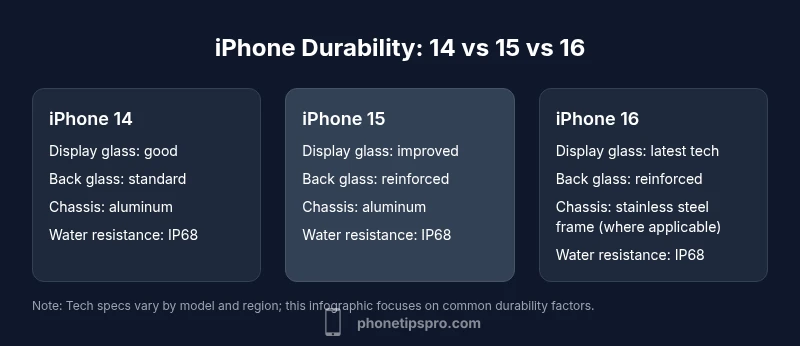
Durability snapshot: iPhone 14, iPhone 15, iPhone 16. In general, the latest generation tends to feature improved display glass and a stiffer frame, but that isn't a guarantee of trouble-free longevity. Case and screen protection still play a pivotal role. If you prioritize maximum protection with minimal added accessories, you might favor a model with durable glass and a robust chassis; if cost is a constraint, pairing an older model with a proven protective setup can be a strong choice.
Practical decision framework for durability-focused buyers
Use a simple decision framework to align durability with lifestyle: 1) assess your risk environment (outdoor work, travel, pocket use), 2) set a budget for protective gear (case + screen protector), 3) decide on coverage (AppleCare+ or extended protection), 4) compare model-specific durability claims against your risk profile, 5) factor in resale and repair costs over time. This approach helps avoid overpaying for marginal gains that won’t translate to real-world longevity.
Feature Comparison
| Feature | iPhone 14 | iPhone 15 | iPhone 16 |
|---|---|---|---|
| Display glass durability | Good (Ceramic Shield front) | Very good (improved glass and coatings) | Excellent (latest durable glass composition) |
| Back glass durability | Standard glass | Upgraded glass with reinforcement | Reinforced back glass with new bonding |
| Chassis/material | Aluminum frame | Aluminum frame (slightly stiffer) | Stainless steel frame (where applicable) |
| Water resistance | IP68 rated | IP68 rated | IP68 rated |
| Repairability/cost of parts | Lower typical repair costs (current parts availability) | Moderate repair costs | Higher repair costs for glass and frame |
Positives
- Helps readers compare durability factors quickly
- Highlights protective strategies that extend longevity
- Focuses on real-world usage and practical upkeep
- Encourages protective accessories and coverage
- Easy to update as new models release
Weaknesses
- Durability tests vary by environment and user behavior
- No universal winner; context matters
- Model-year gaps can complicate direct comparisons
- Accessory quality can skew perceived durability
There is no universal winner; durability is model-dependent and highly influenced by protection choices.
Latest models often offer the strongest materials and protection, but a robust case, screen protector, and AppleCare+ dramatically affect real-world longevity across any generation.
FAQ
Which iPhone model is the most durable?
Durability varies by design, materials, and usage. There is no single “most durable” model that outperforms all others in every scenario. The latest generation often performs best in aggregate tests, but real-world protection still depends on cases, screen protectors, and handling.
Durability depends on design and how you use it—there isn’t one model that’s always the toughest.
Does Ceramic Shield make iPhones break-proof?
Ceramic Shield improves drop resistance but does not render the phone unbreakable. A protective case and screen protector still play crucial roles in preventing damage after a fall.
It helps, but it’s not a shield against every drop.
Is the iPhone 16 more durable than the iPhone 15?
In general, newer generations bring durability improvements in display and chassis, but the difference is not guaranteed in every scenario. Real-world results depend on usage, cases, and maintenance.
Newer isn’t always dramatically tougher in every situation.
How does AppleCare+ affect durability costs?
AppleCare+ reduces out-of-pocket repair costs after accidental damage, making durability investments more affordable over time. It does not make the device immune to damage.
AppleCare+ can save you money after damages.
Should I upgrade primarily for durability?
Upgrade decisions should balance durability with features and cost. If protection and longevity are top priorities, pairing a durable model with accessories can be a smart strategy rather than chasing the latest release.
Think protection first, then price and features.
Quick Summary
- Evaluate risk environment before model choice
- Protect with a high-quality case and screen protector
- Expect durability gains with newer generations but read tests cautiously
- Consider AppleCare+ to lower repair costs after drops
- Protective habits matter as much as device design