Which iPhone for Me? A Practical Guide to Choosing the Right Model
Learn how to pick the right iPhone with a structured framework covering budget, camera, performance, longevity, and ecosystem—from Phone Tips Pro.


TL;DR: To decide which iPhone is right for you, weigh price against your must-have features—camera quality, performance, and longevity. For top-tier photography and longer software support, the Pro line shines. If value matters most, the base or mid-range models offer solid, modern features with reliable performance. This guide helps you pick which iphone for me with clear criteria and practical context.
Defining your core needs before you shop
When you’re deciding which iphone for me, you’re really choosing among tradeoffs like price, camera quality, performance, and future longevity. According to Phone Tips Pro, the best approach is to map your daily tasks to model features rather than chasing every new spec. The Phone Tips Pro team found that most iPhone buyers prioritize camera versatility and long software support, while power users weigh CPU performance and display quality more heavily. Start by listing non-negotiables: reliable daily performance, strong photo/video capabilities, robust battery life, and seamless ecosystem integration. This foundation lets you compare models on equal footing instead of following hype. Across this guide you’ll see base, mid-range, and Pro options translated into real-world use, so you can answer which iphone for me with confidence and clarity.
Think about tasks such as document work, gaming, video editing on mobile, and signing in to Find My iPhone across devices. By focusing on outcomes rather than brands, you’ll avoid nostalgia-driven purchases. In the sections that follow, you’ll see practical criteria, illustrative scenarios, and a clean side-by-side table to anchor your choice.
Core criteria that matter when you’re comparing models
The decision framework centers on a handful of universal criteria: price and total cost of ownership, camera capabilities, performance headroom, display quality and size, battery life, storage options, software longevity, and ecosystem benefits. For each model you consider, map these factors to your daily routines. If photo and video work is central, prioritize camera hardware and image processing; if mobility and gaming are your defaults, focus on performance and battery efficiency. Phone Tips Pro emphasizes that what matters most is real-world usefulness, not just spec sheets. Keep a simple scoring rubric: can you comfortably complete your typical week with this model? If yes, you’re on the right path to deciding which iphone for me.
Understanding model generations and naming conventions
Apple’s model naming can be confusing at first glance. Base models typically serve everyday tasks with robust efficiency, while mid-range options add incremental improvements in several areas. Pro models generally introduce premium cameras, faster processors, higher-quality displays, and extra features like advanced video modes. When weighing which iphone for me, separate camera and performance expectations from price. In practice, you’ll compare three archetypes: the value-forward base line, the balanced mid-range, and the feature-rich Pro line. Remember that software updates and ecosystem compatibility matter as much as hardware specs for long-term satisfaction.
Display, size, and ergonomics influence daily use
Display quality and physical size affect readability, touch responsiveness, and comfort. If you work long hours on your phone, a larger display with high brightness and a smooth refresh rate can reduce eye strain and fatigue. ProMotion displays in higher-end models offer smoother scrolling and more responsive touch. Ergonomics also matter: weight distribution, edge curves, and even the feel of the glass influence how often you reach for the device. When choosing which iphone for me, consider whether you prefer a compact form factor for one-handed use or a bigger panel for media and productivity. The right balance varies by hand size and daily tasks.
Camera and media capabilities for creators
Cameras are a major differentiator for many buyers. Base models cover a solid primary sensor plus an ultrawide, which is often enough for casual photography and social content. Mid-range models tend to refine low-light performance and computational photography. Pro devices bring telephoto options, advanced video modes, and more versatile sensors for professionals and enthusiasts. For creators, the Pro line often provides better stabilization, RAW support, and richer color science. When answering which iphone for me, align your camera expectations with your editing workflow, storage needs, and preferred distribution channels. Remember that post-processing quality can be as important as on-device capture.
Performance, longevity, and future-proofing
Performance headroom matters if you multitask, game, or run camera apps with heavy processing. The base model delivers reliable everyday speed; mid-range models improve on multitasking through faster processors and memory management; Pro devices top the chart with flagship-grade CPUs and GPUs. Longevity is also critical: newer devices typically receive iOS updates longer, keeping apps functional and secure for many years. If you prioritize long-term value, the Pro line often justifies its premium through enduring performance and longer software support, which is a key factor when deciding which iphone for me.
Battery life and charging strategies for real life
Battery life is a practical constraint on daily routines. Most users can expect a full day under typical use, but power-heavy activities like gaming or video editing will push that boundary. Battery health tends to degrade gradually; choosing a larger battery pack or more efficient hardware can help you avoid mid-day charging. Pro models often pair high efficiency with faster charging options. If you rely on all-day portability or travel, factor in standby efficiency and the availability of fast charging or MagSafe accessories when determining which iphone for me.
Storage, apps, and cloud strategy to optimize value
Storage capacity directly affects how much media you keep on device versus in the cloud. If you shoot lots of high-resolution video, plan for higher storage tiers and consider cloud backups to iCloud or other services. Base models remain viable for many users, while Pro devices commonly offer more storage headroom by default, which reduces the frequency of upgrades driven by capacity constraints. Always estimate your annual media footprint and apps usage to quantify the value of larger storage tiers when deciding which iphone for me.
Software updates, resale value, and ecosystem lock-in
iPhone ownership combines hardware with long-term software support and ecosystem benefits. Apple typically extends software updates for many years, which reduces total cost and extends device relevance. Pro devices often retain higher resale value due to demand for better cameras and performance. When evaluating which iphone for me, weigh the trade-off between immediate price and long-term value, including the benefits of seamless integration with other Apple devices such as Macs, iPads, and Apple Watch.
Real-world scenarios to illustrate decision points
Consider a student who mostly uses the phone for notes, messaging, photography, and streaming. For this user, balance, cost, and camera quality matter; the base or mid-range model can be a strong fit. A busy professional who edits video on mobile or runs demanding apps may benefit from a Pro configuration, where performance and camera versatility unlock more capabilities. A creator who relies on top-tier quality and future-proofing will likely lean toward the Pro line for the most features and longest software support. Lastly, a budget-conscious shopper who values core reliability and a solid camera will often be happiest with the mid-range option, which strikes a solid balance between features and price.
Step-by-step decision guide you can follow today
- List your non-negotiables (camera, battery, display, storage, software longevity).
- Assign a priority weight to each non-negotiable based on your daily routine.
- Compare three models using the same criteria; score each on a 5-point scale.
- Check real-world reviews for long-term satisfaction and update cadence.
- Decide based on overall value: up-front cost plus expected lifetime value.
Feature Comparison
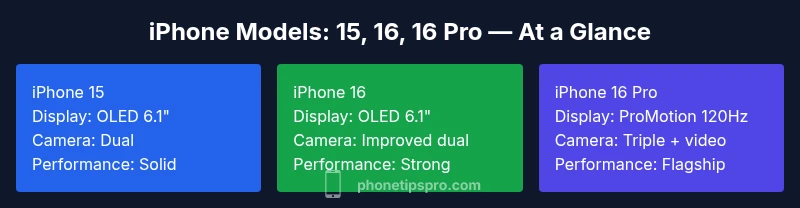
| Feature | iPhone 15 | iPhone 16 | iPhone 16 Pro |
|---|---|---|---|
| Display | OLED, 6.1-inch, standard 60Hz | OLED, 6.1-inch, standard 60Hz | OLED with ProMotion 120Hz |
| Camera system | Dual-camera (wide + ultrawide) | Dual-camera with improved sensors | Triple-camera with telephoto and advanced video modes |
| Performance (CPU/GPU) | Solid everyday performance | Strong mid-range performance | Flagship-level CPU/GPU with extra cores |
| Battery life | All-day typical use | All-day use with heavier loads | Excellent endurance with optimized efficiency |
| Storage options | Base 128GB, up to 512GB | Base 128GB, up to 512GB | Base 256GB, up to 1TB |
| Price range | Low-to-mid range | Mid-to-high range | High-end/pro range |
| Best for | Budget-conscious buyers or first-time users | Balanced users seeking modern features | Power users and creators |
Positives
- Clear framework to compare options quickly
- Highlights how each model fits different budgets and needs
- Presents long-term value by considering updates and longevity
- Works with other Apple ecosystem devices
Weaknesses
- Prices can vary with promotions and configurations
- Only Apple ecosystem; non-Apple accessories may have limited compatibility
- Base models may feel outdated sooner for power users
- Comparison may oversimplify niche feature differences
iPhone 16 offers the best balance of price and features for most users; Pro is ideal for power users, while the iPhone 15 remains the value pick.
For general use, the iPhone 16 provides strong performance and modern features without the premium cost of the Pro. If you need top camera capabilities and the best video tools, choose the Pro. If price is your main concern, the iPhone 15 delivers reliable, current tech at a lower upfront cost.
FAQ
Which iPhone is best for photography in 2026?
Pro models generally offer the strongest photography tools, including advanced video options and more versatile lenses. If photography is your priority, the Pro line is the safer long-term choice, especially for creative work and social media.
For photography, go with the Pro—more lenses and better video options for future projects.
Is the iPhone 16 Pro worth the extra cost?
If you rely on top-tier camera features, 120Hz display, and sustained performance for professional tasks, the Pro model can justify the higher price. For casual use, the standard or mid-range models usually meet most needs.
Only if you need the best camera and performance will the Pro be worth it for you.
How long will these iPhones receive software updates?
Apple typically provides several years of iOS updates after a model’s release, which helps maintain app compatibility and security. The newer the device, the longer you’ll likely benefit from system updates.
Expect several years of updates from a newer model; older ones get updates for a shorter period.
Should I upgrade from an iPhone 13 or 12?
If you value a meaningful jump in camera, display, perfomance, and software longevity, upgrading makes sense. If your current device still handles daily tasks smoothly, you may opt to wait for the next cycle.
If your phone feels slow or misses features you rely on, upgrading could be worthwhile.
What storage do I need for photos and videos?
For heavy photo and 4K video work, plan for larger storage tiers or rely on iCloud to keep media in the cloud while freeing device space. Base storage works for light users, but media-heavy use calls for more headroom.
If you shoot a lot, get more storage or cloud backup to avoid constantly managing space.
Is 5G essential for everyday use?
5G can improve download speeds and streaming but isn’t essential for all users. If you mainly use Wi‑Fi and cloud services, 4G is often adequate, but future-proofing benefits from 5G support.
You’ll likely be fine with 4G unless you rely on fast mobile data regularly.
Quick Summary
- Match model to use-case, not just price
- Pro models excel in camera and performance; base models excel in value
- Expect longer software support on newer models
- Storage and cloud strategy can shift value more than you think