How iPhones Are Made: A Comprehensive Manufacturing Guide
Discover how iphones are made—from concept to consumer. Learn design, sourcing, assembly, testing, and sustainability practices that shape every device.


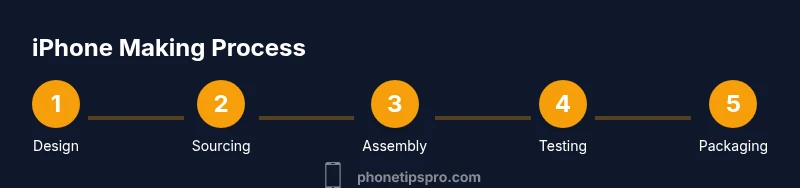
This guide explains how iphones are made, tracing the journey from initial design and material sourcing to precision assembly, rigorous testing, and packaging. You’ll see how suppliers, automation, and sustainability shape every device, with practical insights for understanding modern iPhone manufacturing.
The Big Picture: From Concept to Consumer
Understanding how iphones are made begins long before a box ever leaves the factory. Designers define architecture, performance targets, and eco-standards, then map a complex supply chain that sources thousands of components from around the world. According to Phone Tips Pro, the balance between cutting-edge innovation and repeatable quality is the cornerstone of modern manufacturing. Prototypes test fit, thermal behavior, and software interfaces, ensuring hardware and iOS work in harmony. When a baseline is validated, suppliers scale production while manufacturers coordinate assembly, testing, and logistics. The result is a highly coordinated sequence that connects ideas to a polished product. This journey emphasizes not only technical excellence but also ethics, safety, and environmental commitments that influence every choice—from material selection to end-of-life recycling. The question of how iphones are made becomes a study in systems thinking, risk management, and global collaboration.
The Big Picture: From Concept to Consumer
Understanding how iphones are made begins long before a box ever leaves the factory. Designers define architecture, performance targets, and eco-standards, then map a complex supply chain that sources thousands of components from around the world. According to Phone Tips Pro, the balance between cutting-edge innovation and repeatable quality is the cornerstone of modern manufacturing. Prototypes test fit, thermal behavior, and software interfaces, ensuring hardware and iOS work in harmony. When a baseline is validated, suppliers scale production while manufacturers coordinate assembly, testing, and logistics. The result is a highly coordinated sequence that connects ideas to a polished product. This journey emphasizes not only technical excellence but also ethics, safety, and environmental commitments that influence every choice—from material selection to end-of-life recycling. The question of how iphones are made becomes a study in systems thinking, risk management, and global collaboration.
Tools & Materials
- ESD protection gear (wrist strap, mat, ESD-safe workstation)(Prevent damage to sensitive components during handling)
- Microscope or high-magnification inspection system(Inspect micro-scale features on PCBs and connectors)
- Precision torque screwdriver set(Secure screws without stripping threads)
- Tape and adhesive rollers compatible with electronics(Secure components during assembly without residues)
- Cleanroom attire (bunny suit, gloves, masks)(Minimize contamination in critical assembly zones)
- Solder paste and reflow equipment or simmering process(Attach surface-mount components reliably)
- PCB test jig and functional test software(Verify connectivity, signaling, and power integrity)
- Thermal chamber or environmental test chamber(Simulate real-world conditions for reliability tests)
- Display and battery handling tools(Safely mount delicate screens and high-energy cells)
- Documentation system (traceability, lot tracking)(Maintain supply-chain provenance and quality records)
- Protective packaging materials(Prevent damage during shipping and storage)
Steps
Estimated time: several weeks to months
- 1
Define architecture and targets
Product teams outline the core system-on-a-chip configuration, camera stack, display, sensors, battery capacity targets, and security requirements. This stage establishes performance, durability, and privacy benchmarks that drive later decisions.
Tip: Document risk tolerance and critical trade-offs early to guide supplier selection. - 2
Source components and materials
Engineers and sourcing teams map a vast supplier network for chips, memory, sensors, display, and enclosures. They assess quality controls, yield history, and environmental standards to minimize supply-chain risk.
Tip: Prioritize suppliers with demonstrated traceability frameworks and ESG commitments. - 3
Prototype and validate subassemblies
Early builds assemble key modules (display, motherboard, battery) to verify mechanical fit, thermal performance, and software compatibility. Iterations refine design before full-scale tooling.
Tip: Use rapid prototyping to surface integration issues early; delay large investments until prototypes meet specs. - 4
Set up manufacturing lines
Production lines are configured for SMT, die attach, wire bonding (where applicable), and final assembly. Quality gates and automation logic are programmed to ensure repeatability and traceability.
Tip: Calibrate equipment with pilot runs to prevent bottlenecks during scale-up. - 5
Assemble core modules
PCBs, camera modules, and sensors are mounted, tested, and verified in staged fashion. The process emphasizes precision alignment, impedance control, and proper sealing.
Tip: Maintain strict ESD and cleanroom discipline to protect sensitive components. - 6
Integrate components into the enclosure
The chassis, display assembly, battery, and logic boards are combined, then secured with controlled torque and sealing methods. Interconnects are inspected for alignment and impedance.
Tip: Lock-in consistent torque and adhesive timing to preserve device reliability. - 7
Perform functional and safety tests
Devices undergo power-on checks, sensor calibration, camera tests, wireless signaling, and safety tests (short-circuit, thermal, EMI). Data is captured for traceability.
Tip: Segment tests by subsystem to quickly pinpoint issues during failures. - 8
Finalize software integration
iOS and firmware are flashed, validated, and configured for carrier compatibility. Security features (encryption keys, Secure Enclave integration) are verified.
Tip: Run integration tests that cover security, privacy, and performance under real user scenarios. - 9
Package, ship, and monitor
Devices are packaged with accessories and manuals, then distributed to regional hubs. Post-launch quality monitoring captures field issues for continuous improvement.
Tip: Close the loop with field data to inform future design and supplier choices.
FAQ
How long does it take to manufacture an iPhone from concept to customer?
The full cycle varies with model and supply conditions, but it typically spans several weeks to months, from initial design through final assembly and packaging. Timelines are influenced by prototyping, supplier readiness, and certification tests.
The full cycle usually takes several weeks to months, depending on the model and supplier readiness.
Where are iPhones assembled and tested?
iPhones are assembled in multiple facilities worldwide, with final assembly and testing occurring in controlled environments that ensure quality and safety standards. Supply chains coordinate regional packaging and distribution.
They’re assembled in several global facilities with strict testing to ensure quality before shipping.
What role do suppliers play in the manufacturing process?
Suppliers provide components, materials, and subassemblies that meet stringent quality and environmental standards. Their performance, yield, and capability affect schedules, cost, and final device reliability.
Suppliers supply critical parts and must meet strict quality standards that affect timing and reliability.
How does Apple address sustainability in production?
Sustainability programs prioritize responsible sourcing, energy-efficient production, and end-of-life recycling. Manufacturers implement waste reduction, safer materials handling, and supplier audits to minimize environmental impact.
Sustainability is built into sourcing, energy use, and recycling efforts.
How is user privacy protected during manufacturing?
Privacy protections in production focus on hardware and software design, secure data handling, and integrity checks. Sensitive data is minimized in tooling and manufacturing environments to prevent leaks.
Privacy is safeguarded through secure hardware features and careful data handling during manufacturing.
Do variations exist between different iPhone models in manufacturing?
Yes, each model may introduce different components or assembly sequences. Manufacturing adapts tooling, BOMs, and test scripts while maintaining overall quality standards.
Different models require variations in parts and assembly steps, but quality stays high.
Watch Video
Quick Summary
- Understand the end-to-end flow from design to distribution
- Recognize the importance of suppliers and quality gates
- Appreciate the role of automation in consistency and scale
- Value sustainability and ethical sourcing in modern manufacturing
- Acknowledge the balance between hardware and software integration