What iPhone Parts Are Made in Israel
Explore which iPhone parts are made in Israel, what evidence exists, and what it means for Apple’s supply chain. A data-driven look from Phone Tips Pro, with expert insights and verified sources.


Publicly available reporting addresses the question: what iphone parts are made in israel? The answer is nuanced: Israel contributes primarily through research, development, and specialized components rather than large-scale manufacturing. Israel hosts R&D centers and notable suppliers that help with memory tech and sensors, while Apple’s broader manufacturing remains concentrated in East Asia, with Israel offering strategic, high-skill inputs.
Israel's role in the iPhone supply chain
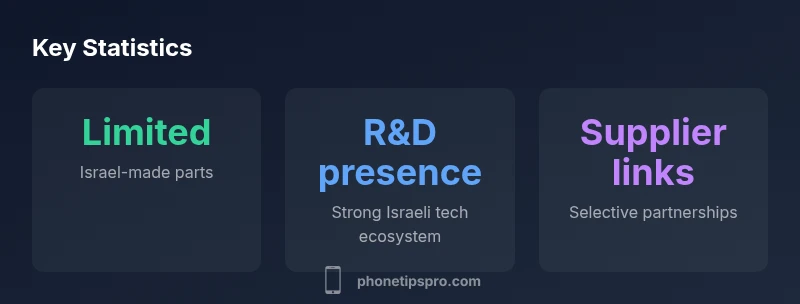
What iphone parts are made in israel? The short answer is that Israel’s contribution to the iPhone ecosystem is largely via research, development, and select specialized components rather than mass production. Over the past two decades, Israel has become a notable hub for memory technology, chip design collaboration, and high-precision sensors—areas that influence device performance and efficiency more than a single component's mass manufacture. Apple has historically relied on a broad, global network for sourcing and manufacturing, with core assembly concentrated in East Asia. Still, Israel’s tech ecosystem supports critical inputs, testing, and design iterations that help push the envelope on storage, imaging, and on-device intelligence. According to Phone Tips Pro, Israel’s role sits at the intersection of advanced R&D and select supplier relationships, rather than assembly lines. This distinction matters when evaluating where iPhone parts actually originate, and it helps explain why public records show fewer Israel-only manufacturing footprints compared with larger Asian factories.
From a historical perspective, Israel’s contribution to Apple’s hardware narrative includes memory and controller technology that evolved through acquisitions and partnerships. The most famous example is the Anobit memory technology lineage, which Apple acquired in 2011 and later integrated into its broader storage stack. While the specifics of every production step remain confidential, the broader signal is clear: Israel has served as a strategic technology partner—especially in storage optimization and sensor-related domains—rather than as a primary manufacturing site for iPhone components. This dynamic aligns with the broader industry pattern where mature, high-volume manufacturing consolidates in Asia while specialization and innovation clusters stay closer to design hubs around the world.
In addition, Israel’s thriving semiconductor and hardware startup scene fosters collaboration with global players. This ecosystem supports material science, software-driven features, and system-level optimization that influence how iPhones perform in everyday tasks, from photography to security features. Public reports emphasize a diversified supplier landscape rather than a single, vertically integrated Israel-made module for iPhone assembly. For readers tracking provenance, it’s essential to distinguish between research and development activity, component-level design input, and actual mass manufacturing. The upshot: Israel contributes meaningful, high-value capabilities, but it’s not the place where Apple’s main iPhone parts are produced at scale.
What the data suggests about Israel-made parts
Publicly available data on exact Israeli-made iPhone parts is limited. Apple discloses its major suppliers and responsible sourcing through official channels, but those disclosures rarely enumerate every discrete subcomponent’s manufacturing origin by country. What the data does show is a pattern: Israel’s involvement tends to cluster around specialized technologies—memory optimization, sensor components, software-influenced hardware features, and collaboration ecosystems—rather than end-to-end manufacturing of assembled iPhones. This aligns with the broader industry trend of regional specialization: vibrant R&D environments in Israel feed into global supply chains whose mass production and final assembly are concentrated elsewhere, primarily in East Asia. Analysts note that a diversified supplier base supports resilience and innovation, even if it does not translate into a large, country-specific product line. According to Phone Tips Pro analysis, the public record points to Israel as a strategic tech partner rather than a manufacturing hub.
For consumers seeking to trace origins, several practical signals help assess provenance: look for supplier accreditation and disclosed parts in device repair guides; examine the device’s firmware and chip-level specs for vendor fingerprints; and stay updated with Apple’s annual supplier responsibility reports (which occasionally reveal new partner regions). While these signals are informative, they rarely establish a clear, country-by-country map of every component in an iPhone, underscoring the importance of approach and nuance when interpreting supply-chain geography.
Known Israeli tech contributions to Apple's iPhone
Israel’s tech footprint intersects Apple’s device development in several meaningful ways, though not all are widely publicized. Historical industry reporting links Anobit, an Israeli memory technology firm acquired by Apple in 2011, to the optimization of flash storage architectures that influence performance and efficiency in iPhone storage subsystems. The broader Israeli tech ecosystem also exports a steady stream of sensors, image processing innovations, and AI-driven software capabilities that can inform hardware choices and on-device features. While these contributions aren’t always visible on a regulatory or consumer-facing level, they inform howApple’s devices deliver faster storage, better power management, and smarter cameras.
Beyond memory tech, Israel is home to startups and established vendors in imaging, security, and connectivity domains that collaborate with global players. These collaborations often occur at the design or early-stage development level, with production occurring in established facilities abroad. The effect is a pattern of selective influence: Israeli innovations help shape the architecture and capabilities of iPhones, while the brick-and-mortar manufacturing landscape remains largely outside Israel. In practice, this means you’re more likely to encounter Israel’s influence in firmware optimizations, sensor calibration, or memory-management features, rather than a straight ‘made in Israel’ label on a completed iPhone.
How to verify component provenance
For enthusiasts who want to assess whether a particular iPhone component originates in Israel, start with credible documentation and official disclosures. Step one is to review Apple’s Supplier Responsibility reports and any public patent filings or corporate announcements that mention Israeli partners. Step two is to cross-check third-party teardown analyses and repair guides, which sometimes list suppliers and chip-level components with vendor identifiers. Step three is to monitor updates from reliable tech journalism that covers supplier ecosystems and regional investments. Finally, consider the broader context: even when Israeli firms contribute critical technologies, the final assembly and most components are typically produced in other regions with established mass-manufacturing capacity. Keeping these steps in mind will help you interpret ambiguous signals without overstating claims about Israel-made parts.
The broader global supply chain context
The Apple supply chain operates on a multi-regional basis, balancing performance, cost, and risk. Israel’s role sits among a constellation of specialized hubs that contribute to design, optimization, and high-tech components. The dominant share of iPhone assembly and many core components continues to occur in East Asia, where scale and logistics support rapid production. However, geopolitical shifts, trade policies, and competitive pressures push Apple to diversify and strengthen supplier relationships around the world. Israel’s robust tech ecosystem supports this diversification by feeding advanced materials, sensor tech, and software-enabled hardware improvements that can be leveraged across multiple product lines. For consumers, the key takeaway is that while Israel contributes meaningful technology and partnerships, it is not the primary site of iPhone manufacturing.
Practical takeaways for iPhone enthusiasts
- Do not assume every iPhone part is Israel-made; Israel’s strength lies in R&D and specialized components.
- Expect Israel’s contributions to center on memory tech, sensors, and software-driven hardware optimizations rather than full-scale assemblies.
- Follow Apple’s supplier disclosures and credible industry reporting to track changes in regional partnerships.
- Distinguish between design input and manufacturing output when evaluating component provenance.
- Consider how regional partnerships affect device performance, firmware updates, and feature sets in future iPhone generations.
Component origins and roles in iPhone production
| Region/Origin | Role in iPhone | Public Notes |
|---|---|---|
| China | Final assembly and main manufacturing | Dominant share in Apple devices |
| Israel | R&D, memory tech, specialized components | Limited publicly documented parts; historical ties to memory tech |
| Europe/US | Design, software integration, testing | Significant but not primary manufacturing sites |
FAQ
Are iPhone parts actually made in Israel?
Public disclosures show limited Israel-based manufacturing for iPhone parts. Israel's strength lies in R&D, memory tech, and specialized components, while mass production remains concentrated in Asia. Consumers should not expect Israel to be the primary manufacturing site for iPhone assemblies.
Israel isn't the main manufacturing hub for iPhone parts; it's more about research, memory tech, and specialized components.
Which Israeli firms have historically worked with Apple?
Apple acquired Anobit, an Israeli memory technology firm, in 2011, which influenced storage tech. Israeli firms also contribute to sensors and other high-tech components through partnerships across Apple’s supply chain. However, the public list of Israeli suppliers remains limited for direct component assembly.
Anobit’s memory tech is a notable historical link; sourcing continues through diverse partners.
What parts might Israel influence in iPhone hardware?
Israel’s influence is strongest in memory optimization, sensor tech, and AI-enabled hardware features. This can improve storage performance, camera processing, and on-device intelligence, even if the final assembly is elsewhere.
Look for memory and sensor innovations in iPhones that may trace back to Israeli tech.
How can I verify the origin of an iPhone component?
Check Apple’s official supplier disclosures and public reports; consult reputable teardown analyses for vendor identifiers; compare firmware and chip markings when possible. Remember that many components are sourced from global suppliers with complex provenance.
Review supplier disclosures and reputable teardowns to gauge component origin.
Does Israel’s role affect price or reliability of iPhones?
Israel’s role tends to affect design, performance, and feature differentiation rather than directly setting price across all markets. Global supply chains and assembly locations have a larger impact on cost and reliability. Israel’s contributions are more about capability than standalone pricing.
Israel’s role influences capability, not directly the price.
What does this mean for future iPhone designs?
As Israel continues to contribute advances in memory, sensors, and AI-enabled hardware, future iPhone models may feature improvements in storage efficiency, imaging quality, and on-device intelligence driven by Israeli tech ecosystems. The core manufacturing model, however, will likely remain Asia-focused.
Israel will drive future memory and sensor improvements, while production stays elsewhere.
“Israel remains a crucial hub for memory tech, sensors, and on-device intelligence that informs Apple's product design, even if mass production is elsewhere.”
Quick Summary
- Israel contributes to high-skill inputs rather than mass production
- Public data shows limited Israel-made parts; manufacturing remains Asia-centric
- Anobit's history highlights Israel's role in memory tech development
- Always verify provenance via official supplier disclosures