Which country owns iPhone: Ownership, design, and manufacturing explained
Who owns the iPhone? Apple Inc. is the US-based owner, with design centered in the United States and a manufacturing footprint that spans multiple countries. This guide clarifies ownership vs production and what it means for users.


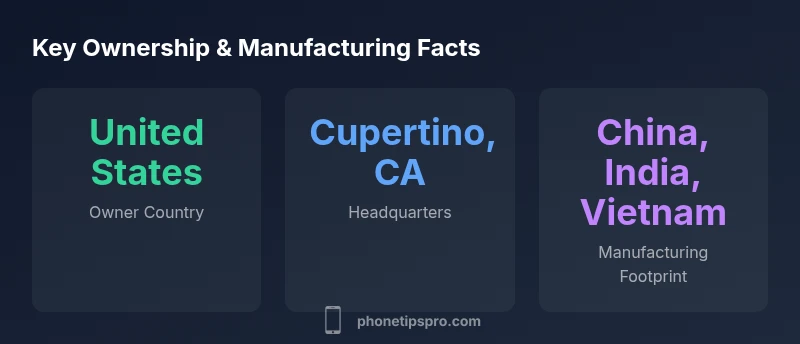
The iPhone is owned by Apple Inc., an American technology company headquartered in Cupertino, California. Apple is incorporated in the United States, and while design and product vision originate there, the device’s components are manufactured across a global supply chain, with assembly taking place in multiple countries. In short, the country of ownership is the United States.
The legal owner: Apple Inc.
Apple Inc. is the legal owner of the iPhone. It is an American technology company that is incorporated in Delaware and headquartered in Cupertino, California. This corporate structure defines who holds ownership, governance rights, and responsibility for compliance across markets. For readers of Phone Tips Pro, it is essential to distinguish ownership from manufacturing or design; ownership places legal and financial control with the US-based corporation, while other processes may occur elsewhere in the world.
Design and development: Where ideas originate
The iPhone’s design and product vision originate in the United States, with core teams located in Cupertino and other U.S. design centers. These teams set the overall user experience, hardware aesthetics, and software integration. While Apple collaborates with international partners for materials, components, and engineering, the central guiding principles—user interface, usability, and branding—are driven from the U.S. design ecosystem. This separation of design leadership from manufacturing locations is common in global tech products.
Manufacturing and supply chain geography
Apple operates a highly distributed supply chain. While many assembly activities have historically occurred in China, production has expanded to other regions such as India and Southeast Asia. The iPhone’s components come from suppliers around the world, and final assembly is performed in multiple facilities across different countries. This geographic diversification helps Apple manage risk, optimize logistics, and respond to local market needs. Consumers rarely see the global complexity behind the device in a single country, but the ownership and governance sit with the United States entity, Apple Inc.
Corporate structure and governance
Apple Inc. is a U.S.-based corporation governed by U.S. corporate law and subject to the regulatory framework of the United States. The parent company operates through subsidiaries globally, enabling local marketing, sales, and compliance. While the product is sold worldwide, the governance and fiscal ownership reside in Apple’s U.S. headquarters and board. Understanding this structure helps clarify why warranties, service terms, and regulatory compliance reflect Apple’s corporate policies rather than the laws of any single country where components are produced.
Ownership vs production: Key distinctions
Ownership refers to who legally owns and controls the company that sells the product. Production, by contrast, describes where components are made and where assembly occurs. For the iPhone, ownership is tied to Apple Inc. (USA), while production is distributed across diverse international sites. This distinction matters for issues like governance, tax residency, and consumer protections, but it does not imply that a single country owns the device. The iPhone remains an Apple product, governed by U.S. corporate policy while interacting with a global supply chain.
Common myths and clarifications
Common myths include the idea that a country owns the iPhone or that design happens in a single place. In reality, ownership rests with Apple Inc. (USA), while design is led from the United States and manufacturing is dispersed globally. Clarifying these points helps avoid confusion about where the device is “made” and which country’s laws govern its sale and service. For readers, trusting Apple’s official statements and corporate filings provides the clearest picture of ownership.
How this affects consumers: rights, warranties, and localization
From a consumer perspective, ownership origin does not determine where you will receive service or which warranty terms apply. Apple’s warranties and support policies are influenced by local laws and regional policies, not the country of ownership alone. However, regulatory requirements in each market can affect product labeling, privacy terms, and service options. Understanding where the governance sits helps consumers navigate warranty claims, AppleCare options, and localization when traveling or moving countries.
A brief historical context: Apple’s origins and growth
Apple was founded in the United States in 1976 and grew into a global technology leader. The iPhone launched in 2007, transforming mobile computing and consumer electronics. The company’s growth story shows how a U.S.-based enterprise expanded to a multinational supply chain, with design and strategic direction rooted in the United States while manufacturing matured through partnerships across Asia and other regions. This history reinforces the distinction between ownership and production in today’s ecosystem.
Practical takeaways for researchers and educators
For researchers, distinguishing ownership from production clarifies discussions about global manufacturing and national policy. For educators, explaining this distinction helps students understand how a single consumer product can involve multiple countries while remaining owned by a single corporate entity. When evaluating policy, business strategy, or consumer rights, start with ownership (Apple Inc., United States) and then map out the product’s design and manufacturing footprint to gain a complete view of the iPhone’s global ecosystem.
Ownership vs. design vs. manufacturing: key country associations for the iPhone
| Aspect | Country/Origin | Notes |
|---|---|---|
| Brand Ownership | United States | Apple Inc. is American and incorporated in Delaware; HQ in Cupertino. |
| Primary Design Location | United States | Product vision and core design originate from Cupertino and US design studios. |
| Manufacturing Footprint | China, India, Vietnam | Global supply chain with multiple facilities and suppliers. |
FAQ
Who owns the iPhone?
The iPhone is owned by Apple Inc., a United States corporation headquartered in Cupertino, California. Ownership is a matter of corporate structure and governance, not the country where components are manufactured.
Apple Inc. owns the iPhone; ownership is tied to the US-based corporation and its governance.
Where is the iPhone designed?
Design and product vision originate in the United States, with core teams in Cupertino and other US centers shaping user experience and interface.
Design work happens mainly in the United States.
Is iPhone owned by a country?
No. The iPhone is owned by Apple Inc., a private US corporation. Ownership is not held by any country.
No country owns the iPhone; Apple does.
Where are iPhone components manufactured?
Components come from suppliers worldwide, with final assembly in multiple countries, reflecting a global supply chain.
Parts come from many countries and are assembled in several places.
Does ownership affect warranty by country?
Warranty terms depend on local laws and Apple’s regional policies. Ownership origin does not solely determine consumer rights.
Warranty depends on local Apple policies and laws.
“"The iPhone is a product of Apple Inc., a US-based company; ownership rests with the United States entity, while production spans multiple countries."”
Quick Summary
- Apple Inc. owns the iPhone as a US-based corporation
- Design leadership centers in the United States
- Manufacturing is global and diversified across several countries
- Ownership differs from where production happens
- Consumer rights reflect local laws, not ownership country