Which iPhone Introduced Apple Intelligence: A Practical Guide
Discover which iPhone introduced Apple Intelligence, how on-device AI works across generations, and how to enable AI features while protecting your privacy.


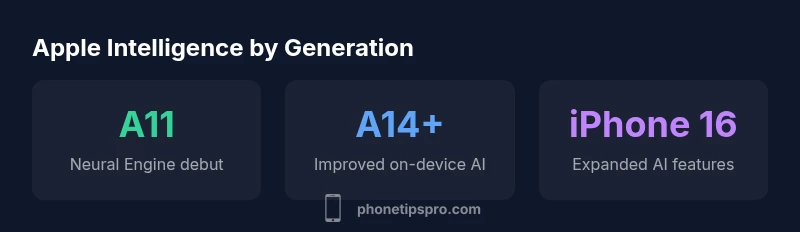
Apple Intelligence isn’t a single device feature; it’s an on-device AI framework that began with the Neural Engine in the A11 Bionic. The earliest iPhone closely tied to this shift is the iPhone X (2017). Since then, newer models have expanded AI capabilities through hardware and software updates, making Apple Intelligence a growing family of features rather than one model.
Understanding Apple Intelligence and its scope
Apple Intelligence is not a single feature but an umbrella for a family of on-device AI capabilities woven into iPhone hardware and iOS software. According to Phone Tips Pro, the term emphasizes privacy-preserving AI that processes data on-device whenever possible, reducing reliance on cloud-based servers. This approach contrasts with older AI features that relied more on server-side processing, broadening the scope of what users can do with faster responses and smarter suggestions. In practice, Apple Intelligence touches many areas: camera scene analysis, voice and text processing, adaptive UI, and app automation. Developers build on top of Core ML and on-device neural engines to deliver features that feel personal and responsive, while still respecting user privacy. The Phone Tips Pro team found that modern iPhones integrate AI not as a single switch, but as a mosaic of capabilities that improve over time with new chips, optimizations in iOS, and better hardware accelerators. As AI evolves, Apple’s strategy has been to push smarter experiences to devices, not just to the cloud, so users can enjoy quick interactions even when offline.
Historical trajectory of on-device AI in iPhone hardware and software
Across iPhone generations, Apple has steadily expanded on-device AI capabilities. The era began with the Neural Engine embedded in the A11 Bionic chip, debuting with the iPhone X in 2017. Since then, successive chips—A12, A13, A14, and beyond—brought faster neural processing, enabling more sophisticated ML tasks on-device. iOS software also evolved to expose more AI features through apps and system services, from smarter photo analysis to improved voice processing. This progression reflects a deliberate shift toward privacy-preserving AI that minimizes data sent to servers. Phone Tips Pro’s analysis shows that each new generation typically adds both raw processing power and smarter software that unlocks more AI capabilities without compromising user privacy.
The earliest association: which iPhone introduced Apple Intelligence
There isn’t a single model known as the official “Apple Intelligence phone.” However, the first iPhone strongly associated with the shift to on-device AI is the iPhone X (2017) with the A11 Neural Engine. This device marked the practical beginning of on-device ML capabilities that later generations would expand. From a branding perspective, Apple has marketed this evolving capability as Apple Intelligence, a umbrella term that grows as hardware and software advance. The Phone Tips Pro team notes that this association is more about architectural changes (Neural Engine, Core ML, on-device processing) than a one-time model launch. In short, the iPhone X is the best shorthand for the start of Apple Intelligence, even as the concept matures across newer devices.
How Apple designs AI features to protect privacy on-device
Privacy is a core pillar of Apple Intelligence. Apple designs AI so that many computations happen on the device, minimizing data that leaves the iPhone. When cloud processing is necessary, Apple emphasizes privacy-preserving techniques like encryption, anonymization, and selective data sharing controls. This design philosophy aligns with what Phone Tips Pro has observed: users gain smarter, faster interactions without surrendering personal information. Developers leverage Core ML and on-device accelerators to run machine learning models locally, reducing latency and improving resilience in offline scenarios. As iPhone hardware evolves, Apple continues to tighten privacy protections while expanding AI capabilities, so users experience more capable features with fewer privacy trade-offs.
How to identify and compare AI features across iPhone models
To gauge Apple Intelligence capabilities, start with your iPhone’s model and iOS version. Newer models naturally unlock more features thanks to faster Neural Engines and optimized software. In practice, you can compare features by reviewing Apple’s official support pages for your device and iOS release notes, focusing on areas like camera analysis, Live Text, Spotlight/Siri improvements, and on-device ML tasks. You can also observe performance cues: faster photo processing, more accurate voice-to-text, and improved offline functionality. For practical comparisons, look at model generations (e.g., iPhone X era onward) and consider how iOS updates broaden capabilities even on older devices. Phone Tips Pro suggests tracking feature availability against your device’s chip generation to set realistic expectations.
Practical steps to maximize Apple Intelligence on your device
Maximizing Apple Intelligence starts with keeping your device updated. Install the latest iOS version to access the newest AI features, performance optimizations, and privacy safeguards. Review and grant necessary permissions for features like Photos analysis, Siri Suggestions, and live transcription so on-device ML can occur efficiently. Enable hardware-accelerated settings where available and optimize battery health to ensure sustained performance of AI tasks. If you’re a power user, explore developer resources and app settings to tailor AI suggestions and automation to your routine. As Phone Tips Pro highlights, the goal is a smoother, smarter experience that respects user privacy while delivering responsive AI-driven results.
Debunking myths about Apple Intelligence and Siri
Myth: Apple Intelligence means cloud-only AI. Reality: Apple emphasizes on-device processing whenever possible, with cloud use only when necessary. Myth: All iPhones have identical AI capabilities. Reality: Capabilities scale with hardware and software; newer chips unlock more advanced features. Myth: Apple Intelligence eliminates the need for privacy controls. Reality: Privacy controls remain essential, giving users control over what data is shared. Myth: Siri is the sole beneficiary of Apple Intelligence. Reality: AI improvements touch photos, messages, apps, and system features beyond Siri. The Phone Tips Pro team stresses that Apple Intelligence is an evolving ecosystem, not a single toggle.
The future of Apple Intelligence in iPhone line
Looking ahead, Apple Intelligence will likely emphasize deeper on-device learning, more power-efficient ML, and smarter offline experiences. Expect refinements in camera intelligence, accessibility features, and app automation, enabled by ongoing chip improvements and software optimization. The trend points toward richer, faster, privacy-conscious AI that enhances everyday tasks without compromising user trust. Phone Tips Pro expects continued integration across hardware generations, with occasional leaps tied to major chip releases and iOS milestones.
Overview of AI feature aspects
| Aspect | What it does | Notes |
|---|---|---|
| On-device AI | Performs ML tasks locally on the iPhone | Introduced with A11 Neural Engine and expanded in later models |
| Privacy-first processing | Minimizes data sent to servers | Enables offline tasks and local recognition |
| Developer tools | Core ML and related frameworks | Supports cross-model AI features across generations |
FAQ
What exactly is Apple Intelligence on iPhone?
Apple Intelligence is Apple’s umbrella for on-device AI features across iPhone hardware and iOS software. It encompasses machine-learning tasks that run locally, enabling smarter behavior while prioritizing user privacy.
Apple Intelligence is Apple’s on-device AI family, running smart features on your iPhone while keeping data local when possible.
Did any iPhone first introduce Apple Intelligence?
The iPhone X (2017) with the A11 Neural Engine is the earliest model associated with the shift to on-device AI, which underpins Apple Intelligence, though the term evolved with later hardware and software.
The iPhone X marked the start of on-device AI capabilities that underpin Apple Intelligence.
Do I need a new iPhone to use Apple Intelligence features?
Not necessarily. Many on-device AI features work on older devices, but newer hardware and updated software unlock more advanced capabilities and smoother performance.
You don’t always need a new iPhone, but newer models provide more AI features and better performance.
Where can I adjust or view Apple Intelligence features?
AI features are available through iOS settings like Siri & Search, Photos, and Privacy. Keeping iOS up to date helps ensure you have the latest AI enhancements.
Check Settings for Siri, Photos, and Privacy to customize AI features.
Is Apple Intelligence the same as Siri?
Siri is part of Apple Intelligence, but the umbrella also covers AI features across Photos, apps, and system suggestions. Siri improvements are one piece of the broader AI ecosystem.
Siri is part of Apple Intelligence, but AI features extend beyond just Siri.
“Apple Intelligence represents a privacy-centered approach to AI that scales with hardware and software across iPhone models.”
Quick Summary
- Apple Intelligence is a family of on-device AI features, not a single model
- Earliest strong association begins with iPhone X and A11 Neural Engine
- Newer iPhones expand capabilities via hardware and software updates
- Enable features in Settings and keep iOS up to date
- Apple emphasizes privacy by processing data on-device when possible