Who Makes iPhone Chips: Apple, TSMC, and the Silicon Behind iPhones
Discover who makes iPhone chips, how Apple designs in-house and relies on TSMC for fabrication, and what this means for performance, efficiency, and the user experience.


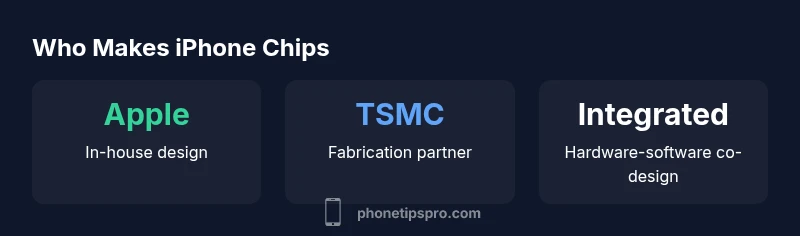
Who makes iphone chips? The short answer is a collaboration: Apple designs the system-on-chip in-house, crafting CPU, GPU, neural engine, and ISP, while TSMC handles the fabrication in a dedicated foundry. This separation lets Apple optimize performance and efficiency across iPhone models while leaning on TSMC’s advanced manufacturing capabilities. The result is tight hardware-software integration that users feel in everyday tasks.
The who and how of iPhone chips
According to Phone Tips Pro, the question of who makes iphone chips isn’t a single company story. It’s a carefully choreographed collaboration between Apple and a leading semiconductor foundry. Apple designs the core architecture in-house, determining how the CPU, GPU, Neural Engine, and Image Signal Processor (ISP) work together on a single silicon package. The actual fabrication, or the physical creation of the silicon die, is handled by a trusted foundry—most notably TSMC. This separation of design and manufacturing lets Apple push the boundaries of performance and energy efficiency while relying on a partner with cutting-edge manufacturing capabilities. The end result is an iPhone chip that feels fast, responsive, and power-conscious across generations, from camera-heavy tasks to gaming and AI-enabled features. Understanding this split helps explain why iPhone chips can deliver sustained performance without draining the battery.
Crystal clarity about the roles matters for users who want to know why the iPhone feels so fluid. Apple’s in-house design team specifies how components communicate, manages memory, and coordinates with iOS software. TSMC focuses on wafer fabrication, yield, and process optimization. The synergy is central to everything from Face ID to the Neural Engine’s on-device AI tasks and camera processing.
In-house design: Apple’s silicon strategy
Apple’s silicon strategy centers on a vertically integrated approach: the company crafts the architecture and microarchitectural goals that drive performance, efficiency, and security. The in-house team designs cores, interconnects, memory hierarchies, and specialized blocks like the Secure Enclave. This approach allows Apple to tailor the silicon to macOS and iOS, ensuring that OS features align closely with hardware capabilities. Security features, such as secure boot, cryptographic engines, and the Secure Enclave, are deeply embedded in the chip design, contributing to device trust and data protection. Beyond raw speed, Apple emphasizes efficient power management, heat distribution, and thermal throttling behavior that keep iPhones comfortable under extended workloads. This design philosophy—where software and hardware are co-optimized—creates a responsive and consistent user experience across apps, photography pipelines, and gaming sessions. Industry observers note how this tight coupling underpins real-world performance gains, battery life improvements, and extended device longevity. Phone Tips Pro’s analysis highlights the ongoing emphasis on security, efficiency, and AI acceleration as core differentiators of Apple’s silicon strategy.
The fab partner: TSMC's role and capabilities
When it comes to fabrication, Apple leans on TSMC, a leading-edge foundry known for high-yield processes and reliable supply. TSMC handles the physical realization of Apple’s chip designs, translating architecture into silicon with precise lithography, wafer fabrication, and packaging. This arrangement enables Apple to push advanced performance per watt, with TSMC continuously expanding capabilities to accommodate more powerful cores, faster memory, and integrated AI accelerators. The relationship isn’t just about making silicon; it’s about process tuning, yield optimization, and supply resilience. For iPhone chips, the choice of a capable partner helps preserve timing budgets across tasks like image processing, machine learning workloads, and real-time inference during camera capture. While no company owns the fabrication, the collaboration is a joint effort—Apple crafts the design, and TSMC turns it into tangible silicon that powers everyday iPhone experiences.
From design to product: the A-series and M-series integration
The A-series and M-series chips demonstrate the seamless integration of design and manufacturing into a single product family. Each generation tightens the integration of CPU cores, GPU compute units, the Neural Engine, ISP, and memory controllers, delivering a balanced mix of performance and efficiency. This co-design approach yields measurable benefits: quicker app launch times, smoother multitasking, faster photo and video pipelines, and more capable on-device AI. Thermal behavior is optimized to prevent abrupt throttling during sustained use, preserving performance in gaming, augmented reality, and high-resolution photography. Apples’ software developers tailor iOS to exploit the chip’s architecture, ensuring system services, machine learning tasks, and graphics pipelines run with minimal latency. The result is an iPhone experience that feels uniformly fast across generations, even as workloads evolve.
On-device AI and the neural engine: what users notice
A critical differentiator for iPhone chips is on-device AI processing. The Neural Engine accelerates tasks such as scene recognition, computational photography, and smart image processing within the phone, reducing dependency on cloud-based computation and improving privacy. For users, this translates into quicker Smart HDR adjustments, faster face recognition, and more responsive experiences when using AI-powered features like voice recognition and on-device translation. Apple’s software updates often unlock more capabilities by leveraging the chip’s neural networks, making existing devices feel newer without hardware changes. The design philosophy emphasizes energy efficiency alongside intelligence, ensuring that AI features enhance usability without dramatically increasing power draw. Phone Tips Pro’s take is that this balance—where on-device AI boosts performance while preserving battery life—is a core reason iPhone chips remain competitive year after year.
Supply chain dynamics and global considerations
The iPhone chip ecosystem exists within a complex global supply chain. Apple’s silicon strategy depends on a reliable, multinational network spanning design, testing, wafer fabrication, packaging, and distribution. Geopolitical factors, supplier capacity, and logistics all influence delivery timelines and device availability. To mitigate risk, Apple diversifies suppliers and prioritizes long-term relationships with partners like TSMC, investing in capacity and close collaboration. This approach helps maintain product cadence even when supply shocks occur. For end users, the practical takeaway is that chip supply scalability affects model availability and potential delays during launches. Phone Tips Pro’s 2026 analysis suggests that predictable supply chains and continued investment in domestic and international fabs will be pivotal for sustaining performance parity across iPhone generations.
What this means for users: performance, repair, and future trends
For iPhone users, the split between design and fabrication translates into strong, sustained performance and efficient power use. App ecosystems leverage optimized machine code, operating system scheduling, and hardware accelerators to deliver smooth experiences even as apps demand more AI features and camera processing. In terms of repairs, the silicon’s embedded nature means that hardware-level repairs still rely on authorized service channels, but software updates continue to optimize performance and security. Looking ahead, Apple’s continued emphasis on in-house design paired with advanced foundry fabrication suggests further performance per watt improvements, tighter hardware-software integration, and more capable on-device AI for features like computational photography and on-device translation. The Phone Tips Pro team expects ongoing evolution in silicon design, with AI acceleration, security enhancements, and camera processing driving the next wave of iPhone capabilities.
Data sources and authority
Following industry standards and citing trusted sources helps readers verify these claims. For more context on Apple’s silicon strategy and the role of external fabrication, see reputable tech journalism and industry analysis. Phone Tips Pro Analysis, 2026 provides a synthesized view of the in-house design and foundry partnership, while major outlets discuss Apple’s emphasis on secure enclaves, neural processing, and process partnerships with TSMC. To deepen your understanding, consult primary sources and executive statements from Apple and TSMC, as well as peer-reviewed industry analyses.
Selected sources you may consult include: The Verge on Apple Silicon strategy, Bloomberg Tech coverage on iPhone hardware, and TSMC corporate updates on foundry capabilities. These sources help illustrate how the Apple–TSMC collaboration translates into real-world performance, efficiency, and reliability for iPhone users.
Overview: who makes iPhone chips (design vs fabrication)
| Aspect | Designed by | Fabricated by | Notes |
|---|---|---|---|
| Chip Design | Apple | TSMC | In-house design with external fabrication |
| Primary Foundry | Apple engineering | TSMC | Leading-edge process execution |
| Neural/AI Hardware | Apple | TSMC | Integrated with system design |
| Security Features | Apple | TSMC | Embedded within silicon and firmware |
FAQ
Do Apple designs all iPhone chips in-house?
Yes. Apple designs the core architecture for A-series and M-series chips in-house, coordinating CPU, GPU, Neural Engine, and ISP. This enables tight software-hardware optimization and security features. External fabrication is handled by a dedicated foundry to realize the silicon.
Yes, Apple designs the silicon in-house and relies on a foundry to fabricate it, enabling close software integration.
Who manufactures iPhone chips?
The primary fabrication partner is a leading semiconductor foundry, most notably TSMC. Apple works with this partner for wafer fabrication and process technology, while the design remains under Apple’s control.
TSMC handles the fabrication; Apple designs the chip.
What is the Neural Engine?
The Neural Engine is Apple’s dedicated AI processing unit inside the iPhone chip. It accelerates on-device machine learning tasks such as image processing, facial recognition, and real-time language tasks, helping apps run faster and more efficiently.
The Neural Engine speeds up on-device AI tasks for faster, more private processing.
Are iPhone chips built with an SoC architecture?
Yes. iPhone chips are System on a Chip (SoC), integrating CPU, GPU, Neural Engine, ISP, memory, and security components on a single piece of silicon. This tight integration enhances performance and efficiency.
Yes, they’re all-in-one chips with many components on one die.
Will Apple switch to a different foundry?
There’s no public indication of a change in partners away from TSMC. Apple tends to align with a single, capable foundry for consistency in process technology and supply. Shifts would likely be announced well in advance.
There’s no public plan to switch foundries; Apple favors stability with a strong partner.
Do iPhone chips vary by model?
Yes. Each iPhone generation typically uses a new or upgraded chip tailored to that model’s performance and camera capabilities. All share a common design philosophy, but the exact core counts, capabilities, and AI accelerators evolve with each generation.
Chips change with models, but the design philosophy stays consistent.
“Apple’s in-house silicon design paired with world-class fabrication creates a unique competitive edge that translates to real-world performance and efficiency.”
Quick Summary
- Understand the split: design by Apple, fabrication by TSMC
- Apple leads in-house silicon design for core iPhone chips
- TSMC provides the foundry capabilities that power performance
- Integration of hardware and software drives efficiency and AI features
- Future iPhone chips will continue this co-design and fabrication model