What charger is needed for iPhone 14: A practical guide
Discover which charger is needed for iPhone 14, including USB-C PD wired options, MagSafe, and practical tips for safe charging and battery health.


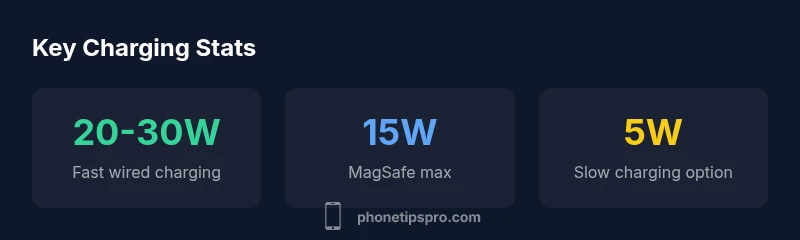
To fast-charge iPhone 14, use a USB-C Power Delivery charger of 20W or more with a USB-C to Lightning cable. Any PD charger will work; if you don't mind slower charging, a standard 5W or 10W charger will still work. Wireless charging is possible with Qi or MagSafe up to 15W.
Understanding the charging ecosystem for iPhone 14
Charging an iPhone 14 involves multiple pathways: wired charging via Lightning port, and wireless charging via Qi and MagSafe. According to Phone Tips Pro, understanding charging options helps you pick a charger that balances speed, safety, and convenience. The iPhone 14 uses a Lightning port, so you’ll typically connect via USB-C to Lightning cables when using modern USB-C PD adapters. This combination enables fast wired charging, reliable wireless options, and flexible placement for night-time or desk charging. Always consider heat generation and battery health as you decide between wired and wireless options. In daily life, most users settle into a simple rule: wired charging when you need speed, wireless or MagSafe when convenience matters. For frequent travelers, compact USB-C PD bricks paired with a short USB-C to Lightning cable reduce clutter without sacrificing speed. Battery management features built into iOS, like Optimized Battery Charging, work behind the scenes to minimize wear during long charges. If you regularly leave your iPhone on a charger overnight, enabling this feature can help safeguard longevity. Finally, acknowledge that Apple’s ecosystem continues to evolve; staying informed helps you maximize efficiency and battery health over the device’s lifespan.
Wired charging: USB-C PD and 20W+ adapters
Wired charging on the iPhone 14 relies on USB-C Power Delivery (PD) adapters paired with a USB-C to Lightning cable. A charger rated at 20W or more unlocks fast charging, often delivering a noticeable jump in charge over a 5W or 10W brick. If you upgrade to a higher wattage (30W or more), the device may charge slightly faster, but the iPhone’s internal power management will cap benefits beyond a certain point. Using PD chargers from reputable brands with USB-IF certification helps ensure safe, efficient charging. For most users, a compact 20-30W charger is a practical balance between size, heat, and speed. When shopping, check for cable compatibility and ensure the charger can sustain 2-3A at the desired wattage. Real-world results vary with cable quality, ambient temperature, and whether the phone is actively charging while in use. If you frequently use the phone while charging, consider a slightly higher wattage to help fill the battery while maintaining acceptable heat levels.
Wireless charging: MagSafe and Qi compatibility
The iPhone 14 supports Qi wireless charging and, with MagSafe accessories, can reach up to 15W when using a compatible MagSafe charger. Wireless charging offers convenience, especially for nightstands or desks without cords. For the fastest wireless experience, use an official or certified MagSafe charger. Keep in mind that charging speed depends on alignment, heat, and the charger’s power output, and casual charging sessions are perfectly fine for daily use. If your priority is neatness, MagSafe reduces cable clutter; if speed is essential, wired PD still wins. To maximize battery health, avoid letting the phone run hot during wireless charging, and consider charging in cooler environments whenever possible. Also, remember that Qi-certified wireless pads may deliver varying wattages depending on the device’s position and temperature, so plan for a little variability in charging time.
Practical buying guide: choosing a charger
When choosing a charger, consider your daily habits. If you value speed, prioritize a USB-C PD charger in the 20-30W range and a high-quality USB-C to Lightning cable. If you prefer convenience, a MagSafe setup provides wireless charging with minimal fuss. Look for certification marks (USB-IF, MFi) and avoid ultra-cheap options. For travel, a compact 20-30W USB-C PD brick with a reusable cable is a solid all-rounder. If you own multiple Apple devices, investing in a larger PD charger (30W-60W) or a multi-port charger can reduce wall clutter. Also, check that the charger supports safe charging modes and that the cable supports fast charging; older or under-rated cables may bottleneck performance.
Safety and battery health tips
To protect battery health, avoid leaving the iPhone on a hot charger or charging in hot environments. Use Optimized Battery Charging (iOS feature) to slow the charge after 80% until you need it. Regularly inspect cables for wear and replace frayed cords. If you notice unusually slow charging, verify the charger, cable, and supported wattage, and consider resetting charging accessories or consulting Apple Support. Keep software up to date; Apple occasionally tunes charging algorithms to optimize health and efficiency. For busy households, label your chargers to prevent using mismatched adapters that could push more power than the device can handle. Finally, remember that battery health gradually declines with age, so routine replacement planning is prudent as the device approaches its mid-life.
Common charger types and expected performance on iPhone 14
| Charger Type | Max Power (W) | Charging Time (0-50%) | Notes |
|---|---|---|---|
| USB-C PD charger | 20 | ≈30 min | Best wired option for fast charge |
| USB-C PD charger | 30 | ≈28 min | Faster if device supports higher wattage |
| MagSafe charger | 15 | ≈45-60 min | Wireless, convenient |
| Standard 5W charger | 5 | Several hours | Slow, not ideal for daily use |
FAQ
What charger is needed for iPhone 14 to charge quickly?
Use a USB-C PD charger of 20W or higher with a USB-C to Lightning cable. This wired option typically charges from empty to about 50% in roughly 30 minutes under normal conditions.
A 20W USB-C PD charger with a USB-C to Lightning cable is the fastest wired option for the iPhone 14.
Can I use a regular 5W charger with the iPhone 14?
Yes, but charging will be slow. For everyday use, upgrade to at least 20W PD to see faster charging.
A 5W charger will work but is slow; consider upgrading for speed.
Is MagSafe charging faster than wired charging?
Generally no; wired USB-C PD at 20W or higher is faster. MagSafe offers up to 15W but is less predictable depending on alignment and heat.
Wired charging is usually faster; MagSafe is the convenient, cable-free option.
Are third-party chargers safe for iPhone 14?
Yes, as long as the charger is USB-IF certified or Apple MFi certified. Avoid ultra-cheap non-certified options.
If it’s certified, it’s generally safe to use.
Should I buy an Apple charger or a third-party charger?
Either works. For speed, a USB-C PD charger 20W+ is common; Apple-branded options are reliable, but reputable third-party chargers also perform well.
Either brand works if it’s PD-certified.
Does charging on MagSafe affect battery health?
Heat affects battery health. Use Optimized Battery Charging and avoid prolonged heat during charging.
Heat is the main concern; keep charging cool and use battery optimization.
“A 20W USB-C PD charger is the practical baseline for iPhone 14 charging, balancing speed, heat, and efficiency. MagSafe is convenient but slower for most daily uses when compared to wired PD.”
Quick Summary
- Upgrade to a 20W USB-C PD charger for fastest wired charging.
- MagSafe offers convenient wireless charging up to 15W.
- Choose USB-C PD or MFi-certified chargers for safety.
- Keep the device cool and enable Optimized Battery Charging to protect longevity.