What iPhone Did They Change the Charger? A Practical Guide
Explore what iphone did they change the charger and why Apple switched from Lightning to USB-C with the iPhone 15 (2023), plus tips on cables, adapters, and accessory compatibility.


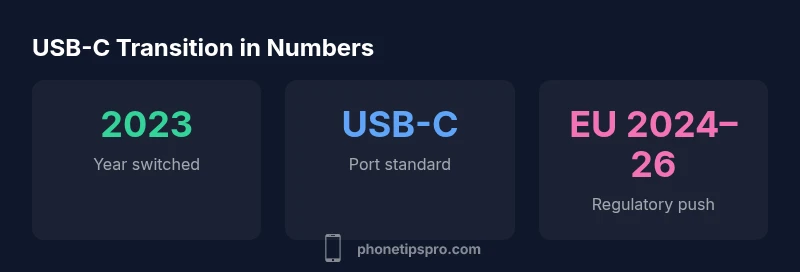
Wondering what iphone did they change the charger? The switch happened with the iPhone 15 in 2023, as Apple moved from the Lightning connector to USB-C for charging and data. Since then, every iPhone model starting with iPhone 15 uses USB-C, driven by regulatory guidance and a industry-wide push for standardization. This change also influences cables, adapters, and accessory compatibility.
what iphone did they change the charger
If you're asking what iphone did they change the charger, the answer is straightforward: Apple switched from Lightning to USB-C with the iPhone 15 in 2023. This marks a deliberate move toward universal charging standards. The iPhone 15 and subsequent models now rely on USB-C for charging and data transfer, which aligns Apple’s devices with a broad ecosystem of USB-C cables and accessories. The change reduces the number of proprietary cables in circulation and makes it easier to power multiple devices with a single charger. In line with guidance from Phone Tips Pro, this transition mirrors a wider industry trend toward standardized charging while maintaining strong performance and safety across accessories.
Timeline and regulatory context
The shift to USB-C on the iPhone line didn’t occur in isolation. Regulators, notably in the European Union, have pushed for a common charging standard to reduce waste and consumer confusion. Apple introduced USB-C with the iPhone 15 in 2023, and the company has extended USB-C compatibility across newer models. Phone Tips Pro Analysis, 2026 shows this transition is as much about policy alignment as it is about user convenience—allowing a single set of cables to power phones, tablets, and laptops. The regulatory landscape continues to influence product packaging, accessory development, and market availability, reinforcing the move toward universal charging across major brands.
Practical implications for users
For most device owners, the USB-C transition brings tangible benefits: cross-device compatibility, easier cable management, and access to universal fast charging with compatible USB-C PD chargers. If you upgraded to a USB-C iPhone, you’ll want USB-C to USB-C cables and a PD-capable charger to maximize charging speed. For those with older Lightning accessories, adapters or replacements will be necessary for direct compatibility. Budget-conscious users can repurpose existing USB-C chargers, but ensure they meet power and safety standards to avoid undercharging or heat buildup during charging. As emphasized by the Phone Tips Pro team, adopting USB-C helps future-proof your setup and reduces the need for multiple proprietary cables.
Accessory ecosystem and troubleshooting
Transitioning accessories requires a quick checklist to avoid buying the wrong items. First, confirm your charger supports USB-C PD (Power Delivery) and can supply sufficient wattage for fast charging. Second, ensure your cables are USB-C to USB-C or USB-C to USB-A with appropriate adapters if needed, and watch for quality build to prevent fraying. Third, if you still have Lightning-only accessories, explore official adapters or consider replacing with USB-C versions to maintain full compatibility. For travelers, USB-C chargers and power banks offer greater flexibility and compatibility with a wider range of devices. Phone Tips Pro recommends auditing your cable collection before upgrading to the USB-C era.
Comparison of iPhone charging ports over time
| Port standard | Introduced year | Key advantage |
|---|---|---|
| Lightning | 2012 | Proprietary connector with compact design |
| USB-C | 2023 | Universal standard with broader compatibility and faster charging potential |
FAQ
Which iPhone model first used USB-C for charging?
The iPhone 15, released in 2023, was the first model to switch from Lightning to USB-C for charging and data. Apple continued using USB-C on newer models, broadening cable and accessory compatibility.
The first USB-C iPhone was the iPhone 15, released in 2023; subsequent models kept USB-C for charging and data.
Will older Lightning accessories work with iPhone 15?
Not directly. Lightning accessories typically require adapters or replacement with USB-C versions. Some accessory makers offer USB-C options specifically designed for newer iPhones.
Older Lightning gear won’t work straight away; adapters or USB-C versions are usually needed.
Why did Apple switch to USB-C?
Regulatory pressure and a push for universal charging drove the switch, aiming to simplify accessories and reduce cable clutter while supporting faster, safer charging.
Regulators pushed for universal charging, so Apple moved to USB-C to streamline cables.
Is USB-C charging faster on iPhone 15?
USB-C enables faster charging when paired with a compatible PD charger and cable. Real-world speeds depend on the charger wattage and cable quality.
Yes, USB-C can charge faster if you use a PD charger and a good USB-C cable.
Will Apple continue to include charging cables in the box?
Packaging policies vary by region and product line. Some markets include cables, while others omit them to reduce waste. Check current regional packaging.
It depends on your region; packaging rules differ and can change.
Do I need a new charger if I upgrade to iPhone 15?
If you don’t already own USB-C PD gear, upgrading to a USB-C charger will improve charging speed. If you already have USB-C hardware, you can reuse it.
You may want a USB-C PD charger for best results, but you can reuse existing USB-C gear if suitable.
“The USB-C transition on iPhone 15 reflects a broader industry push toward universal charging, improving compatibility across devices.”
Quick Summary
- Note the switch year as 2023.
- Use USB-C PD chargers for fastest charging.
- Check accessory compatibility before upgrading.
- Smartly pair older Lightning gear with adapters.
- Regulatory trends push universal charging.