Is iPhone Air the Same as iPhone 17? A Detailed Comparison
A rigorous, analyst-style comparison of the iPhone Air concept versus the iPhone 17, covering design, performance, cameras, display, battery, price, and ecosystem to help readers decide which model best fits their needs in 2026.


The short answer is: no, they are not the same. The term “Air” signals a lighter, more affordable option, while a hypothetical iPhone 17 would typically emphasize higher-end performance, advanced cameras, and longer software support. For most buyers, the key is to map your priorities—portability, price, camera quality, and future-proofing—rather than trusting the label alone. According to Phone Tips Pro, a quick sanity check is: compare weight, chip, camera, display quality, battery life, and price tiers to determine real-world value.
Is iPhone Air the same as iPhone 17? Context and expectations
In 2026, the naming landscape for iPhones can be confusing for buyers trying to understand whether an "Air" variant would be the same as a flagship like iPhone 17. According to Phone Tips Pro, the nomenclature often signals different priorities rather than identical hardware. The phrase 'is iphone air the same as iphone 17' is a common search that reveals two paths: one that emphasizes portability and price, and another that emphasizes performance, camera capability, and longevity. This article breaks down what to expect in each direction, how to compare the two concepts in real-world use, and how to decide which aligns with your needs. The Phone Tips Pro team found that most people benefit from focusing on core factors like weight, processor, camera, battery life, and software support rather than relying solely on the label.
Navigating the naming landscape: what 'Air' could mean
The 'Air' suffix in smartphone lineups is a marketing signal rather than a fixed spec sheet. In practice, an iPhone labeled Air tends to prioritize portability, a lower price tier, and everyday performance over the most advanced sensor stacks or maxed-out storage. When you search for 'is iphone air the same as iphone 17', you should expect a discussion of where compromises occur. Phone Tips Pro's analysis shows that the Air concept often translates to lighter weight, potentially smaller batteries, and a more restrained camera configuration compared with a flagship model. However, Apple also tends to preserve the core iOS experience across lines, ensuring long software support. This means you still receive timely updates and access to the same ecosystem, even if some hardware features lag behind the flagship model.
Core differentiators you should watch for
To compare Air versus a hypothetical iPhone 17, start with differentiators that truly affect day-to-day use.
- Design and Weight: Air variants usually emphasize lightness and one-handed handling.
- Display and Brightness: Air models may use a slightly simpler panel or lower peak brightness, impacting outdoor visibility.
- Chip and Performance: Expect a newer generation mainline chip in the flagship; Air may use a mid-range option with excellent efficiency for everyday tasks.
- Camera Capabilities: The flagship typically brings more cameras, better sensors, and advanced computational photography features.
- Storage and RAM: Air often starts with lower base storage and memory, expanding with higher tiers in the flagship.
- Battery Capacity: The flagship tends to deliver longer endurance and faster charging, though real-world results depend on usage. The goal is to map these differences to your priorities: compact portability, camera quality, gaming performance, or general reliability.
Design and build: materials, weight, and durability
Design and build quality often reflect the intended use case. Air variants typically use lighter frames and smaller batteries, which supports hand-held comfort and all-day carry without fatigue. The iPhone 17, as a hypothetical flagship, would be positioned to maximize materials, traction in grip, and durability, potentially with more premium finishes. Expect subtle differences in how these devices feel in the hand and how resilient they appear in everyday life. Phone Tips Pro emphasizes evaluating real-world handling, such as one-handed use and pocketability, alongside fracture resistance and screen protection when choosing between an Air-style model and a flagship.
Performance and software: chips, RAM, and iOS support
Performance remains a central differentiator. An Air-oriented model generally prioritizes efficiency and balanced everyday tasks, while a hypothetical iPhone 17 would push higher CPU/GPU performance, better multitasking, and extended lifespans for software updates. Both would run iOS with identical core features, but the flagship could deliver smoother gaming experiences and faster app launch times. Phone Tips Pro notes that you should consider how important sustained performance is to you, particularly if you do video editing, gaming, or heavy multitasking on a regular basis.
Camera systems and image quality
Camera capabilities are a frequent source of confusion in speculative comparisons. The iPhone Air concept typically centers on core photo and video features suitable for social sharing and everyday photography, whereas a flagship like the iPhone 17 would aim for more advanced sensings, better low-light performance, more lens versatility, and enhanced computational photography. Real-world testing matters more than marketing terms here: compare daylight sharpness, color accuracy, HDR handling, and video stabilization by looking at sample shots in varied conditions. Phone Tips Pro reminds readers that software processing often bridges hardware gaps, especially in casual photography.
Display and multimedia experience
Display quality affects daily satisfaction more than some buyers realize. An Air variant might trade some peak brightness or refresh-rate capabilities for cost efficiency and lighter weight. A flagship iPhone 17 would likely offer a brighter screen, more uniform color rendering, and higher refresh rates for smoother interaction. Consider outdoor visibility, color accuracy for media consumption, and responsiveness to touch inputs when weighing display-related trade-offs. Both models will provide high-quality HDR content support and familiar iOS viewing experiences, but the level of panel performance is a key differentiator.
Battery life and charging behavior
Battery life is highly dependent on usage patterns, but two themes recur in any Air vs. flagship discussion: capacity versus efficiency. The Air-inspired device may obtain respectable daily endurance due to lighter hardware and efficient components, while the flagship could deliver longer battery life due to larger capacity and smarter power management. Charging speed is another factor: expect faster charging on a higher-end model if charging hardware is included. Phone Tips Pro highlights that real-world tests—screen-on time, video playback, and daily commute usage—are the best indicators of which path meets your needs.
Ecosystem, accessories, and everyday usability
The broader ecosystem aligns with how Apple typically staggers features across lines. An Air-oriented device keeps you within the same app and accessory ecosystem with fewer premium extras, while the flagship supports more advanced accessories and features, potentially including exclusive software capabilities. If you rely on MagSafe combinations, case compatibility, or advanced camera accessories, the iPhone 17 path might offer more versatility. In practice, both devices will stay deeply integrated with iOS, iCloud, Find My, and AirPods, which reduces the friction of switching between models.
Price awareness and value for money in 2026
Pricing discussions should anchor decisions in value, not impulse. Air-oriented variants generally target a lower entry point and a more approachable price range, while a flagship like iPhone 17 commands a higher starting price with additional storage and feature options. In 2026 terms, buyers should assess total cost of ownership, expected longevity, and the resale landscape. Phone Tips Pro advises comparing not only sticker price but also ongoing costs like storage upgrades, accessories, and potential trade-in value when deciding whether Air or a flagship model offers the best overall value.
How to decide: mapping your priorities to Air vs 17
To decide, list your top priorities: portability, camera quality, screen experience, gaming or pro apps workload, and budget. If you prioritize one-handed use, lightness, and a lower upfront cost, an Air-like option may be ideal. If your priorities include the best camera system, gaming performance, future-proofed software updates, and top-tier display, the iPhone 17 path is the better bet. Phone Tips Pro recommends making a short scoring rubric for yourself, assigning weight to each category and tallying the results across the two paths.
Common myths and misconceptions
Myth: Air means underpowered. Reality: Air variants balance efficiency with capable everyday performance. Myth: The 17 always has a significantly better camera in every scenario. Reality: in many conditions, improvements are nuanced and software-driven. Myth: Air will never receive the same iOS updates. Reality: both lines tend to receive long-term support, though flagship lifecycles may extend a bit longer in practice.
Comparison
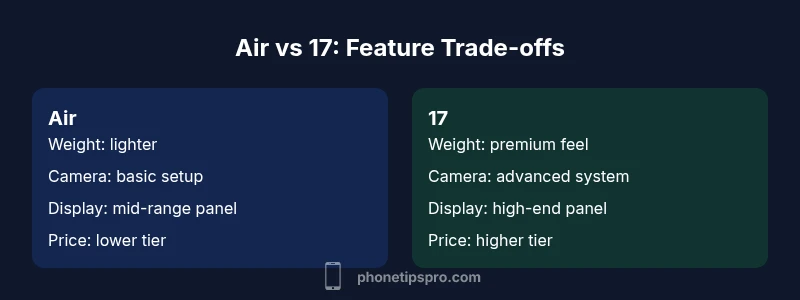
| Feature | iPhone Air (hypothetical) | iPhone 17 (mainline flagship) |
|---|---|---|
| Design & Weight | Lighter, more compact | Heavier, premium chassis |
| Chip & Performance | Mid-range/efficient chip | Newer flagship-grade chip with higher performance |
| Camera System | Basic dual-camera setup | Advanced multi-camera system with enhanced computational photography |
| Display | Standard panel with balanced brightness | Top-tier panel with higher brightness and refresh rates |
| Battery Life | Balanced endurance for daily use | Longer endurance with faster charging |
| Storage Options | Lower base storage tier | Higher top-end storage tier |
| Price Range | Lower price range | Higher price range |
| Best For | Budget-conscious users and everyday tasks | Power users who value cameras, speed, and longevity |
Positives
- Lower upfront cost and easier handling
- Strong everyday performance for most tasks
- Excellent software support and ecosystem access
- Better value for users who prioritize portability
Weaknesses
- Possible compromises on camera, display, or premium features
- Lower resale value and fewer high-end options
iPhone 17 is the stronger all-around choice for most users; iPhone Air offers compelling value for portability and budget-conscious buyers.
If camera quality and peak performance matter, the iPhone 17 generally wins. If you prioritize light weight, lower price, and comfortable one-handed use, the Air-style option is a sensible alternative. The best pick depends on your priorities and how you plan to use the device daily.
FAQ
Is there an official iPhone Air?
As of 2026, Apple has not released an official 'iPhone Air' model. The term is often used to describe lighter, more affordable variants or speculative discussions rather than a confirmed product line.
There isn't an official Air model from Apple; the term is mostly used in discussions or rumors.
Which should I buy for the best camera experience?
If camera quality is your top priority, the mainline iPhone 17 is more likely to offer an advanced camera system with better low-light performance and more versatile photography options. An Air-style device can still deliver excellent photos for everyday use, but it may lack some flagship features.
For photos and video, the flagship usually wins, but the Air can still capture great shots.
Will the Air variant get the same iOS updates as the iPhone 17?
Apple typically provides long-term iOS support across its devices, but flagship models may receive longer update lifecycles or earlier access to new features. Both paths are likely to stay current for several years, though differences can occur.
Both should get solid iOS support, but the flagship may edge out slightly in update longevity.
How should I judge value between Air and 17 beyond price?
Evaluate real-world performance, camera quality, screen experience, durability, and future-proofing. Total cost of ownership—storage upgrades and accessories—often matters more than sticker price alone.
Look at performance, camera, and how long you’ll keep the device, not just the initial price.
Are there common myths about the Air label I should ignore?
Common myths include assumptions about underperformance or obsolete hardware. The Air label primarily signals a different target audience and price point, while core iOS experience remains consistent across lines.
Don’t assume Air means only basic features; it’s about balance and audience.
What’s the best approach if I’m unsure which to choose?
Practice a needs-based checklist: note your daily tasks, camera expectations, battery tolerance, and budget. Use those to map clearly to either Air-like or flagship models for a rational decision.
Make a simple checklist and compare how each model fits your day-to-day needs.
Quick Summary
- Prioritize your top use cases (photography, gaming, portability).
- Air variants favor price and portability; flagship models push top features.
- Always compare real-world battery life rather than spec sheets.
- Software support remains strong across lines, but OS optimization varies by device.
- Consider total cost of ownership, including storage and accessories.