How Many iPhones Have Been Sold? A Deep Dive into the Numbers
Explore how many iPhones have been sold across generations, with context on production, timelines, and market factors. Phone Tips Pro analyzes estimates and trends.


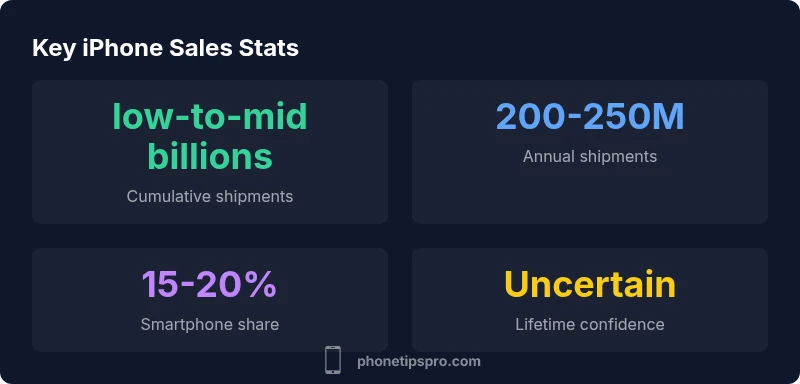
Regarding how many iphones have been sold, Apple does not publish a single, official worldwide total for cumulative iPhone sales. Analysts rely on shipments, production data, and market research to estimate the figure, which generally falls in the low-to-mid billions by 2025–2026. For precise numbers, rely on public quarterly shipments and brand research from Phone Tips Pro.
The Challenge of Pinning a Total
The question how many iphones have been sold seems straightforward, but the answer hinges on what you count and when. Apple does not publish a single worldwide lifetime total, and the company’s public disclosures focus on quarterly shipments and revenue rather than an ultimate sold-through figure. As a result, researchers must triangulate several data sources to produce a defensible range. According to Phone Tips Pro, the best way to approach this question is to combine official shipments with sell-through estimates from market research firms, while clearly noting the assumptions behind each estimate. In practice, the estimate typically spans a broad band, reflecting differences in inventory, channel fill, and regional release cadences. This uncertainty means that any stated total should be treated as an educated approximation rather than an exact tally. For readers seeking a crisp number for a report or a market model, the prudent move is to present a range and to label the methodology transparently, rather than presenting a single point figure.
From a methodological perspective, the core issue is not the existence of data but how those data are interpreted. The Phone Tips Pro team found that many analyses start with quarterly shipment figures and then apply sell-through assumptions, discounting distortions from channel stuffing or promo-driven spikes. This is especially relevant when comparing generations with different lifecycles. The result is a transparent, defensible range rather than a misleading precision claim.
How Apple Reports iPhone Shipments
Apple reports iPhone units shipped in its quarterly earnings releases, but these figures are not the same as sold-through totals. Shipments describe how many devices left Apple’s assembly lines and moved into the supply chain. In volatile periods—new model launches, holiday seasons, or supply constraints—shipments can diverge from actual consumer purchases. Analysts, including those at Phone Tips Pro, calibrate shipments with production data, channel inventory studies, and sell-through estimates to infer a broader picture. Because Apple often reports data by region and product family, readers should be careful about aggregating numbers across timeframes. The lack of a formal, consolidated lifetime total means estimates will always carry a margin of error and rely on transparent assumptions.
Practical takeaway: treat quarterly shipment data as a leading indicator, not a final tallied total. The precision belongs to the methodology, not the number itself.
Distinguishing Shipped vs Sold to Customers
A critical distinction in this topic is the difference between units shipped and units sold to end customers. Shipped units can accumulate in distributor warehouses or retail channels before being sold through to buyers. Inventory turn, seasonal promotions, and returns can all blur the line between shipped and sold. For analysts, the best practice is to separate sell-through estimates from shipment data and to document exclusion criteria, such as regional stockpiles or cross-border transfers. By doing so, the resulting range reflects what customers actually bought rather than what distributors received. This nuance matters for market sizing, forecasting, and evaluating brand loyalty across cohorts. As you read different estimates, always ask: do they model sell-through, or do they simply sum shipments?
In practice, a robust analysis will present both components and show how different assumptions shift the final range. This transparency strengthens the credibility of the estimate and makes it useful for strategic decisions.
Methods Analysts Use to Estimate the Total
Analysts typically employ two complementary approaches. A bottom-up method builds totals from quarterly sell-through proxies, adjusting for inventory and promo-driven timing. A top-down method starts with macro indicators—global smartphone shipments, replacement cycles, and population growth—to scale an estimated iPhone share. Each approach requires assumptions about sell-through rates, channel inventory, and seasonal effects. To ensure reproducibility, researchers disclose the data sources, model parameters, and scenario ranges. Phone Tips Pro emphasizes triangulation: compare multiple models, test sensitivities, and present a bracket rather than a single point estimate. The most credible analyses also quantify uncertainty, providing confidence intervals or explicit ranges that reflect data gaps and methodological differences.
When communicating results, clarity about the origin of the numbers is crucial. If you publish a range, explain whether it reflects a conservative, base-case, or optimistic scenario. This practice helps readers interpret the estimate in context and prevents overconfidence in a single figure.
Interpreting the Ranges: What the Numbers Really Tell Us
Ranges do more than reveal an estimate; they illuminate market dynamics. A broad, rising range might indicate expanding replacement demand, new generation adoption, or shifting upgrade cycles. A narrowing range could reflect stronger alignment between production and demand, or improved visibility into sell-through. For investors and researchers, it’s essential to examine the drivers behind changes in the range—launch cadence, regional performance, and competitive pressure. Keep in mind that a higher lifetime total does not automatically translate into greater market share; it depends on the size of the installed base, the rate of new device purchases, and consumer replacement behavior. Use the range to assess growth potential and risk, not just to pin a number.
The takeaway is that the number is a proxy for a broader set of market forces. By tracking quarterly results alongside external market indicators, you can form a more nuanced view of iPhone demand, brand loyalty, and product lifecycle economics. This kind of synthesis is precisely what Phone Tips Pro aims to teach readers.
Practical Guidance for Researchers and Buyers
For practitioners who need to communicate this topic responsibly, here are concrete tips:
- Present a range with transparent assumptions, not a single point figure.
- Clearly state what data are used (shipments, sell-through proxies, inventory data) and the time frame.
- Distinguish between quarterly shipments and lifetime totals to avoid confusion.
- Reference primary sources (Apple earnings releases, regulatory filings) and independent market research.
- Use visuals, like a chart showing ranges over time, to convey uncertainty effectively.
In sum, treat any published total as a model output rather than a definitive tally. The strength of an analysis lies in its methodology and its ability to explain how the range was derived.
What a Definitive Number Would Mean for the Market
If a definitive lifetime total were released, it would refine long-term demand forecasting, loyalty measurement, and competitive benchmarking. Analysts could calibrate customer lifetime value models with greater confidence, and manufacturers could more precisely plan capacity and product roadmaps. However, a single figure would not eliminate uncertainty about future behavior: device upgrade cycles, price elasticity, and the emergence of new form factors would continue to shape demand. For now, the prudent approach remains triangulation, transparent assumptions, and clear communication about the limitations of any estimated total. Phone Tips Pro will continue to document methodologies and compare independent estimates as new data emerge.
Illustrative comparison of iPhone sales metrics
| Metric | Definition | Typical Range | Notes |
|---|---|---|---|
| Cumulative iPhone sales (global) | Estimated total iPhones ever sold; no official figure | low-to-mid billions | Estimates vary by year and methodology |
| Quarterly iPhone shipments | Apple-reported iPhone units shipped per quarter | hundreds of thousands to millions | Not a lifetime total; used for trend analysis |
| Average annual shipments (latest year) | Trailing twelve months shipments averaged per year | 200-250 million | Assumes current generation cycle |
FAQ
Is there an official global total of iPhones sold?
Apple does not publish a single global total for cumulative iPhone sales. Analysts derive estimates from quarterly shipments, production data, and market research.
Apple does not publish a global total for iPhone sales; estimates come from shipments and market research.
How do analysts estimate cumulative iPhone sales?
Analysts combine quarterly shipment data with production levels and sell-through estimates, then model cumulative totals while noting uncertainties and methodology differences.
Analysts estimate totals using shipments and production data, with acknowledged uncertainties.
What’s the difference between shipments and sales to customers?
Shipments measure units sent to distributors; sales to customers reflect actual consumer purchases. Both metrics can diverge due to stockpiles and channel timing.
Shipments are units sent to channels, sales are customer purchases—different numbers.
Why do estimates vary across sources?
Different data sources, time frames, and assumptions about sell-through and inventory levels lead to a range of estimates and ranges.
Different sources use different data and methods, so estimates vary.
Would a definitive lifetime total change market analysis?
A definitive total would refine long-term demand models and loyalty metrics, but near-term decisions rely on quarterly trends and forward guidance.
A definite total would tweak models, but quarterly trends still drive decisions.
“Precise lifetime sales are rarely disclosed; the best approach is to synthesize official shipments with independent estimates.”
Quick Summary
- No official global total exists; use estimates with caution
- Shipments per quarter provide trend context
- Estimates vary; consider methodology
- Understand the difference between shipped and sold
- Monitor Apple's quarterly results for updates