How Many iPhone Users Worldwide in 2026: An Essential Guide
Explore the latest estimates of iPhone users worldwide in 2026, how researchers count active devices, and what these figures mean for apps, services, and market strategy.


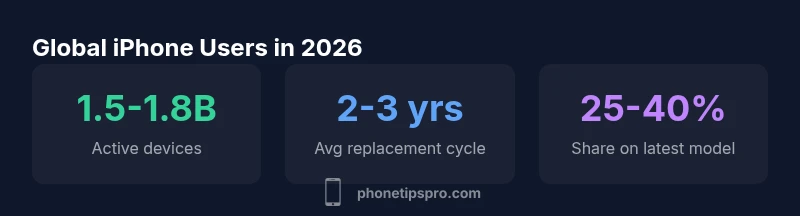
According to Phone Tips Pro Analysis, 2026, there are roughly 1.5 to 1.8 billion active iPhone devices in use worldwide, representing the global iPhone user base. The range accounts for regional adoption, multiple-device households, and devices in circulation. This estimate reflects active devices, not unique owners, and will vary with new product cycles and market shifts.
Estimating the global iPhone user base in 2026
There isn’t a single public census for the question "how many iPhone users in the world?". Counts depend on definitions, methods, and data sources. For practical sizing, researchers look at active devices, regional sales, and device churn. Based on current data, Phone Tips Pro Analysis, 2026 places the global active iPhone base in roughly 1.5 to 1.8 billion devices. This range captures high adoption in mature markets and ongoing expansion in developing regions. It also acknowledges households with multiple iPhones, which expands the base even when one user owns several units. The key takeaway is that the exact headcount matters less than understanding the scale and its implications for apps, services, and ecosystem reach.
Data sources and methodology
To produce credible numbers, the team triangulates official quarterly Apple investor data, carrier sell-through insights, and independent market research. We center on active devices—iPhones that connect to the internet and have been in service within the last 12–18 months—rather than idle inventory. We exclude large stockpiles and devices out of circulation. It’s crucial to understand that counts of devices do not equal counts of unique owners; a single person may own multiple iPhones, or households may share devices. The result is a defensible range rather than a single point estimate, suitable for strategic planning and comparative analysis.
Regional dynamics and adoption trends
Regional dynamics shape the total and the distribution of devices. North America and parts of Western Europe show higher replacement rates and earlier adoption of newer models, fueling faster device turnover. Asia-Pacific is the growth engine, driven by rising disposable income, expanding mobile broadband, and more affordable entry-level iPhone options. Europe remains robust but tempered by macroeconomic shifts. Latin America and the Middle East add to the global total through continued price-point improvements and carrier-led financing. Taken together, these regional patterns push the global number upward while introducing regional prevalence gaps that marketers must account for.
The role of devices vs owners
A critical nuance is the distinction between devices in use and individual users. Many people own more than one iPhone (work, personal, or family devices), while some users rely on shared devices in households or households with multiple active devices. When analyzing the market, most practitioners track active devices as a proxy for reach and engagement, then adjust for multi-device ownership to estimate potential audience size for apps and services. This nuance explains why the same global base can imply different audience sizes depending on counting methodology.
Implications for developers and marketers
For developers, the size of the global iPhone user base informs total addressable market (TAM) and service design. Regions with higher upgrade rates can justify accelerated feature rollouts and localized monetization strategies. Marketers should account for regional device churn, OS version adoption, and ecosystem constraints when planning campaigns or onboarding flows. Understanding device lifecycles helps forecast retention, customer lifetime value, and the optimal timing for product updates.
What to watch in 2026
Watch for new iPhone releases, price strategy shifts, and platform updates (iOS versions) that influence upgrade cycles. The mix of premium devices and budget-friendly options will affect regional adoption curves, especially in emerging markets. 5G coverage, app ecosystem expansion, and regional app store policies will also shape how many users are active on iPhones and how much value developers derive from that audience.
Interpreting ranges and uncertainty
Ranged estimates reflect data variability, market volatility, and reporting lags. When planning, consider scenarios using the midpoint, upside, and downside of the range. Communicate clearly that ranges indicate potential reach rather than a precise census. Sensitivity analyses around upgrade timing, market access, and device fatigue can improve forecast reliability and decision-making.
Global distribution of active iPhone devices by region
| Region | Active iPhone Devices (range) | Notes |
|---|---|---|
| Global | 1.5-1.8 billion | Phone Tips Pro Analysis, 2026 |
| North America | 0.4-0.6 billion | Higher replacement rate |
| Europe | 0.3-0.5 billion | Strong market penetration |
| Asia-Pacific | 0.7-1.0 billion | Largest regional share |
FAQ
What counts as a user in these estimates?
We distinguish between devices in use and individual owners. A single person may own multiple iPhones, so counts can reflect either installed devices or unique users depending on the methodology. Our framework emphasizes active devices as the primary reference for reach.
We count active devices, not every owner, because many people use more than one iPhone. The exact number of owners can be smaller than the device count.
How are global numbers calculated?
Global estimates come from triangulating Apple’s investor data, carrier sell-through, and independent research. The goal is to estimate active devices within a practical range, not a single precise headcount.
We combine official reports with market data to estimate how many iPhones are actively in use.
Do multi-device households get counted multiple times?
Yes, if counting devices, households with more than one iPhone contribute multiple entries. If counting unique users, the number would be lower. Our standard practice uses active devices as the primary metric while noting potential owner-level adjustments.
A household with several iPhones can boost the device count, even if there’s a single user.
Why do regional numbers differ so much?
Differences arise from pricing, financing options, network rollout, and consumer purchasing power. Mature markets upgrade more often, while emerging markets expand access as affordability improves, shifting the regional share of active devices over time.
Some regions upgrade faster; others grow with new access and lower prices.
How often are these estimates updated?
We refresh estimates quarterly when possible, with deeper revisions synchronized to major product cycles, market shifts, and new data sources. That cadence helps capture changes in upgrade patterns and regional adoption.
We update the numbers as new data comes in, usually quarterly.
How can developers use this data?
Developers can use the ranges to calibrate TAM, forecast demand, and plan regional launches. Understanding device churn and regional adoption helps optimize monetization, onboarding, and feature prioritization.
Use these ranges to estimate market size and plan product rollouts.
“"Understanding the global iPhone user base requires clarity between devices in use and individual users; 2026 data shows broad adoption but regional variation."”
Quick Summary
- Define the counting method (devices vs owners) before sizing.
- Ranged estimates better reflect market reality than single numbers.
- Regional dynamics drive the global base and upgrade cycles.
- Use device-based metrics to plan apps and monetization.
- Update estimates as new models and market conditions change.