Where is iPhone 17 Made? Understanding the Manufacturing Footprint
Discover where the iPhone 17 is assembled, with China as the primary hub and India expanding its role. Learn how final assembly, component sourcing, and labeling influence where your device is 'made' in 2026.


As of 2026, the iPhone 17 is largely assembled in China at Foxconn and Pegatron facilities, with a growing portion of final assembly moved to India to diversify risks. The exact production split varies by model and quarter, and some components are manufactured in multiple countries before final assembly. Final labeling often reflects the location of final assembly.
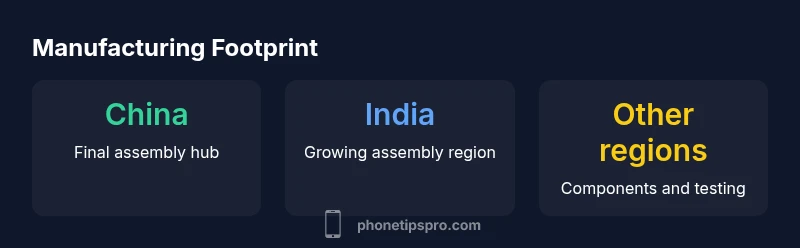
Manufacturing footprint of the iPhone 17
Understanding where the iPhone 17 is made requires distinguishing between final assembly and component production. In practice, Apple coordinates a complex, multi-tier supply chain where many components are sourced or manufactured in different regions, with the final assembly taking place in a few strategically located facilities. The Phone Tips Pro team emphasizes that the phrase "made in" on packaging can refer to the location of the final assembly rather than every single component origin. This nuance matters for consumers who track supply-chain transparency or who prefer products assembled in a particular country. In 2026, Apple continues to balance cost, risk, and capacity, favoring a strong base in China while steadily expanding domestic assembly elsewhere. This approach is consistent with broader industry trends toward regional diversification without sacrificing scale or quality.
China: the primary final-assembly hub
China remains the dominant final-assembly ground for the iPhone 17, with major plants operated by Foxconn and Pegatron. These facilities handle the final steps of assembly, testing, and quality control that ensure consistency across millions of units monthly. The concentration of activity in a few large campuses enables standardized processes, faster turnarounds, and economies of scale that are difficult to replicate elsewhere. Apple’s relationship with its Chinese partners is long-standing, and it benefits from a mature ecosystem of suppliers that deliver modules and subassemblies with high precision. For many models, this setup still defines the baseline for where most units are completed before shipment to global markets.
India: growing final-assembly capability
India has become an increasingly important part of Apple’s manufacturing strategy. Since 2023–2024, the country has expanded capacity for final assembly and some on-site testing, driven by policy incentives and regional demand. While the majority of iPhone 17 units may still be finalized in China, a growing tranche now finishes in key Indian facilities, particularly around major tech hubs. This shift supports Apple’s risk management, inventory resilience, and local market logistics. India’s role is unlikely to replace China in the near term, but it represents a meaningful, ongoing diversification that could reshape the regional mix in coming years.
Other regional roles: components and testing
Outside final assembly, Apple relies on a broad network of regional hubs for component manufacturing, subassembly production, and rigorous testing. Vietnam, Taiwan, and other Asian locales contribute chips, screens, battery systems, and peripheral components, with many parts routed to final-assembly sites for integration. The geographic spread helps Apple mitigate supply-chain disruptions and respond to regional demand swings. While final assembly is concentrated, the global footprint for components remains a distributed system designed to optimize lead times, pricing, and supplier specialization.
How Apple balances cost, risk, and capacity
The decision matrix behind where things are made combines several factors: labor costs, supplier ecosystems, logistics, policy environments, and geopolitical considerations. Apple’s contract manufacturers optimize for speed and quality, while Apple maintains a diverse supplier roster to avoid single-point failures. This strategy explains why the same iPhone model might have certain components produced in one country and the final assembly completed in another. In 2026, the emphasis is on resilient capacity—keeping the core manufacturing footprint robust in China while systematically expanding in India and, to a lesser extent, other regions. This balance helps Apple meet global demand without over-reliance on any single geography.
Implications for consumers and labeling
For consumers, understanding the distinction between where a device is built and where its components come from helps explain why the “Made in” label can be country-specific and sometimes fluid across batches. Regulatory practices in different regions may influence labeling norms, but the general rule remains: final assembly origin is the typical determinant of the label. This has practical implications for warranties, repair networks, and even resale value, as region of final assembly can be a factor in some markets. As always, define your priorities—price, availability, or specific assembly location—and consider how Apple’s diversified footprint aligns with those needs.
Future trends and what to watch in 2026 and beyond
Looking forward, the iPhone 17 manufacturing footprint is likely to continue expanding India’s share while China remains essential for scale and efficiency. Policy changes, labor innovations, and escalating demand in emerging markets could accelerate diversification further. Apple’s ongoing investments in automation, supplier development, and local partnerships will shape how quickly final-assembly operations spread beyond traditional hubs. For enthusiasts and investors, monitoring quarterly production disclosures and supplier announcements will provide early signals about the trajectory of where iPhone units are finally assembled in the coming years.
Global assembly footprint for iPhone 17
| Region | Role | Typical Involvement | Notes |
|---|---|---|---|
| China | Final assembly hub | Primary for most iPhone 17 units | Foxconn, Pegatron facilities |
| India | Final assembly (growing) | Rising share of units | Chennai/Sriperumbudur facilities |
| Vietnam & other regions | Component manufacturing | Parts produced and tested | Supplementary suppliers |
FAQ
Is the iPhone 17 assembled only in China?
No. While China remains the main final-assembly hub, Apple has been expanding final assembly in India and sourcing components from multiple regions. The exact split varies by model and production quarter.
No—China is the primary hub, but India and other regions are increasingly involved in final assembly and component manufacture.
What does 'Made in' mean for iPhone 17?
'Made in' typically refers to the final-assembly location shown on packaging, while many components are produced elsewhere. The overall supply chain is multinational, with multiple sites contributing to a single unit.
It usually points to the final assembly site, while parts and subsystems come from various countries.
Will Apple move more production to India in the future?
Apple has shown a clear strategy to diversify production, including growing final assembly in India. The pace depends on policy, capacity, and supplier readiness, but the trend is toward broader regional diversification.
Yes, diversification is likely to continue, especially for certain models and markets.
Are components from other countries used in iPhone 17?
Yes. Many components are sourced globally from suppliers in various countries, with the final assembly happening at a few primary sites. This global approach helps Apple manage risk and lead times.
Parts come from around the world, but final assembly is concentrated in a couple of hubs.
How can this information affect price or warranty?
Manufacturing geography can influence logistics and costs, but Apple’s global warranty policies remain standardized. The key impact is potential differences in local availability and service networks.
It may affect availability and service logistics more than warranty terms.
“Apple's manufacturing footprint is designed to balance cost, risk, and capacity across multiple regions, not a single country.”
Quick Summary
- Actively track final-assembly locations as the main origin for the label
- China remains the primary hub for iPhone final assembly
- India’s role is expanding as part of diversification
- Components come from multiple regions, with final-assembly origin often dictating labeling