Which iPhone Should I Get? A Practical 2026 Guide
Analytical guide comparing iPhone models in 2026 to help you decide which iPhone to buy, with clear criteria, real‑world scenarios, and a step‑by‑step decision framework.


Which iPhone should I get? In 2026, the best pick depends on budget, intended use, and how much you value speed, camera, and longevity. For most buyers, the mid‑range model delivers the strongest overall value. The Pro line is ideal for power users who want top‑tier cameras and performance, while the base model suits tight budgets. Use this guide to map your priorities to a model.
What factors influence the choice when you ask which iphone should i get
Choosing between iPhone models isn’t only about the newest hardware. It’s about how you’ll use your phone today and how long you want it to stay current. If you’re asking which iphone should i get, start with three practical questions: what’s your budget, which tasks consume most of your time, and how important is future‑proofing—updates, cameras, and features—for you. According to Phone Tips Pro, the most effective approach is a three‑tier framework: base models for everyday tasks, mid‑range models for stronger performance, and Pro models for power users. The Phone Tips Pro team found that, for most buyers, balance—price with capability—outweighs chasing every new feature. Consider storage needs, battery life, and ecosystem commitments (Apple Watch, AirPods, iPad) since these shapes long‑term satisfaction. In the end, the question isn’t “which iPhone is best?” but “which iPhone should I get given my priorities, budget, and timeline?”
Your decision also hinges on how long you plan to keep the device. If longevity of updates matters, you’ll likely prefer newer base or mid‑range models that will receive software support for years. If camera performance drives your daily use, a Pro model starts to justify its premium. Storage decisions matter too: more onboard storage reduces the need for frequent cloud purchases. Finally, don’t overlook the broader ecosystem, because seamless integration with accessories can add real value over time. This framework, rooted in practical decision making, helps you avoid buyer’s remorse and aligns your pick with your real needs.
blockTitleOverride":null}
Understanding the three tiers: base, mid-range, and Pro models
When you map out options for which iPhone to get, you’ll typically encounter three tiers: base, mid‑range, and Pro. The base models focus on core functionality—smooth iOS performance for everyday tasks, adequate cameras, and reliable durability at a friendlier price. Mid‑range models add improvements in display quality, camera versatility, and processor performance, offering a balanced mix of speed and features. Pro models push the envelope with advanced photography and video capabilities, higher‑quality materials, and features like more flexible display tech and enhanced performance headroom. The key trade‑offs are price, performance delta, and feature depth. For many people, the mid‑range option delivers the strongest overall value, while the Pro line is ideal for enthusiasts and professionals who rely on top‑tier photography, video workflows, or demanding apps. If you’re budget‑conscious or want a simple device with long software support, the base model remains a compelling choice. Remember, the right tier is determined by your priorities, not by trend alone. Phone Tips Pro’s guidance emphasizes matching your real needs to the tier that best meets them, rather than chasing the latest release.
blockTitleOverride":null}
Budgeting, storage decisions, and trade‑ins
Budgeting for which iPhone to get means weighing upfront cost against long‑term value. Storage level often influences the total cost of ownership more than you might expect, since larger onboard storage reduces the need for expensive cloud plans and prevents throttling when you capture lots of high‑quality media. If you’re deciding between models, simulate your annual costs with and without extra storage, taking into account typical app sizes and photo libraries. Trade‑in programs can significantly reduce the upfront price, making a higher tier more accessible without overspending. Likewise, consider resale value and platform longevity; iPhones tend to retain value longer than many rivals, which can improve the effective cost of ownership over time. Phone Tips Pro analyses suggest that buyers who couple a reasonable upfront price with a solid storage plan and a favorable trade‑in condition often end up with better total value over the lifespan of the device. In short, don’t focus solely on sticker price—evaluate total cost of ownership, ongoing expenses, and how soon you expect to upgrade again.
blockTitleOverride":null}
Real‑world usage scenarios: students, professionals, families
Scenario planning helps answer which iPhone should i get in practical terms. A student on a tight budget might prioritize battery life and essential features, choosing a base or mid‑range model with enough storage for coursework and media. A professional who relies on photography, video editing, or professional apps may lean toward the Pro tier for its advanced camera capabilities and performance headroom. A family user might value durability, battery longevity, and broad accessory compatibility, favoring a model that balances price with robust everyday use. Across these scenarios, your decision should reflect how much you value camera quality, display smoothness, processing speed, and ecosystem integration. In every case, the choice should also consider future software updates and the practicality of upgrading in 2–3 years. Phone Tips Pro’s analysis highlights that most buyers are best served by selecting the tier that aligns with their most frequent tasks and long‑term needs rather than temporary trends.
blockTitleOverride":null}
How to read the specs in plain language
Spec sheets can be intimidating, but translating them into practical implications makes the decision clearer. Instead of chasing numbers you don’t use daily, focus on: performance headroom (how fast apps feel when multitasking), camera versatility (ultra‑wide, portrait, computational photography), display quality (brightness, color accuracy, refresh rate), and battery endurance (how many hours of mixed use you can expect). For photography enthusiasts, pay attention to sensor quality, low‑light capabilities, and video features; for casual users, a reliable camera system and smooth everyday performance matter most. Don’t confuse megapixels with image quality—modern iPhone cameras are designed to maximize computational photography with more meaningful improvements in Pro and mid‑range models. Also, consider software longevity: a newer model typically earns more years of updates, extending its usefulness. Throughout, reference the three‑tier framework to ensure your interpretation of specs maps to a real‑world benefit, not just a number on a spec sheet. This approach helps you answer which iPhone should i get with confidence and clarity.
Phone Tips Pro notes that update cadence and feature parity across generations influence long‑term value, so prioritize a model that can stay current longer rather than chasing the newest headline feature.
blockTitleOverride":null}
A practical decision framework you can use today
Here is a concrete, repeatable framework to decide which iPhone to get. Step 1: list your top three must‑haves (e.g., camera, battery, price). Step 2: assign a budget range and a desired upgrade cadence (how often you want to replace the device). Step 3: choose the tier that best meets those must‑haves—base for essential use, mid‑range for balance, Pro for maximum capability. Step 4: estimate storage needs based on your photo and video habits, apps, and cloud usage. Step 5: check trade‑in options and bundle deals that could tilt the decision in favor of a higher tier. Step 6: verify software longevity expectations—new models usually receive updates longer, which matters for long‑term value. Finally, validate your choice with a risk check: if you’re unsure, pick the mid‑range and reserve the option to upgrade later when your workflow demands it. This structured approach makes the process transparent and removes guesswork from the decision about which iPhone should i get. Phone Tips Pro’s framework emphasizes practical evaluation over hype, so you’re confident in your choice today and years from now.
blockTitleOverride":null}
Brand perspective and user feedback
From a brand perspective, Apple’s ecosystem advantages—watch, AirPods, and seamless continuity—often justify staying within the iPhone family. The Phone Tips Pro team emphasizes that the best model for most users remains the one that aligns with daily needs, price tolerance, and long‑term software support. Feedback from users across the spectrum indicates that mid‑range models typically offer the strongest balance of speed, camera versatility, and cost efficiency, while Pro models shine for those who routinely use high‑end imaging tools. The trend in 2026 points to a continued emphasis on long‑term software updates and camera improvements that keep mid‑range devices compelling choices for everyday users, with Pro models serving niche demands for advanced photography and professional workflows. The Phone Tips Pro analysis highlights that staying within the ecosystem and selecting a model with ample storage and robust battery life matters more than chasing every new headline feature.
blockTitleOverride":null}
Feature Comparison
| Feature | iPhone 16 Pro | iPhone 16 | iPhone 15 | |||
|---|---|---|---|---|---|---|
| Display & camera capabilities | Premium display, advanced camera features, top‑tier versatility | Strong display and camera improvements with solid daily performance | Reliable camera system and familiar comfort with good all‑round use | |||
| Performance headroom | Latest‑generation silicon with maximum headroom for apps | Strong performance with balanced efficiency | Solid performance for everyday apps and casual power users | |||
| Storage options | Higher storage tiers available; best for media creation | Moderate storage with room for apps and media | Base storage plus expandability via cloud options | Best For | [ | |
| Battery life | Longest endurance with high‑efficiency charging | Very good endurance for typical use | Reliable day‑to‑day battery with moderate charging needs | |||
| Price range | high | mid | low |
Positives
- Clear tiered pricing and feature mapping
- Excellent long‑term software support and ecosystem
- Strong resale value and broad accessory compatibility
Weaknesses
- Premium models can be expensive relative to gained features
- Storage options may push you toward higher tiers or cloud costs
- Base models may feel underpowered for demanding apps
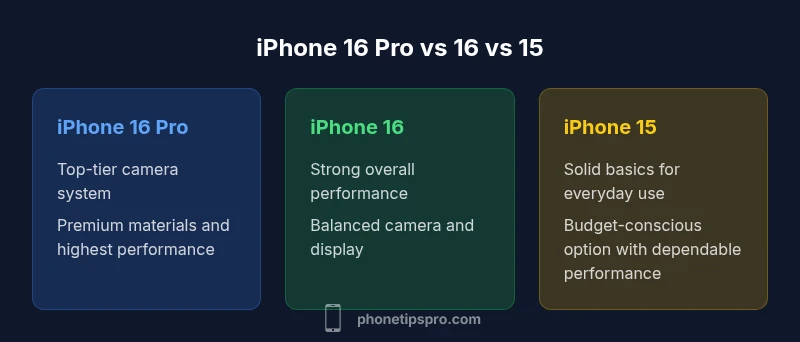
iPhone 16 offers the best balance for most users; Pro models are for power users, and base models suit tight budgets.
Choose iPhone 16 for everyday performance at a strong value. Opt for the Pro if you need top‑tier cameras and maximum headroom. If cost is the primary constraint, the base model remains a solid, long‑lasting option with generous software support.
FAQ
Which iPhone is best for photography?
Pro models generally offer the strongest photography capabilities, including advanced sensors and computational features. For casual photographers, the regular or mid‑range models still produce excellent results. Your choice should depend on how seriously you pursue imaging and whether you need professional‑level tools.
Pro models usually give you the best cameras; for casual photography, a mid‑range option is typically enough.
Is it worth upgrading from iPhone 15 to 16?
If you value faster performance, improved cameras, and newer features, the upgrade is reasonable. If your current phone meets your daily needs and you won’t benefit from higher specs, it may be better to wait or focus on storage and battery improvements instead.
If you want noticeably better speed and camera features, upgrading makes sense; otherwise, you can wait.
Should I buy now or wait for the next release?
Unless you need a phone immediately, waiting for the next release can pay off in price drops and new features. If your current device is functioning well, plan your purchase around your budget and desired upgrades rather than chasing every launch.
If you’re not rushed, waiting can pay off with newer features and better deals.
How long do iPhones get updates?
Apple typically supports iPhones with iOS updates for several years, providing security patches and new features. As models age, the frequency of updates can decrease, but you still get meaningful software support for many years.
iPhones usually receive updates for many years, giving you long‑term value.
What storage size should I choose?
Choose storage based on your media habits and cloud reliance. If you store many photos and apps locally, select more onboard storage to avoid frequent cloud purchases, while lighter users can opt for smaller tiers and rely on cloud backups.
Think about your photos and apps size—more storage means less cloud dependency.
Do trade‑in programs really lower the price?
Trade‑ins can substantially reduce the upfront cost, effectively lowering the price of a higher‑tier model. Check current offers and consider the timing of sales events to maximize the discount.
Trade‑ins can make higher‑tier models affordable; compare offers to get the best deal.
Quick Summary
- Define your budget first to narrow options
- Mid-range models often deliver the best value for most users
- Pro models excel for photography and performance tasks
- Factor storage needs and cloud costs into the total price
- Utilize trade‑ins to offset upfront costs