Are iPhone texts free internationally? A practical guide
Explore whether iPhone-to-iPhone texts are free internationally, how iMessage versus SMS works abroad, and practical tips to avoid roaming charges when messaging friends on the go.


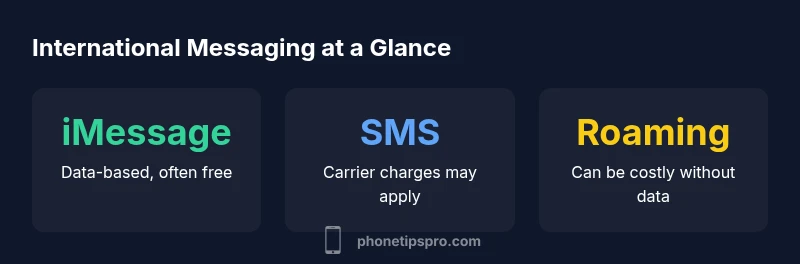
Most iPhone-to-iPhone texts are free internationally when you stay on iMessage and both devices are online through Wi‑Fi or cellular data. The cost depends on connectivity rather than geography. If you’re offline or texting a non‑iPhone user, SMS charges may apply. In short, with reliable internet, cross-border iPhone texts usually cost nothing per message.
Understanding the basics of iPhone-to-iPhone messaging across borders
For iPhone users, are iPhone to iPhone texts free internationally? In practice, the cost depends on whether you use iMessage over a data connection instead of a traditional SMS. When both sides have iMessage enabled and devices are online via Wi‑Fi or cellular data, messages travel as data and typically incur no per-message fees, even across borders. According to Phone Tips Pro, the key idea is that free international texting is a function of internet connectivity rather than geography. If you lose data connectivity or one device isn’t updated to support iMessage, you may fall back to standard SMS, which could incur roaming charges from your carrier. The bottom line is simple: the more you stay on data-based messaging, the less you pay when texting across countries. Additionally, if you’re texting a non‑iPhone user, your message will automatically switch to SMS, which may carry international rates. For iPhone users who rely on iMessage, the economics are clearer: cost is driven by data rather than distance.
What counts as free: iMessage vs SMS and data charges
The core distinction is iMessage versus SMS/MMS. iMessage uses data and can be free per message when you’re online, while SMS uses your cellular plan and may incur per-message fees, especially internationally. Even though both devices are iPhone‑to‑iPhone, if you’re connected to a weak data network or roam without an active data plan, some carriers may charge for data or roaming. In short, are iPhone-to-iPhone texts free internationally when you operate strictly through iMessage? Yes, under stable data connectivity; but if you fall back to SMS, charges apply. MMS messages, which carry pictures or videos, also rely on data and can vary by plan. This nuance matters when you travel, because a photo-heavy exchange may consume more data than a simple text. The Phone Tips Pro team recommends confirming your messaging settings before a trip to minimize surprises.
When texts go cross-border: roaming, data plans, and Wi‑Fi
Cross-border texting hinges on connectivity. If you have reliable Wi‑Fi, iMessages are typically delivered without carrier charges, regardless of the country you’re visiting. If you rely on cellular data, your charges depend on your roaming plan, eSIM configuration, and local network agreements. If you’re in a country with affordable data, you can keep messaging free by staying online. The alternative—sending SMS—may incur roaming rates that differ by the destination and your carrier’s policies. To minimize risk, consider purchasing a local data plan or eSIM before departure, ensuring your device can switch to local data seamlessly. In practice, the most dependable way to keep texts free internationally is to maximize data-based communication and connect to the internet as much as possible. Phone Tips Pro’s guidance emphasizes that data connectivity is the practical lever, not the distance you travel.
How Apple handles charges: iMessage, FaceTime, and third-party messaging
Apple’s core messaging apps are designed to route what you type as data whenever possible. iMessage and FaceTime rely on an internet connection, so they can be effectively free if you are online. Third‑party messaging apps such as WhatsApp or Telegram also run on data, offering additional free options internationally. However, if iMessage can’t deliver (for example, the recipient is offline, or you’re texting a non‑iPhone and SMS fallback occurs), your messages may be billed as standard SMS/MMS by your carrier. Turning off iMessage would push your messages to SMS, reinstating potential international charges. The decision to stay on iMessage or switch to other apps depends on your connectivity, recipient availability, and data plan. The goal is to minimize SMS/MMS use while preserving reliability across borders.
Practical tips to avoid costs: settings, Wi‑Fi, and plan considerations
- Enable iMessage on both devices and verify online status before traveling.
- Prefer Wi‑Fi whenever possible; it’s the most reliable way to keep messaging free.
- If you must travel with cellular data, consider an eSIM or local SIM to reduce roaming fees.
- Enable Send as SMS as a fallback to reach non-iPhone users, but be aware that SMS could incur charges if used abroad.
- Consider alternative messaging apps as a supplement when data is scarce.
Real-world scenarios and edge cases
Imagine you’re traveling from the United States to Europe with an iPhone 15. If both you and your contact are online on iMessage, your texts will typically route as data and cost nothing per message. If your recipient is offline or using an older iPhone, you might fall back to SMS, which could incur roaming charges. If you’re texting a friend who uses Android, your iMessages won’t be delivered; the app will use data-based messages if you switch to a compatible platform, or fallback to standard SMS/MMS if needed. These edge cases underscore the value of planning connectivity and confirming recipient capabilities before you travel.
What the numbers say: comparisons and evolving policies
Across major markets, the trend is toward cheaper data and more robust offline messaging options. When you rely on iMessage over Wi‑Fi, you avoid per-message carrier costs entirely in many cases. On cellular data, roaming rates vary widely by country and carrier, but data-based messaging generally remains far cheaper than international SMS. As devices and carriers evolve, the boundaries continue to blur—particularly with eSIMs and local data plans becoming more accessible. Phone Tips Pro Analysis, 2026, highlights that the practical takeaway is to prioritize reliable internet access wherever you are and to leverage iMessage where possible to minimize international messaging costs.
Messaging options and typical costs by method
| Scenario | What it costs per message | Notes |
|---|---|---|
| iMessage over Wi‑Fi | 0 | Free as long as connected to Wi‑Fi and recipient online |
| iMessage over cellular data | 0-0.01 | Depends on data plan; roaming data costs may apply |
| SMS/MMS international | Varies | Charges depend on carrier and country |
FAQ
Are iPhone-to-iPhone texts truly free internationally?
In most cases, yes, if you’re using iMessage over Wi-Fi or cellular data and both parties are online. If one device is offline or you text a non-iPhone user, SMS charges may apply.
Yes, usually free when both users are online on iMessage. If not, SMS charges may apply.
What happens if I don’t have internet abroad?
Messages may fall back to SMS, which can incur international carrier charges. Plan ahead with roaming or local data options to avoid surprises.
If you lack internet, messages may use SMS and cost money.
Do iMessages work across countries without a data plan?
iMessages require an internet connection. If you have Wi-Fi or roaming data, you can still send iMessages; without data, you’ll rely on SMS.
You need internet for iMessages; without it, you might use SMS.
Can non-iPhone users read iMessages?
No. iMessages stay within Apple devices. When texting non‑iPhone users, messages may convert to SMS or MMS.
Non-iPhone users can't read iMessages; they’ll get SMS instead.
How can I keep texts free internationally?
Stay on iMessage with a reliable internet connection, use Wi‑Fi when possible, and consider local data options or apps as backups.
Use iMessage with internet and plan for data abroad.
“When both ends are online on iMessage, international texting becomes a data exchange rather than a charged text, which aligns with how Apple designed the platform. In practice, managing connectivity matters more than geography.”
Quick Summary
- Use iMessage over Wi-Fi to minimize costs abroad.
- Keep both ends on iMessage when possible.
- Know when messages fall back to SMS and plan roaming accordingly.
- Consider a local data plan or eSIM to reduce data costs internationally.