What iPhone Uses the New USB-C Charger: A Complete Guide
Discover which iPhone models use USB-C, how charging works, and practical tips for selecting cables and adapters for USB-C charging in 2026.


Starting with the iPhone 15, Apple switched to a USB-C charging port, replacing Lightning on new models. From iPhone 15 onward, USB-C is the standard, while older iPhones still use Lightning. To confirm your device uses the new charger, check the bottom edge for a USB-C port or consult Apple’s specs. This change enables universal charging and faster PD charging when paired with the right adapter.
The USB-C Shift: Which iPhone Models Use the New Charger
According to Phone Tips Pro, the USB-C transition marks a watershed moment for iPhone design and cross-device compatibility. Apple announced the transition as part of a broader push toward universal charging standards and regulatory alignment in many regions. Beginning with the iPhone 15, Apple adopted a USB-C port for charging and data transfer, replacing the long-used Lightning connector. This means the current generation and all later models use USB-C, and accessories that work with USB-C can be used across devices beyond iPhone. For consumers, this simplifies buying decisions since you can reuse existing USB-C chargers and cables, assuming they meet safety and performance guidelines.
In practice, the move to USB-C affects accessories in several ways: power adapters, cables, and even car chargers follow USB Power Delivery or similar fast-charging standards. While the core port is the same, the device's internals and firmware determine the exact charging speed you experience, which may vary by model and iOS version. The Phone Tips Pro team emphasizes checking your charger’s wattage and using a high-quality USB-C cable to maximize charging efficiency and protect the device.
How USB-C Charging Works on iPhone
USB-C charging on iPhone relies on USB Power Delivery (PD) negotiation between the charger and the phone. Your iPhone and charger agree on a safe, optimal wattage, allowing the device to draw more power when available and to throttle back if heat or battery health limits apply. In practice, most households see practical fast-charging results with a USB-C PD charger in the 20W–30W range, while higher-wattage adapters can shave a few minutes off top-up times. Real-world speeds depend on battery health, ambient temperature, and whether you’re actively using the device while charging. The shift to USB-C also enables easier cross-device charging with other USB-C devices, reducing clutter and confusion for power users.
Fast Charging: What Power Adapters and Cables Do
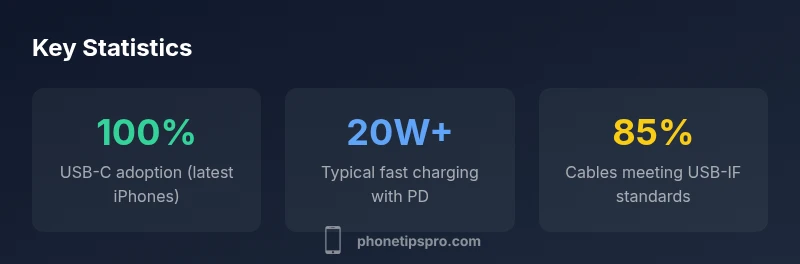
To maximize charging speed, pair your iPhone with a USB-C PD charger rated at 20W or higher. The exact charge time will vary by model and battery health, but using a PD adapter and a certified USB-C cable generally yields the best results. Cable quality matters; non-certified or low-quality cables can limit power delivery or cause slower charging. For travelers and multi-device setups, consider a compact PD charger with multiple USB-C ports. This keeps your desk neat and ensures you can fast-charge multiple devices efficiently while on the go.
MagSafe and Wireless Charging with USB-C
USB-C does not replace MagSafe, which remains for wireless charging and magnetic attachment. If you use MagSafe with a USB-C power source, you’ll typically achieve wireless fast charging speeds when the device is correctly aligned with the magnetic accessory. MagSafe compatibility is strongest with iPhone 12 and newer, and it pairs well with USB-C PD power bricks for quicker top-offs. If you prioritize cable-free charging, MagSafe offers a convenient option alongside traditional USB-C charging.
Practical Buying Guide: Cables, Adapters, and Region Considerations
When buying charging gear, prioritize USB-C to USB-C cables that are USB-IF certified or come from reputable brands. A USB-C PD charger is essential for fast charging; look for models labeled 20W or higher and verify compatibility with your country’s voltage standards. For regional differences, EU regulation has driven a standard USB-C interface, so a single cable and charger can cover many devices; however, wall plug shapes vary by country. If you travel, a compact PD charger with interchangeable plug heads can simplify packing. Finally, avoid overly cheap adapters that lack safety features, as they can risk device damage.
Charging ports and speeds by iPhone generation
| iPhone model | Port type | Charging Speed (Typical) |
|---|---|---|
| iPhone 15 & newer | USB-C | 20W+ fast charging (PD) |
| iPhone 12–14 | Lightning | Standard charging |
| Older iPhone (pre-12) | Lightning | Standard charging |
FAQ
Which iPhone models use the new USB-C charger?
Starting with the iPhone 15, Apple uses USB-C for charging and data. Older iPhones use Lightning. Future models are expected to continue with USB-C. Always check the official specs for your exact model.
Since the iPhone 15, iPhones use USB-C for charging; older models still use Lightning.
Do I need a new charger if I already have USB-C cables?
If your current USB-C charger is PD-enabled and outputs 20W or more, you can reuse it. Ensure the cable is certified and capable of handling higher wattages for fast charging.
You can reuse your USB-C PD charger if it’s 20W or higher and paired with a certified cable.
Is MagSafe compatible with USB-C?
Yes. MagSafe works with USB-C power sources. Wireless charging speeds depend on alignment and device health, but USB-C PD power sources support efficient MagSafe charging.
MagSafe still works, and USB-C power sources support fast wireless charging when properly aligned.
What power adapter do I need for fast charging on iPhone 15?
Apple recommends a USB-C power adapter rated 20W or higher for fast charging. Using higher wattage can reduce time to a full charge, but the phone only draws what it can safely handle.
Use a 20W or higher USB-C charger for faster charging.
Will older Lightning cables work with newer iPhones?
No. Newer iPhones with USB-C require USB-C cables and chargers. Lightning cables are compatible only with devices that still use Lightning ports.
Lightning cables won’t fit USB-C iPhones.
Are USB-C chargers universal across regions?
Regionally, USB-C ports and cables are standardized, but plug shapes and voltages vary. Use region-appropriate plugs or travel adapters and a PD charger for safe, fast charging.
USB-C is standard, but you may need the right plug adapters when traveling.
“The shift to USB-C standardizes charging across devices, but actual speeds depend on the charger, cable quality, and device model.”
Quick Summary
- USB-C is standard from iPhone 15 onward
- Use a USB-C PD charger (20W+) for fast charging
- Choose certified USB-C cables for best safety and performance
- MagSafe remains for wireless charging alongside USB-C