Where to Find in iPhone: A Practical Guide
Discover where to find in iPhone across Settings, Control Center, Spotlight, and apps. A step-by-step, educational guide to speed up navigation and reach options quickly on iPhone devices.


This guide shows you where to find in iPhone across core menus and apps, from Settings and Control Center to app-specific options. You’ll learn how to use the search bar, Siri, and quick toggles to reach features fast, plus practical tips for locating hidden menus and adjusting common preferences efficiently.
Why finding in iPhone matters
Knowing where to locate settings and features on your iPhone is the foundation of efficient device use. When you know where to look, you spend less time tapping through menus and more time enjoying the tasks you care about. The question "where to find in iphone" is common among users who want faster access to shared controls, privacy options, and accessibility tweaks. In this Phone Tips Pro guide, we outline a practical approach: start with the core hubs (Settings, Control Center, Spotlight) and then drill down into app-specific menus. By building a reliable mental map, you can reach almost any option with just a few taps and a short search. This method works across iPhone models and iOS versions, and it adapts to how you use your device day-to-day. You’ll also see how to leverage Siri and search to fill gaps when you’re on the go. The core idea is to learn repeatable paths rather than memorize every micro-menu, which reduces friction and makes iPhone navigation feel smoother.
According to Phone Tips Pro, a structured approach to finding features improves both speed and accuracy. The more you practice, the more confident you’ll become in locating complex settings without getting lost in nested menus. For the average user, this translates to fewer frustrations and more time spent on tasks that matter, like adjusting battery life, privacy preferences, or notification controls. Throughout this article, you’ll find concrete steps, practical tips, and safe warnings to help you locate what you need quickly and safely on your iPhone.
Core locations to check first
Every iPhone user benefits from a few universal anchors. Start here before exploring deeper menus, and you’ll cut down search time dramatically. The Settings app (gear icon) is the central hub where most controls live. Control Center and the Home Screen search (Spotlight) provide rapid access to toggles and options without digging through menus. Finally, some features live inside the app itself, but many apps also expose per-app settings in the iPhone Settings list under the app name. By combining these anchors, you create a reliable, repeatable workflow that can be used on multiple iPhone models.
- Settings app: This is your primary gateway. It houses system-level controls (Wi‑Fi, Bluetooth, Privacy), device preferences (Display & Brightness, Battery), and account-based options (Passwords, iCloud). If you’re asking where to find in iphone for a specific feature, the Settings app is almost always the right starting point.
- Control Center: Accessed by swiping down from the top-right corner on newer iPhones or up from the bottom on older models. This panel has quick toggles for common actions like Brightness, Volume, Silent Mode, Do Not Disturb, and screen recording. Customizing which controls appear here helps you save taps later.
- Spotlight search: A powerful cross-device search tool. Pull down on the Home Screen (or swipe right on newer iPhones) to reveal a search field. Spotlight can locate Settings, specific options, apps, contacts, emails, and more in seconds. This is especially useful when you’re unsure which menu houses a particular setting.
- App-specific settings: Some features exist inside an app’s own menu, while others are in Settings under the app’s name. If you don’t see a setting where you expect it, check both locations. This approach minimizes the number of places you need to look and aligns with how iOS groups features.
Using Search and Spotlight to locate settings
Spotlight is your fastest on-device search tool for finding where to locate in iphone. Start from the Home Screen and pull down to reveal the search field. Type the feature you want to adjust, such as “Privacy,” “Battery,” or “Screen Time.” The results list shows related Settings items, apps, and system features, letting you jump directly to the right node with a single tap.
When you know the exact wording of a setting, Spotlight will often take you there in one step. If you don’t know the exact term, try synonyms or shorter phrases (for example, “privacy” instead of “privacy settings”). Use the search bar inside the Settings app as well to narrow down options without leaving the app’s hierarchical structure. For features tied to iCloud or accounts, Spotlight can often surface the correct control by showing results from Settings and the relevant apps.
Siri can complement Spotlight by opening settings aloud. Try phrases like “Open Privacy settings” or “Take me to Battery settings.” This hands-free approach is especially helpful when you’re multitasking, exercising, or teaching others how to locate options on their devices.
Phone Tips Pro recommends building a habit of using Spotlight first, followed by a targeted Settings path. Over time, you’ll reduce the number of taps and redirects, turning a potential maze into a clean, repeatable flow. If you’re teaching someone else, model your exact search terms to reinforce memory and speed.
Navigating Settings by category
iOS organises most controls into logical categories. Knowing the typical placement helps you predict where a missing option is likely to live. This section covers the most common areas where people look for options and what you should expect to find there.
- Network & Internet (Wi‑Fi, Cellular, VPN, Airplane Mode): These controls govern how your iPhone connects to networks and the internet. If you’re troubleshooting connectivity, start here.
- Display & Brightness (Brightness, Night Shift, True Tone): Visual preferences live under this heading. If you’re adjusting readability or color balance, this is your first stop.
- Privacy & Security: This is where permissions for apps, location services, analytics, and data sharing live. Make it a habit to review Privacy settings periodically.
- Battery: Battery health, usage, and optimization options can be found here. If you see unexpected drain, this category is your starting point.
- Accessibility: If you or someone you know requires assistive features, this is the hub for screen readers, magnification, and hearing accommodations.
- Accounts & Passwords: Settings for iCloud, email accounts, and saved credentials. If you’re signing in on a new device, this is where you’ll likely spend time.
Each category has submenus. If you’re unsure where a feature fits, use the Settings search to confirm the right category rapidly. The goal is to move from general to specific quickly, without trapping yourself in a deep, rigid path. Phone Tips Pro’s approach emphasizes predictable routes: start at the top-level categories, then drill down as needed, keeping a mental map of where common settings live across iOS versions.
Finding app-specific options
Many settings are exposed per app or in the app’s own menu. When you install or update an app, check the app’s Settings screen first, then review the iPhone Settings list for the app name. In many cases, the app will offer its own privacy controls, notification preferences, and data-sharing options that sit under the app’s name in the Settings app.
- Open the Settings app and scroll to the list of apps toward the bottom. Here you’ll see which apps have special permissions (like Notifications, Background App Refresh, Location, and Camera access).
- Inside an app, look for a gear icon or a dot menu; many apps consolidate user preferences there. If you can’t locate an option in-app, switch to the Settings app and search for the feature name.
- When you can’t find something, check for a related option that achieves the same result. For example, if you’re trying to disable a feature, you might instead adjust a related permission in Privacy or Notifications.
This approach avoids the trap of assuming every setting exists in one place. App-specific controls often sit alongside system-level toggles, and knowing both locations speeds up navigation significantly. If you consistently check both levels, you’ll become proficient at quickly locating almost any option on any iPhone.
Quick tricks for faster navigation
Practice makes faster. Adopt a few simple habits to shave seconds off each search and location task. First, always start with Spotlight or Settings search before drilling down. Second, leverage Siri to open targets by name rather than navigating there manually. Third, customize your Control Center to include the toggles you use most—this minimizes the need to locate a setting in Settings for routine actions.
- Use concise phrases in searches. Short terms often yield faster results and reduce the cognitive load of parsing long menu names.
- Create a mental map of where top features live. For common settings (Brightness, Wi‑Fi, Privacy), memorize the approximate path you’re likely to take on a standard iPhone model.
- Avoid over-reliance on one path. If you’re traveling with someone who uses a different iPhone model, you’ll benefit from knowing multiple routes to the same feature.
Phone Tips Pro emphasizes habit-building: by routinely following a few repeatable steps, you’ll internalize efficient routes and reduce friction when you need to locate a setting in a hurry.
Troubleshooting when something seems missing
If you can’t locate a setting, the issue is rarely that the feature doesn’t exist. It’s usually a version difference, a location shift, or a permission that hides behind a sub-menu. Start by confirming your iOS version supports the feature you’re seeking. Then search in Spotlight and in Settings; if you still don’t see it, try resetting the Settings app (not the entire iPhone) or checking for a specific category such as Privacy or Notifications.
- Confirm iOS version: Some options move between iOS releases. If you recently updated, re-check the path to the feature.
- Use search aggressively: Enter short, relevant terms first, then expand to related terms.
- As a last resort, consider a reset of network settings or a full Settings reset. Always back up before performing resets.
If the problem persists, consult Apple Support or reputable sources, since certain features may be restricted by device capabilities or regional availability. The goal is to avoid assuming non-existent options and instead verify the correct location using multiple access points.
Key takeaways you can apply right away
- Start with core anchors: Settings, Control Center, Spotlight, then app-specific menus. This reduces search time and taps.
- Use Spotlight as your first tool for locating features, followed by targeted Settings navigation.
- Customize Control Center with your most-used toggles to avoid repetitive finding of settings.
- When something seems missing, verify iOS version and search aggressively across Settings and Spotlight.
Tools & Materials
- iPhone with current iOS version(Ensure software is up to date to reflect latest menu locations)
- Stable internet connection(Helpful for iCloud-related settings and account sign-ins)
- Optional: quick reference notes(Save a checklist of your most-used settings paths)
Steps
Estimated time: 20-30 minutes
- 1
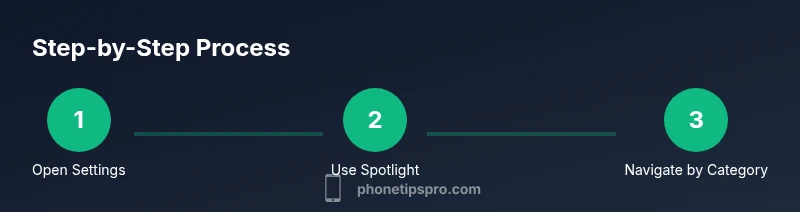
Open Settings
Tap the Settings app (gear icon) on the Home Screen to access the central hub for iPhone controls. This is the primary starting point for most where-to-find queries.
Tip: If you’re unsure where a feature lives, begin here and use the Settings search field. - 2
Use Spotlight to search
Swipe down on the Home Screen to reveal Spotlight. Type a feature name (e.g., Privacy, Battery) to jump directly to the appropriate Settings page or app option.
Tip: Keep searches concise; Spotlight often returns direct results with a single tap. - 3
Check Control Center
Swipe from the top-right corner (iPhone X and later) to open Control Center. Look for quick toggles and shortcuts; customize the layout if needed.
Tip: Tap and hold a control to customize which items appear for faster future access. - 4
Browse by category in Settings
Within Settings, scan major categories like Privacy, Battery, Display & Brightness, and Network. Use the back button to retrace steps if you overshoot.
Tip: If you can’t find it, try a two-step path: first locate the generic category, then search within that submenu. - 5
Inspect app-specific settings
Open Settings and scroll to the list of apps; some apps expose granular permissions here. If you don’t see what you want, check inside the app as well.
Tip: Remember that some settings live inside the app rather than in System Settings. - 6
Ask Siri for direct access
Invoke Siri and say commands like ‘Open Privacy settings’ or ‘Show Battery settings’ to land directly on the target screen.
Tip: Use natural phrasing to get better results from Siri. - 7
Verify with iOS version
If a setting isn’t visible, confirm that your iOS version supports it; some options move between releases.
Tip: Update if possible and re-check the location after the update. - 8
Perform safe cleanups
When in doubt, back up data before doing resets or significant changes. Use guided steps to avoid accidental changes.
Tip: Document steps you take for future reference.
FAQ
Where is the Settings app located on iPhone?
The Settings app is the gear icon on your Home Screen. It serves as the central hub for system controls, privacy, and app permissions. You can reach many options by tapping the appropriate category or by using Spotlight to jump there.
The Settings app is the gear icon on your Home Screen; use Spotlight if you want to jump directly to a specific setting.
How can I quickly find a setting without digging through menus?
Use Spotlight search and the Settings search field. Start typing a keyword like Privacy or Battery, and tap the right result to land on the exact screen.
Use Spotlight or the Settings search field to quickly locate a setting, then tap the result to open it.
Are some settings hidden or moved in newer iOS versions?
Yes. iOS updates sometimes relocate or rename options. Check the post-update Settings map or use search to locate the new path. If in doubt, consult the help sections for the latest iOS version.
Some settings move with iOS updates; use search to locate the new path or check Apple’s help for the latest map.
How do I find app-specific settings?
Open Settings and scroll to the list of apps to view app-level permissions. If you don’t find what you want there, open the app and look for its own Settings or Preferences menu.
Open Settings, scroll to the app, and review its permissions; if not there, check inside the app itself.
What if a setting seems missing after a reset or update?
Verify the iOS version supports the feature, then retry the search. If still missing, consider a reset of network settings or contacting support; ensure you have a backup before major changes.
If a setting is missing after an update, check the iOS version and search again; backups are advised before resets.
Can I open a setting with Siri?
Yes. Say, ‘Open [Setting name]’ or ‘Go to [Setting name]’ to have Siri navigate to the screen for you. This is especially helpful when multitasking.
Siri can open settings by name; say 'Open Privacy settings' to jump there.
Watch Video
Quick Summary
- Start with Settings, Control Center, and Spotlight for fastest results
- Use Spotlight to jump to settings or app options quickly
- Customize Control Center to reduce repetitive lookups
- Always verify iOS version before assuming a setting location
- Use Siri to open settings hands-free when multitasking