Which iPhone Has the Best Camera in 2026? A Data-Driven Comparison
An objective, data-driven comparison of iPhone camera systems across models to help you decide which iPhone has the best camera for stills and video in 2026.


If you're asking which iphone has the best camera, the short answer is that the Pro models generally lead in image quality and versatility, but the best pick depends on your shooting style and budget. This comparison reviews lenses, video features, and computational photography across recent generations to help you decide.
How
Core camera specs that matter
When evaluating
Practical takeaways for spec-focused shoppers
- Prioritize sensor quality for low light and color accuracy
- Consider optical zoom range if you shoot subjects at a distance
- Weigh ProRes and high-bitrate video if you plan to edit on desktop
- Remember: software updates can improve or broaden features over time
The role of sensor size, lenses, and software
Sensor size matters, but software has become a powerful equalizer. Larger sensors deliver better dynamic range and detail in shadows, while modern lenses unlock more focal options and reduce distortion in wide shots. Computational photography—multi-frame exposure blending, night mode tricks, and AI-based noise reduction—extends capability beyond hardware limits. Phone Tips Pro analysis shows that while newer sensors bring tangible gains, the best results come from a balanced mix of hardware and software boosts. In practice, you’ll notice the most benefit in high-contrast scenes and indoor lighting where texture and color accuracy matter most.
Photo quality across lighting conditions
Light conditions determine how you should shoot and which
Pro video capabilities and capturing modes
Video features often decide the best camera phone for creators. Pro models bring higher bitrate recording, ProRes options, and extended dynamic range. Cinematic mode remains a popular feature for depth-of-field storytelling, while stabilization improvements help keep shots steady in motion. HDR recording and color profiles give editors more latitude in post-production. Phone Tips Pro notes that the latest generations also improve autofocus tracking during video and offer more reliable auto white balance in varied lighting. If you shoot frequently in motion or need broadcast-quality options, the high-end models are clearly advantageous.
Which models dominate for stills vs video
For still photography, the latest Pro models typically deliver the strongest combination of resolution, detail, and color accuracy across typical subjects—portraits, landscapes, and street scenes. For video, the same Pro tier often leads with higher-quality stabilization, ProRes workflows, and richer color science. However, the top-end Max variants can offer subtle advantages in longer focal ranges, slightly steadier telephoto performance, and longer continuous shooting sessions under demanding lighting. If you rarely edit on the go, a non-Pro flagship may provide exceptional results at a lower price with a simpler workflow.
Practical buying guide: how to pick the best camera
Real-world usage scenarios and case studies
Case study A: Street photographer capturing fast-moving subjects benefits from fast autofocus, high dynamic range, and a reliable optical zoom range found in Pro models. Case study B: A vlogger who shoots in varied lighting values relies on strong noise control in low light and robust video features like ProRes and Cinematic mode. Case study C: A casual user who wants reliable color accuracy across scenes may not notice a dramatic difference between mid-range and flagship models in everyday use, but will appreciate improved night performance and video stabilization still available on newer devices. These scenarios illustrate how the best choice depends on your workflow and typical environments.
How to test a phone camera yourself
To compare cameras, perform a weekend test with three simple tasks: 1) Shoot a high-contrast scene (sunlight and shadows) to evaluate dynamic range; 2) Capture a low-light indoor scene to judge noise and color accuracy; 3) Record a short video in motion to test autofocus and stabilization. Compare ProRAW and standard JPEG/HEIF outputs if available. Use a consistent exposure and white balance across devices. Finally, review images on a larger screen to assess detail, texture, and color reproduction. This practical test helps you quantify differences and pick the right model for your needs.
The future of
Feature Comparison
| Feature | iPhone 15 Pro | iPhone 16 Pro | iPhone 16 Pro Max |
|---|---|---|---|
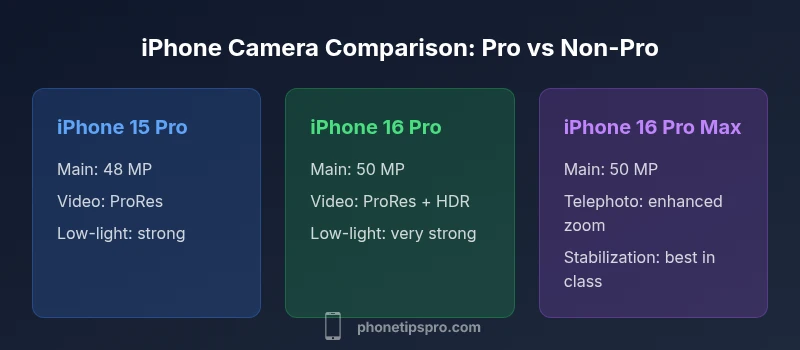
| Main camera resolution | 48 MP wide with sensor-shift stabilization | 50 MP wide with enhanced low-light | 50 MP wide with improved stabilization and multitap focus |
| Ultra-wide | 12 MP with distortion correction | 12 MP with improved macro support | 12 MP with expanded field of view |
| Telephoto / zoom range | 3x optical zoom | 3x optical zoom with better stabilization | 5x optical zoom with stabilized telephoto |
| Video capabilities | ProRes up to 4K | ProRes up to 4K/60, Cinematic mode | ProRes up to 4K/60 + improved HDR and stabilization |
| Low-light performance | Strong with good noise control | Very strong with higher ISO performance | Best-in-class in challenging lighting |
| Battery impact while shooting | Moderate | Moderate to high depending on settings | Low to moderate with power-efficient modes |
| Estimated price range | $999-1199 | $1099-1399 | $1299-1599 |
Positives
- Excellent stills and video across generations
- Strong computational photography across recent generations
- Solid color science and consistent results
- Wide ecosystem of camera accessories and apps
- Good resale value for camera-centric models
Weaknesses
- Pro models carry higher upfront cost
- Advanced features increase file sizes and workflow complexity
- Software updates may shift expectations and features
- Non-Pro options sometimes miss the latest zoom or Pro features
Pro models generally offer the best camera experience; pick based on budget and how you shoot
For the strongest stills and videos, choose a Pro model. If price and simplicity matter more, a newer non-Pro flagship remains an excellent option, delivering superb image quality with fewer bells and whistles.
FAQ
Which iPhone has the best camera in 2026?
Typically, the Pro models offer the best overall camera performance, especially for video and low-light stills. Your best choice depends on how you shoot and your budget. Consider the Pro options if you want the strongest feature set, but you can still get excellent results from newer non-Pro models.
The Pro models usually have the strongest cameras, but your needs drive the decision.
Do newer iPhones always have the best cameras?
Not always. Each generation brings improvements, but the top-tier Pro models often carry the most advanced sensors and video features. If you primarily shoot casual photos, a newer non-Pro may suffice while saving money.
Newer often means better, but not always. It depends on how you shoot.
How can I compare camera specs like sensor size, aperture, and focal length?
Look for the sensor size and lens options first, then review stabilization, HDR, and video features. Compare ProRAW/ProRes support if you plan post-processing. Always test in your typical lighting to see how specs translate to real results.
Compare sensor size, lenses, and video features; test in your lighting.
Is the iPhone Pro Max worth it for camera quality?
The Pro Max often offers the strongest stabilization and the best zoom range, which can matter for video and distant subjects. If those features align with your shooting style, it’s worth considering; otherwise, a lower-cost Pro may deliver nearly identical results for many scenarios.
Pro Max usually has the best camera features, if you need them.
Can software improve camera quality on older iPhones?
Yes. iOS updates frequently introduce camera enhancements, and Apple’s computational photography improvements can elevate results on older devices. However, the hardware limit remains a constraint for certain advanced tasks like high-bitrate video and extreme zoom.
Software updates can help, but hardware still matters.
What about macro and ultra-wide performance?</n>
Macro and ultra-wide performance improve over generations, with newer models offering better min focus distance, distortion control, and color accuracy. If you enjoy close-up work or dramatic wide shots, look for those capabilities in the model you choose.
Macro and ultra-wide get better with newer cameras.
Quick Summary
- Define your primary use: stills, video, or both
- Pro models deliver the most versatile camera tools
- Consider your budget and storage needs for large photo/video files
- Test cameras in real-world lighting before buying
- Future updates may enhance performance across generations