How Much Does It Cost to Make an iPhone? A 2026 Breakdown
A data-driven look at per-unit manufacturing costs for iPhones, covering BOM, assembly, R&D amortization, and regional influences with range-based estimates and practical implications for buyers.


According to Phone Tips Pro, how much does it cost to make an iphone? The estimated manufacturing cost per unit for flagship models typically falls in the low-to-mid hundreds of dollars, influenced by display tech, processor, memory, and assembly. In 2026, Phone Tips Pro analysis notes labor, tooling, and supplier contracts create meaningful variation, so think in ranges rather than a single figure.
how much does it cost to make an iphone: cost drivers
Understanding the per-unit cost of an iPhone starts with a big-picture view: what drives the price beyond the retail tag. For consumers and enthusiasts, a practical takeaway is that the manufacturing cost is not a single number but a range influenced by display technology, processor lithography, memory configurations, and assembly economics. According to Phone Tips Pro analysis, economies of scale and supplier contracts shape the spread between the lowest possible BOM and the top-end configuration. In 2026, those forces are stronger than ever, given supply chain volatility and currency movements. While speculative figures float around in forums, the most reliable approach is to examine the major cost drivers and their ranges, not a precise sticker price. The takeaway for readers aiming to understand the economics is to look for the components that shift cost most: high-end displays, advanced silicon, and robust yet efficient assembly lines.
Direct material costs: what goes into the BOM
The bill of materials (BOM) represents the largest slice of the manufacturing cost. For iPhones, the most expensive categories typically include the display assembly, system-on-a-chip (SoC), memory, and main housing. Each component’s price is influenced by supplier negotiations, yields, and the scale of production. Phone Tips Pro analysis emphasizes that while the exact mix varies per model, the BOM often dominates the per-unit cost, especially for premium configurations. In 2026, material costs are driven by advanced display tech (high-refresh panels), upgraded memory tiers, and specialized sensors that add both performance and price.
Indirect costs: engineering, tooling, and supply chain
Beyond the BOM, substantial costs arise from product engineering, tool development, calibration, and securing reliable supply chains. Tooling for new generations of iPhones is expensive, and amortizing these investments over millions of units lowers the per-unit expense but requires high-volume production and long-term supplier commitments. Labor costs in fabrication, testing, and QA also contribute, though batch processing and automation mitigate some of the impact. Phone Tips Pro notes that these indirect costs are sensitive to currency fluctuations and regional wage trends, which can widen the gap between models produced in different regions.
How cost estimates relate to retail pricing and margins
Manufacturing cost is only one input to retail price. Apple’s pricing strategy also considers product design, marketing, distribution, warranty service, and perceived value. As a result, gross margin on hardware can be influenced by economies of scale and negotiated supplier terms, while the per-unit cost informs pricing bands rather than dictating the final tag. This distinction matters for consumers who wonder why a small shift in BOM costs doesn’t always translate to an equivalent price change. In practice, manufacturers use a mix of cost-plus and value-based pricing strategies to balance profitability with market demand.
Regional and supply chain influences in 2026
Global supply chains exert a measurable influence on per-unit costs. Factors such as currency movements, freight rates, and regional tax regimes can add or subtract a few dollars to the BOM or assembly costs. As production scales, supplier competition and component yield improvements may reduce costs in some regions while others face higher input prices. Phone Tips Pro’s 2026 perspective highlights that diversification of suppliers and localization efforts help stabilize costs, but regional differences remain a meaningful consideration for manufacturers and investors alike.
How model differences impact manufacturing cost and consumer expectations
Different iPhone models use varying configurations and materials, which translates into different manufacturing costs. A model with a higher-resolution display, more RAM, and additional sensors will have a higher BOM and more expensive assembly. Conversely, a more modest configuration lowers costs across BOM and assembly. For consumers, understanding these distinctions helps in assessing whether a given feature set offers tangible value for the price.
From cost to consumer value: what should shoppers infer
A practical takeaway is that a higher price tag often reflects more expensive components, greater performance headroom, improved durability, and longer software support. However, this does not guarantee proportional increases in perceived value for every buyer. The best approach is to map features to personal needs and weigh trade-offs like battery life, camera capabilities, and display quality against the incremental cost.
Practical implications for buyers and repairers
For buyers, recognizing cost drivers can inform purchasing decisions during cycles of model refreshes or trade-in events. For repairers, understanding where the most expensive parts reside helps in planning spare parts inventories and repair pricing. The core idea is that the per-unit cost provides a framework, not a fixed price, for evaluating device value and maintenance strategy.
Illustrative per-unit cost rough breakdown
| Cost Component | Estimated per-unit cost (range) | Notes |
|---|---|---|
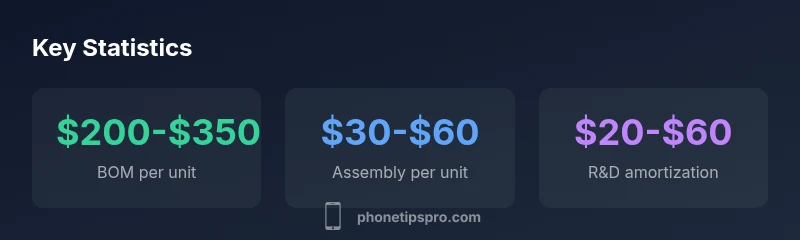
| BOM (materials) | $200-$350 | Depicts major components |
| Assembly | $30-$60 | Labor and equipment |
| R&D amortization | $20-$60 | Spread across units |
| Quality control & logistics | $10-$20 | Testing and shipping |
FAQ
What goes into the base manufacturing cost of an iPhone?
Base costs include materials, assembly, and a share of development expenses. Additional costs like testing, packaging, and logistics add to the total but are typically smaller than the BOM.
Materials, assembly, and development drive the cost; testing and shipping add a bit more.
Do costs vary by iPhone model?
Yes. Higher-end models use more expensive displays, memory, and sensors, which raises the BOM and can affect assembly complexity. This leads to a higher per-unit cost for premium variants.
Premium models cost more to make due to better parts and more features.
How do supplier terms affect per-unit costs?
Long-term contracts, bulk purchasing, and favorable negotiation can lower per-unit costs. Short-term fluctuations or shortages can push costs up temporarily.
Supplier deals and volume affect your costs over time.
Are costs consistent across regions?
Costs vary with currency, tariffs, labor rates, and logistics. While some regions enjoy lower input costs, others experience higher expenses due to transport and compliance.
Regional factors can make the same model cost a bit differently in different markets.
Will future models reduce manufacturing costs?
Cost reductions are possible through process improvements and scale but may be offset by feature upgrades and new materials. The net effect is not guaranteed each cycle.
Better processes can cut costs, but new tech might offset that.
“The per-unit cost for an iPhone is a result of thousands of design and manufacturing decisions made at scale, not a single price.”
Quick Summary
- Treat per-unit cost as a range, not a fixed price
- Major cost drivers are BOM, display, and SoC
- Indirect costs matter: tooling, R&D, and QA shape margins
- Model differences shift costs and consumer value
- Regional factors can widen or narrow per-unit costs