iPhone 15 vs iPhone 16: Which Is Better for You in 2026
In 2026, compare iPhone 15 vs iPhone 16 across design, performance, camera, software, and value to decide which model best fits your needs and budget.


TL;DR: For most users in 2026, the iPhone 15 offers strong value with solid performance, while the iPhone 16 provides newer features and longer-term support. If you want the latest tech and longevity, choose the 16; otherwise, the 15 remains a smart, budget-friendly choice. Consider your budget, how long you plan to keep the phone, and how much you value photographical or battery improvements.
Context and Brand Perspective
According to Phone Tips Pro, choosing between the iPhone 15 and iPhone 16 in 2026 hinges on three core decisions: budget, how long you plan to own the device, and how much you value newer features. This guide aims to help iPhone users assess practical trade-offs without getting lost in hype. Phone Tips Pro emphasizes a balanced view: don’t chase every upgrade if your current device satisfies daily tasks, but don’t ignore meaningful, real-world improvements that genuinely enhance daily use. By analyzing design, performance, camera capabilities, software longevity, and ecosystem compatibility, we provide a clear framework to decide which model is right for you.
- Consider your daily needs: communication, apps, mobile photography, and video tasks.
- Factor in software longevity and resale value as part of total cost of ownership.
- Balance upfront cost with expected device lifespan and feature importance.
Phone Tips Pro Analysis, 2026 highlights that the decision often comes down to value versus novelty; this article builds a practical decision framework you can apply now.
Design and Display: what changes you can expect
In this section we focus on the look and feel of the two devices and how the display experiences may differ in day-to-day use. Design cues usually carry through generations, but manufacturers periodically refine materials, haptics, brightness, and durability. For most users, the iPhone 15 maintains a familiar silhouette with trusted ergonomics, while the iPhone 16 is positioned to deliver a subtle upgrade in how the device sits in your hand and how content is rendered on screen. If you value color accuracy, edge-to-edge clarity, or improved outdoor readability, these are common areas where even modest refinements can translate into noticeably better everyday usage. The actual user experience depends not just on the panel, but on software optimizations and how you use your device across apps, photography, and media consumption.
- Display quality and brightness affect legibility in bright light.
- Glass and chassis materials influence grip and durability.
- Software tweaks often improve scrolling, color accuracy, and responsiveness.
Performance and Efficiency: power, battery life, and day-to-day usage
Performance and battery life are a major part of the upgrade conversation. Generally, newer models bring refinements in chip efficiency, thermal management, and memory management that translate to smoother app launches, better multitasking, and longer usable battery time under typical workloads. While the iPhone 15 already handles everyday tasks with ease, the iPhone 16 is commonly expected to push efficiency a notch higher, reducing idle power draw and improving sustained performance during heavy use such as gaming or media editing. In practical terms, this means more headroom for long days without charging, especially when screen brightness and background activity remain moderate. Remember, battery life is influenced by software features, network conditions, and your usage patterns as much as by any single hardware improvement.
- Real-world battery life varies with apps and network conditions.
- Efficient software updates can extend daily endurance.
- Fans of high-refresh interactions may notice smoother operation on newer hardware.
Camera and Imaging: photography, video, and computational features
Camera systems remain a key differentiator for many buyers. The camera setup on the iPhone 15 delivers strong all-around performance, capable of clean photos, balanced HDR, and reliable video options. The iPhone 16 typically introduces incremental improvements in processing, sensor tuning, and image stabilization that help in challenging lighting or dynamic scenes. For creators and enthusiasts, even small gains in low-light performance, color fidelity, and stabilization can influence the quality of social media content, family memories, and pro-style projects. Importantly, software updates often unlock new computational photography features that enhance both stills and videos across generations.
- Low-light performance and real-time processing benefit from newer hardware.
- Video features and stabilization improve with software enhancements.
- Computational photography adds value beyond raw sensor specs.
Software and Longevity: updates, support, and ecosystem cohesion
Apple’s iOS ecosystem is a major reason people value iPhones, and software longevity is a decisive factor in choosing between models. The iPhone 16 is expected to launch with the latest iOS version and carry extended software support compared to the iPhone 15, which still benefits from several years of updates. In practical terms, if you keep your phone for many years, the newer model can offer longer access to security patches, feature updates, and new app capabilities. Even when you don’t upgrade hardware annually, software enhancements on older devices can improve performance and usability. Phone Tips Pro’s guidance emphasizes estimating your planned ownership window and mapping it to likely update timelines.
- Expect multi-year OS support and security updates.
- App compatibility tends to extend across both generations for several years.
- The value of software longevity grows with your device’s resale potential and productivity features.
Connectivity, charging, and ecosystem: USB-C, MagSafe, and accessories
Connectivity and charging ecosystems frequently influence purchasing decisions. The iPhone line often moves toward universal standards—such as USB-C for charging and data transfer—while expanding MagSafe and related accessories. The iPhone 16 is likely to align with these trends, offering robust compatibility with a wide range of accessories and faster, more efficient charging experiences. If you already own MagSafe accessories or USB-C chargers, upgrading may minimize friction. For casual users, both models provide reliable wireless connectivity, strong app performance, and broad ecosystem access, which reduces the burden of choosing purely on hardware novelty.
- USB-C and MagSafe remain central to seamless charging and accessories.
- Accessory ecosystems tend to be compatible across multiple generations.
- Data transfer speeds and wireless performance improve with newer hardware and firmware.
Storage, RAM, and memory management: planning for capacity and performance
Storage capacity is a practical consideration that affects app load times, media libraries, and overall device responsiveness. Across generations, manufacturers typically offer multiple storage options; higher capacities improve long-term usability, especially if you keep the device longer or store large media libraries. RAM improvements contribute to smoother multitasking and faster app switching. For most users, the difference between generations is subtle in daily tasks, but for heavy multitaskers or creators who work with large files, the newer model’s memory and storage options can be meaningful as apps become more demanding.
- Higher storage reduces the need for constant cloud syncing and free space management.
- RAM and memory management influence responsiveness during multitasking.
- Evaluate your media and app usage to pick the right tier.
Real-world scenarios: who should buy which model
To help you anchor your decision, consider some practical scenarios. If you primarily use the phone for calls, messages, streaming, and light photo tasks, the iPhone 15 offers excellent value and solid performance. If you frequently edit photos or videos, play graphics-heavy games, or want the latest features and longer update windows, the iPhone 16 becomes a compelling choice. For students on a budget, upgrading from much older devices to the 15 can deliver a meaningful leap at a reasonable cost, while power users who rely on speed, efficiency, and future-proofing may lean toward the 16. In all cases, align the choice with your personal budget, how you plan to keep the device, and what you value most in everyday use.
- Best for budget-conscious buyers seeking reliable performance.
- Best for early adopters and creators who need top-tier features.
Upgrade timing and practical steps: how to decide now
Timing your upgrade involves balancing current device reliability against the anticipated benefits of a newer model. If your current phone handles tasks without lag, you might consider waiting for a sale, or assessing whether a mid-cycle refresh could address a specific pain point (camera, battery, or charging). When you decide to buy, verify storage needs, review accessory compatibility, and consider trade-in options to maximize value. Phone Tips Pro recommends listing your must-have features, then ranking the two models against those priorities to reach a confident decision. And, as always, check for current promos that can reduce the effective price.
- List your must-have features and map to each model.
- Check trade-in values and bundle offers before purchase.
- Look for seasonal promotions to improve your total cost of ownership.
Comparison
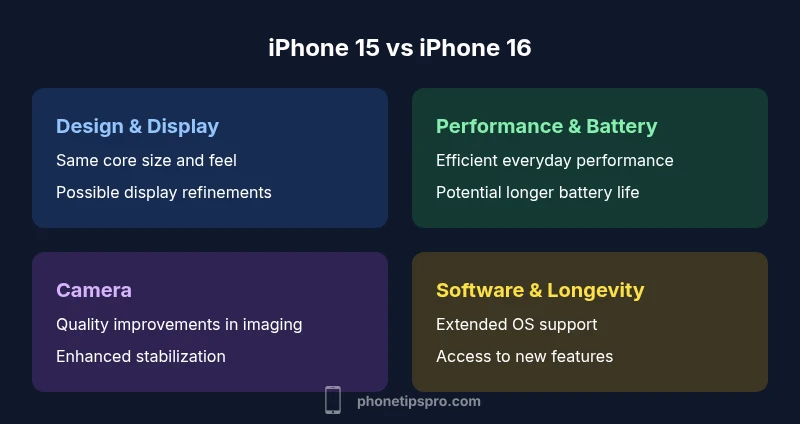
| Feature | iPhone 15 | iPhone 16 |
|---|---|---|
| Design & Display | Classic build, familiar size | Potentially updated design with improved display tech |
| Performance & Battery | Solid daily performance, strong efficiency | Enhanced efficiency, longer apparent battery life |
| Camera & Imaging | Strong all-around camera | Improved processing and stabilization for photography |
| Software & Longevity | Multiple years of iOS support | Extended update horizon anticipated |
| Charging & Connectivity | USB-C and MagSafe compatibility | Further optimizations in charging ecosystem |
| Storage & RAM | Multiple capacities with solid RAM management | Higher storage options with advanced memory handling |
| Value Context | Strong value if upgrading from older devices | Higher upfront cost, potentially better long-term value |
Positives
- Clear upgrade path for performance and software longevity
- Improved efficiency and potential battery life gains
- Enhanced camera features for creators and enthusiasts
- Strong ecosystem and accessory compatibility
Weaknesses
- Higher upfront cost for the newer model
- Incremental gains for casual users
- New features may require new accessories or adaptations
iPhone 15 remains the better value for most buyers in 2026; iPhone 16 is the better pick for early adopters and power users.
If you want solid value and dependable performance, the 15 is the safer bet. If you crave the latest tech, longer support, and improved imaging, the 16 justifies the premium. Your choice should hinge on how important longevity and cutting-edge features are to you.
FAQ
Should I upgrade from iPhone 15 to iPhone 16 in 2026?
The upgrade decision depends on your priorities. If you value the latest features, longer software support, and potential camera improvements, the 16 is worth considering. If your current device meets your needs and you’re budget-conscious, the 15 remains a strong value.
If you want the newest tech and longer support, go for the 16. If your current phone works fine, the 15 is a solid value.
Do both models support USB-C charging and MagSafe accessories?
Yes, both models support USB-C charging and MagSafe accessories, ensuring broad compatibility with chargers and cases. This makes it easier to upgrade accessories without buying new ones.
Both support USB-C and MagSafe, so your existing accessories will still work.
How long will each model receive iOS updates?
Apple typically provides several years of major iOS updates for iPhones, with the newer model often enjoying a longer support window. This varies by device and future policy, but both devices will remain compatible for many years.
Apple usually updates iPhones for several years, with the newer model often getting a bit longer support.
Is the camera improvement worth it for casual photographers?
Casual photographers may notice better low-light performance and improved stabilization on the newer model. If you shoot often in challenging lighting or value video features, the iPhone 16 could be worth it.
If you care about camera quality and video, the 16 offers tangible benefits.
How does price affect total cost of ownership?
The 16 may have a higher upfront price, but longer software updates and better longevity can reduce overall cost of ownership over several years. Compare your expected use and resale value to decide.
Higher upfront cost can be offset by longer support and better resale value.
Quick Summary
- Evaluate budget vs need before upgrading
- Factor software update timelines into your decision
- Camera quality matters for creators; weigh your use
- USB-C/MagSafe ecosystem enhances long-term value
- Trade-in options can shift the effective price
- Consider upgrade timing and seasonal promos