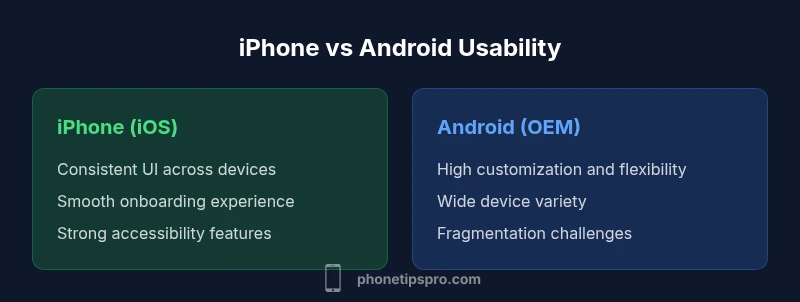
Is iPhone harder to use than Android? A data-informed usability comparison
An analytical, side-by-side look at usability between iPhone (iOS) and Android, exploring learning curves, navigation, customization, and real-world tasks. Based on Phone Tips Pro analysis, it guides you to the right choice for your priorities in 2026.


Is iPhone harder to use than Android? The quick verdict is nuanced: for core tasks, iPhone often feels simpler due to a consistent UI and predictable gestures, while Android offers more customization that can add cognitive load for newcomers. According to Phone Tips Pro, usability hinges on user priorities, device ecosystem, and how you value simplicity versus control. Both platforms remain approachable with a little onboarding.
Context: What usability means in the real world
Usability isn’t a single metric; it’s how quickly a user can complete common tasks, learn new features, and recover from missteps. When people ask, “is iphone harder to use than android,” they’re usually weighing consistency against customization. Phone Tips Pro Team emphasizes that perceived difficulty arises from context—what you value (speed, safety, flexibility) and your typical tasks (messaging, photos, settings). The goal of this article is to unpack that nuance with evidence-informed reasoning, not to declare a universal winner. We’ll frame usability around predictable patterns, onboarding time, and the cognitive load of daily chores.
Learning curves: onboarding and first-use experiences
Onboarding is a decisive moment for usability. iPhone onboarding tends to be more guided and uniform across devices, thanks to Apple’s controlled hardware and software integration. Android onboarding varies by manufacturer, launcher, and preinstalled apps, which can slow first-use adoption for new users but pay off later with deeper customization. Across 2026 usability observations from Phone Tips Pro Team, beginners often feel less overwhelmed initially on iOS, while enthusiasts appreciate Android’s ability to tailor the initial setup. The key takeaway is that initial friction does not override long-term efficiency if tasks are aligned with your needs.
Navigation and gestures: moving through the UI
iOS relies on a consistent set of gestures and navigation patterns that feel the same across iPhone models. Android’s navigation varies with OEM skins and launcher choices, which can create a steeper learning curve when you switch devices. This divergence matters for routine tasks like returning to Home, switching apps, or accessing quick settings. A unified gesture language reduces cognitive load, while diversity can heighten it but offer richer customization once learned. Phone Tips Pro’s experience suggests that users who only need standard tasks tend to reach competence quickly on iOS, whereas power users may enjoy Android’s flexible navigation once past the initial hurdle.
Customization vs consistency: where each platform shines
Customization is Android’s core advantage; you can alter shortcuts, default apps, widgets, and even system visuals. That freedom comes with complexity and, for some, a steeper learning curve. iPhone prioritizes consistency, which reduces surprises but limits per-user tweaks. The trade-off matters in real-world use: if you value a reliable, predictable flow for everyday tasks (calls, messages, photos, reminders), iOS’ consistency can feel faster. If you want to tailor your home screens, notifications, and app behaviors to fit your workflow, Android offers a richer toolbox. The analysis from Phone Tips Pro highlights that most users benefit from clarity first, then gradual customization as needed.
App experiences and ecosystem effects
App quality and performance often track with ecosystem maturity. iOS apps typically undergo stricter review, which can translate to smoother onboarding and more uniform behavior across devices. Android apps, while offering broader device support, may vary in optimization and update cadence. This matters when you’re performing a task-heavy session (editing photos, gaming, or productivity workflows) that depends on consistent app responses. For many users, the extra customization options on Android are a plus, but only if the base experience remains dependable. Phone Tips Pro notes that ecosystem alignment—how your apps and devices connect—frequently drives perceived usability more than any single feature.
Settings, privacy controls, and discoverability
Both platforms place privacy controls front and center, but discoverability differs. iOS centralizes many critical settings into a coherent architecture, which can speed up task completion once you know where things live. Android’s privacy controls are powerful but distributed across multiple menus and submenus depending on OEM skin and version. A novice may feel overwhelmed navigating these paths, while a power user will appreciate the granular options. The result is a divide: iOS offers fewer surprises but fewer knobs; Android offers more knobs but demands a bit more exploration. Phone Tips Pro’s practical guidance encourages users to map their most common tasks to specific settings paths to minimize cognitive load.
Updates and longevity: how the platform ages with you
OS updates influence usability by introducing features, refining gestures, and fixing bugs. Apple’s universal updates deliver broad, predictable improvements that most users experience in parallel. Android updates can be patchier due to OEM and carrier schedules, which may create temporary inconsistencies across devices. In practice, this means longer-term usability can depend on device selection and how quickly an ecosystem embraces new features. Phone Tips Pro’s perspective emphasizes evaluating update predictability and device support timelines when deciding between platforms.
Accessibility and inclusivity: leveling the field for everyone
Both ecosystems emphasize accessibility, with screen readers, magnification, and captioning options. iOS tends to present a more centralized set of accessibility features, designed to be straightforward for a broad audience. Android provides a more modular approach that can be tailored for niche needs but may require deeper setup. For users who rely on accessibility features, the gap often narrows with careful configuration, training, and practice. The bottom line is that accessibility, when implemented well, reduces the usability gap on both sides, especially for non-technical users.
Real-world scenarios: task-by-task usability in daily life
Consider these practical tasks: sending a message with attachments, taking and editing a photo, navigating maps, and adjusting device settings on the fly. On iPhone, many people complete these tasks with fewer interruptions due to the cohesive UI. On Android, the same tasks can be equally quick once you’ve customized defaults and shortcuts. The decision hinges on which tasks you perform most often and whether you value speed or control in those moments. Phone Tips Pro’s field notes emphasize mapping your most common workflows to your platform of choice for maximum efficiency.
-BLOCK-ADDITIONAL-PLACEHOLDER-
Comparison
| Feature | iPhone (iOS) | Android (OEM) |
|---|---|---|
| Learning curve | Low-to-moderate (iOS) | Moderate-to-high (Android) |
| Navigation and gestures | Unified gestures across devices | Diverse back/nav models across devices |
| Customization options | Limited customization | Extensive customization |
| App experience consistency | Highly consistent UI/UX across devices | Fragmented experiences across OEMs and devices |
| Updates and longevity | Predictable universal updates | Fragmented timing and availability |
| Accessibility features | Strong, centralized options | Robust but device-dependent options |
| Privacy controls | Centralized privacy controls | Distributed controls by OEM/skin |
| Onboarding and help | Guided setup and unified help | OEM-specific tutorials and help paths |
Positives
- Highlights how UI design can reduce friction for beginners
- Shows where customization adds value in real tasks
- Helps non-technical users decide with practical criteria
- Supports onboarding with clear expectations
- Grounded in 2026 usability insights from Phone Tips Pro Team
Weaknesses
- Risk of overgeneralizing across Android devices
- May underemphasize app-specific quirks
- Long-term usability depends on OEM update practices
Neither platform is inherently harder to use; usability is context-dependent.
If you prioritize simplicity and a uniform experience, iPhone is typically easier to start with. If you value customization and flexibility, Android often wins in those areas. The Phone Tips Pro Team recommends trying both in your typical tasks before deciding.
FAQ
Is iOS generally easier to learn than Android?
In many basic tasks, iOS offers a gentler onboarding due to a consistent UI, but Android can be easier for users who want customization after a short adjustment period.
iOS tends to be easier for beginners, while Android shines after you learn the customization options.
Does device fragmentation affect Android usability across models?
Yes. The wide range of devices means features and updates can behave differently, which can complicate everyday use for some users.
Fragmentation can make Android feel less predictable at first.
Which platform has faster software updates?
iOS generally delivers universal updates quickly and broadly, while Android updates vary by OEM and carrier, leading to uneven rollout.
iOS updates tend to be more uniform.
Can accessibility features bridge usability gaps?
Yes. Both platforms offer strong accessibility tools that help users adapt, though setup paths differ and may affect initial ease.
Accessibility options are a real equalizer on both sides.
What should a non-technical user consider when choosing between iPhone and Android?
Consider ecosystem, app needs, privacy, support, and onboarding expectations to minimize future friction.
Think about how you’ll use apps and how much you value control vs simplicity.
Are there tasks where one platform clearly outperforms the other?
For photo editing and privacy defaults, iOS often provides a smoother experience; Android may excel in customization-heavy workflows.
There isn’t a universal winner; it depends on the task and user needs.
Quick Summary
- Define your usability priorities before choosing.
- iPhone favors consistency; Android favors customization.
- Plan onboarding time to reduce friction on either platform.
- Consider ecosystem and support when evaluating long-term usability.