What Is Better Than iPhone? A Practical Comparison
Explore practical alternatives to the iPhone by weighing ecosystem, privacy, price, and longevity. This Phone Tips Pro guide analyzes Android and other options to help you decide what is better than iphone for your priorities in 2026.


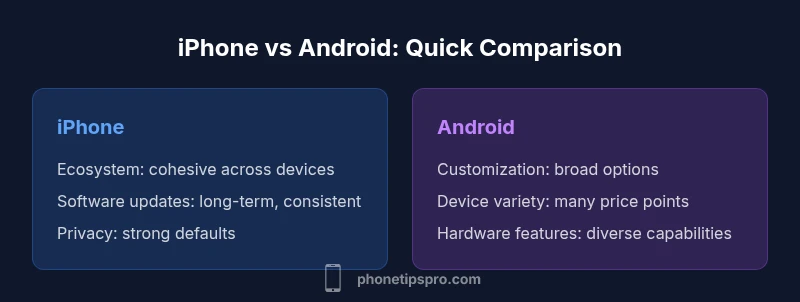
There is no universal device that is universally better than the iPhone; the answer depends on what you value most. If you prioritize a cohesive ecosystem, consistent software updates, and strong privacy, the iPhone remains hard to beat. If you crave customization, broader hardware choices, and often lower upfront costs, Android options like Pixel or Galaxy may be better for you.
Framing the question: what is better than iphone
When readers ask what is better than iphone, they are really asking which smartphone best fits their priorities. This analysis, guided by Phone Tips Pro's methodology, starts from your needs rather than brand loyalty. For many, the question hinges on ecosystem, software updates, privacy controls, price, and hardware flexibility. In 2026, the landscape has matured to offer compelling Android alternatives that challenge iPhone on several fronts, while preserving iOS strengths in reliability and integration. The goal here is to present a balanced framework and clear scenarios that help you decide whether an iPhone remains the best fit or if another platform makes more sense given your daily use, budget, and goals. Throughout, we’ll use the keyword what is better than iphone to anchor the comparison and keep the lens focused on practical decision factors. By the end, you’ll know which path aligns with your priorities, whether that path leads to iPhone retention or a switch to Android or another ecosystem.
Core decision criteria
To judge what is better than iphone for you, start with a consistent set of criteria that matter in daily use. First, ecosystem and services: how smoothly devices, wearables, and apps work together across days, seasons, and tasks. Second, price and value: initial cost is important, but total cost of ownership—including repairs, accessories, and trade-in value—often matters more over three to five years. Third, privacy and security: default protections, permission controls, and software update cadence protect data and user control. Fourth, customization and freedom: flexibility in the user interface, app behavior, and hardware choices. Fifth, camera and media capabilities: how photos, video, and editing tools perform under real-world conditions. Finally, longevity and repairability: device resilience, battery life, screen durability, and availability of affordable repairs. This framework, drawing on Phone Tips Pro's experience, helps compare devices on equal footing rather than marketing claims. You’ll see how different platforms excel in some areas while lagging in others.
Android landscape at a glance
Android devices span a wide range of hardware, price points, and software experiences. The best Android alternatives to iPhone typically offer strong customization, rapid hardware innovation, and aggressive price bands. Google Pixel emphasizes clean software and timely updates, while Samsung Galaxy models blend high-end cameras with extensive hardware features and long-term support in some regions. OnePlus focuses on speed and value, and broader device ecosystems include foldables, large screens, and niche form factors. What matters most is alignment with your priorities: are you willing to trade some polish for more control, or do you prefer a predictable, uniform experience? Android choices also vary in terms of repairability, aftermarket accessories, and carrier flexibility. Phone Tips Pro's analysis indicates that with careful feature-by-feature comparison, you can often match or exceed iPhone performance in areas such as display quality, charging innovations, and multi-device interoperability, especially when you are not tied to a single brand.
iPhone strengths you should weigh
iPhone has enduring strengths that many users value above all else. The ecosystem provides seamless continuity across iPhone, iPad, Mac, and Apple Watch, with a unified app experience, find-my-device reliability, and consistent software quality. Privacy protections are baked into default settings, and updates are issued for many years, reducing fragmentation. Build quality, battery life management, and resale value are typically strong, supporting long-term ownership. The camera pipeline emphasizes color science, video stabilization, and consistent results across lighting conditions. The user experience tends to be predictable, with fewer surprises in app behavior or performance, which many professionals rely on for work tasks. When evaluating what is better than iphone, these constants can offset concerns about customization or price for a large portion of buyers who prioritize stability and ecosystem depth.
Measuring what matters: a quick framework
To compare options objectively, translate preferences into measurable priorities. Use a simple scoring approach: assign importance weights (for example, 0–5) to categories such as ecosystem, privacy, price, updates, camera, and repairability. Then assign performance scores for each device in those categories. The result is a transparent, reproducible ranking rather than a gut feeling. For many households, the most influential factor is ecosystem continuity—whether a phone, tablet, computer, and wearable work in a single, coherent way. For others, price-to-value and the ability to customize the user interface will drive the decision. Phone Tips Pro suggests a practical habit: test a device in your real life for a week, document how often you rely on services unique to each platform, and weigh the friction of switching. This approach makes the abstract question what is better than iphone concrete and actionable.
Price, value, and total cost of ownership
Price matters, but total value matters more. Upfront cost is just one piece of the equation; accessories, screen protectors, cases, extended warranties, and repair costs all contribute to the long-term bill. Android ranges tend to cover budget, mid, and premium tiers, while iPhone prices cluster toward premium segments with strong resale value. In practice, a switch may pay off if you expect to upgrade within a few years, or if you value features that are costly to obtain elsewhere. On the other hand, staying with iPhone often reduces hidden costs linked to software compatibility and ecosystem lock-in. The key is to map your typical device lifetime and your preferred balance of features versus price. Phone Tips Pro recommends using a simple calculator: estimate annual depreciation, repair costs, and accessory spending, then compare five-year totals across options.
Privacy and security trade-offs
Privacy and security are not absolutes, but they do differ by platform. iPhone emphasizes strong default protections, controlled app permissions, and consistent security updates across devices. Android provides rich customization and more transparent access to alternatives, but the onus on privacy can be higher when using third-party apps or less regulated app stores. In practice, privacy outcomes depend on behavior as much as platform design: enabling screen-time restrictions, managing app permissions, and avoiding risky downloads matter more than the brand. If privacy is your top criterion, a careful, cautious usage pattern on either platform can yield excellent results, but the baseline protections on iPhone tend to be easier to maintain without deep technical knowledge. Phone Tips Pro's stance is to encourage informed choices and ongoing updates rather than one-size-fits-all prescriptions.
Camera and media capabilities across ecosystems
Camera performance varies with lighting, lenses, and processing pipelines. iPhone models have long offered reliable color science, cinematic video features, and strong autofocus across scenes. Android devices compete by excelling in specific areas: ultra-wide quality, high-contrast dynamic range, and flexible camera apps that let you tweak settings. If you shoot a lot of video or rely on consistent color grades for social media, you may find certain Android models deliver different looks that suit your style. For casual use, iPhone’s consistency can save time and reduce post-processing effort. One practical approach is to identify your most common shooting scenarios—landscape, portrait, night, or action—and compare devices on those tasks. Phone Tips Pro's comparison highlights that there are Android devices capable of rivaling iPhone in many conditions, while still preserving distinct advantages depending on hardware and software choices.
Repairability, service, and long-term care
Repairability and service access influence long-term costs and satisfaction. iPhones often benefit from widespread authorized service networks and consistent repair tooling, but parts and labor can be pricey. Android devices vary widely: some models are designed for easier DIY repair and accessible parts, while others are shielded by manufacturer-controlled repair ecosystems. Availability of third-party repairs, pricing, and official replacement programs should factor into your calculations. If you anticipate frequent repairs, a device with modular design or robust third-party support may offer lower friction. Phone Tips Pro suggests requesting OEM repair estimates and checking local shop capabilities before committing to a platform, as this decision can swing the total cost of ownership over time.
Decision maps for common use cases
Different users fall into different decision maps. If you prioritise a frictionless, integrated workflow across devices, iPhone remains compelling. If you value customization, hardware variety, and price flexibility, Android alternatives often perform best. Students and budget-conscious buyers may lean toward mid-range Android models, while professionals who rely on uniform software experiences and long-term support may prefer iPhone. For families with multiple devices and shared services, ecosystem coherence can translate to real-world time savings and fewer compatibility headaches. These maps are designed to be practical: write down your top three must-haves, chart how each platform delivers on them, and simulate a one-week usage period to spot friction. The bottom line: what is better than iphone is highly situational and depends on how you use your devices every day.
How to decide in 4 steps
- List your top priorities (privacy, ecosystem, price, camera, software updates). 2) Score devices against those priorities using a simple 1–5 rubric. 3) Consider total cost of ownership by including accessories and repairs. 4) Do a live test: use a friend's device or a trial period to gauge daily friction. If you still feel uncertain, rely on the top priority category—security for some users, customization for others—and rank accordingly. The goal is a clear, repeatable decision process rather than relying on marketing claims. Phone Tips Pro recommends documenting your results and revisiting your choice after a few months to ensure the decision holds under real-world use.
Comparison
| Feature | iPhone | Android alternatives |
|---|---|---|
| Ecosystem & services | Tightly integrated across devices; long-term support | Diverse devices and flexible integration; platform-agnostic app experiences |
| Customization freedom | Limited, with consistent UI and fewer hacky options | Extensive customization and launcher options, widget support |
| Price range | Typically premium upfront | Wide range: budget to premium |
| Privacy controls | Strong default protections and permissions | Privacy controls vary by vendor and app; more knobs to turn |
| Software updates | Long, timely updates across devices (where supported) | Manufacturer-dependent; some devices receive fast updates; others slower |
| Repairability | Apple-wide repair network; often pricier | Fragmented repair landscape; some models easy to repair |
| Camera versatility | Consistent color science and video features | Broad hardware options with varied image processing |
Positives
- Strong, cohesive ecosystem and long software support
- High resale value and reliable performance
- Excellent default privacy protections and security features (on iPhone)
- Broad hardware options and competitive price points (Android)
Weaknesses
- Higher upfront price and ecosystem lock-in (iPhone)
- Varied update cadence and support across Android devices
- Platform fragmentation can complicate app compatibility and user experience
No single platform is universally better; choose based on your priorities
If ecosystem, privacy, and long-term updates top your list, iPhone is often the safer bet. If customization, hardware variety, and price flexibility drive you, Android alternatives frequently offer superior alignment with those needs.
FAQ
Is there a universal 'best' phone after iPhone?
No. The best choice depends on individual priorities like privacy, customization, price, and ecosystem needs. Use a structured framework to compare devices rather than relying on marketing claims.
There isn’t a universal best—it depends on what matters most to you. Try a structured comparison to see which platform fits your priorities.
Are Android phones always cheaper than iPhones?
Not always, but Android offers a wider price range, from budget to premium. Your total cost of ownership depends on features you value, repairs, and accessories.
Android often offers more price options, but total cost depends on features and repair needs.
Which is better for privacy, iPhone or Android?
iPhone tends to have stronger default privacy protections and more consistent updates. Android can be equally private with careful app management, settings, and trusted devices, but outcomes depend on user behavior.
Both can be private with the right settings; iPhone makes it easier by default.
How important are software updates for longevity?
Regular software updates extend device longevity by patching security flaws and improving reliability. iPhone generally offers longer, more consistent updates; Android varies by manufacturer.
Updates matter a lot for security and longevity, and iPhone tends to lead in consistency.
Can Android cameras beat iPhone quality?
Yes in some models and scenarios, especially in specific lighting or with certain lenses. Overall, iPhone cameras offer strong consistency; Android can outperform in niche contexts.
Some Android phones can beat iPhone in certain shots, but consistency varies by model.
How should I decide in 4 steps?
List priorities, score devices, calculate total ownership costs, and test in real life. This formal approach reduces bias and marketing influence.
Make a quick four-step plan, then test a device in real life to confirm your choice.
Quick Summary
- Evaluate your top three priorities before choosing
- Use a simple scoring method to compare devices
- Factor total cost of ownership, not just upfront price
- Test real-world use to identify practical friction