Who Makes iPhone Screens: Inside the Display Chain
Explore who makes iphone screens and how Apple coordinates multiple suppliers to deliver OLED and LCD panels, touch sensors, and cover glass across generations.


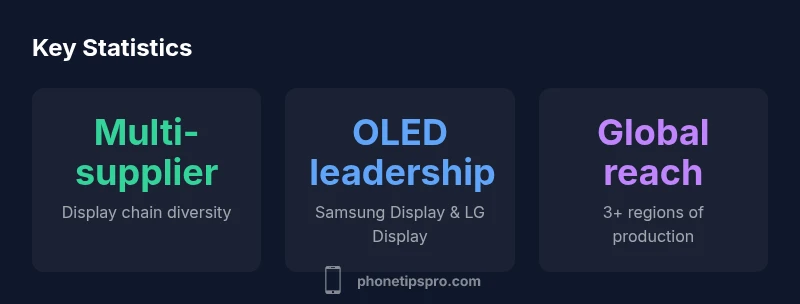
Who makes iphone screens? Apple relies on a diversified, global supplier network rather than a single source. For OLED panels, the dominant producers are Samsung Display and LG Display, with other partners contracted for specific models or regions. Apple manages integration, driver ICs, and touch layers to ensure uniform brightness, color accuracy, and durability across generations.
who makes iphone screens: overview
When people ask who makes iphone screens, they are asking about the display supply chain that powers every iPhone. The phrase encompasses OLED and LCD panels, touch sensors, protective cover glass, and the driver electronics that run the panel. Apple designs the overall stack, but it relies on a network of external manufacturers to fabricate and assemble the final display. In 2026, the primary OLED panel suppliers are Samsung Display and LG Display, with others contracted for specific models or regions. The display stack is a global, highly confidential process, where quality, yield, and security drive supplier selection. Different iPhone generations may shift the balance of who makes iphone screens, depending on technology choices like LTPO, color management, and power efficiency. For consumers, this means two things: the perceived screen quality is the result of many moving parts, and the supply chain constraints can influence availability and repair options. Understanding the basics helps demystify why screen-related issues sometimes differ between models and why third-party repairs can be more complex than expected.
Major OLED panel suppliers and why they matter
The most visible players in the iPhone display story are the OLED panel manufacturers. Samsung Display has long provided high-volume OLED panels and advanced deposition technology, while LG Display contributes complementary design and production capacity that helps Apple scale across models. These suppliers deliver the core color and brightness performance that users notice, including contrast, peak brightness, and uniformity. Apple negotiates terms, quality controls, and timing with each supplier, aiming for consistency across devices even when models switch between panel plants. The exact mix of suppliers shifts by generation as new display architectures arrive, such as improved LTPO backplanes and more efficient driver electronics. While Samsung and LG are the anchors, Apple’s engineering teams coordinate with additional partners to handle non-panel components like touch sensors, cover glass, and driver ICs.
The role of Apple in the display stack
Apple does not manufacture the glass, panel substrate, or driver circuits in-house for iPhone screens; instead, it exercises end-to-end control over the system integration, calibration, and software interfaces. The design process specifies critical tolerances for color accuracy, color temperature, and brightness while defining how the touch layer interacts with the panel. Suppliers are audited for quality systems, ethical sourcing, and export controls, and Apple often negotiates non-disclosure agreements to protect design details. This collaboration is not simply a handoff of parts; it is a coordinated cascade of specifications, toolings, and test protocols that ensures every device looks and behaves the same, regardless of where the screen is manufactured. Consumers benefit when Apple can enforce consistent quality across regions, while suppliers benefit from long-term planning and stable demand.
Glass, touch sensors, and cover materials
The surface you touch on an iPhone screen is the result of layered materials: a glass cover, an optically clear touch sensor, and the OLED or LCD panel beneath. Glass suppliers provide hardened covers with anti-reflective coatings, while touch sensor layers translate finger input into signals that the chipset can interpret. The driver electronics, connection ribbons, and circuit boards are part of the broader display assembly managed by Apple and its contract manufacturers. Differences in cover glass hardness, glare reduction, and edge curvature can influence perceived quality as much as the panel itself. Understanding that the screen is a multi-part system helps explain why some screens feel crisper on one model and warmer on another, even if the core panel technology is similar.
Testing, reliability, and durability standards
Before an iPhone screen reaches customers, it goes through a battery of tests designed to simulate real-world use. Manufacturers assess optical performance, color accuracy, brightness stability, and touch sensitivity under varied lighting and temperatures. Accelerated aging tests probe how coatings hold up under repeated tapping, cleaning, and exposure to moisture. Apple’s QA teams apply additional scrutiny through panel-by-panel sampling, burn-in tests, and end-to-end device validation to ensure that the display stack remains consistent across units. The result is a product with predictable color reproduction and response characteristics—an outcome that hinges on the quality of each supplier’s contribution as well as the finesse of integration.
Sustainability, ethics, and responsible sourcing
The iPhone screen supply chain raises questions about materials sourcing, recycling, and migration away from conflict minerals. Suppliers are pressured to improve energy efficiency, reduce waste, and invest in safer working conditions. Apple publicly outlines supplier responsibility programs, materials recycling, and closed-loop design goals aimed at lowering the environmental footprint of the display stack. Customers can support these efforts by choosing devices from brands that emphasize transparency and ethical sourcing in their supply chains. While progress is incremental, the focus on sustainability affects decisions about where and how screens are manufactured, and it shapes ongoing negotiations with suppliers as new panel technologies emerge.
Consumer considerations: assessing screen quality
When evaluating an iPhone screen, look beyond the pixel count. Brightness, color accuracy, and uniformity matter, as does touch latency and the consistency of the coating against fingerprints and reflections. Compare devices under similar lighting and check for color shading or backlight bleed, which can indicate panel or assembly variations from different supplier lots. For repairs, remember that screen components are proprietary and tightly integrated with True Tone, color management, and haptics. If you encounter issues that seem model-specific, it could reflect a different supplier mix or calibration settings rather than a defect in your unit alone. The more you know about the display stack, the better questions you can ask a technician or retailer.
Future trends: resilience and new panel technologies
The display supply chain continues to evolve with new panel architectures, like higher efficiency OLEDs and more durable glass combinations. As Apple broadens its supplier network, the emphasis on security, anti-counterfeiting, and end-to-end calibration grows. Consumers can expect more consistent quality across devices even as production scales to meet demand. For the curious reader, understanding who makes iphone screens helps explain variability between model years and offers insight into how Apple keeps screens bright, accurate, and responsive in a competitive market in 2026 and beyond.
Display panel supply chain overview
| Aspect | Supplier Type | Notes |
|---|---|---|
| Technology | OLED panels (primary); LCD legacy | Panel technology and generations vary by model |
| Main Suppliers | Samsung Display; LG Display (primary) | Mix varies by generation |
| Additional Suppliers | Other panel vendors (contracted as needed) | Contracted per model/region |
| Integration & QA | Driver ICs, touch sensors, cover glass | Apple-led assembly and rigorous testing |
FAQ
Who makes iPhone screens?
Apple sources iPhone displays from multiple suppliers, primarily Samsung Display and LG Display for OLED panels, with other partners contracted as needed by model and region. Apple manages integration, driver electronics, and calibration to ensure consistency across devices.
Apple uses several display manufacturers, with Samsung and LG leading OLED panels; the exact mix depends on the model.
Do iPhone screens come from a single manufacturer?
No. Apple uses a diversified supplier network to balance capacity, pricing, and risk. The exact mix changes by generation and region.
No—the display stack involves multiple suppliers to ensure steady supply and quality.
Are iPhone screens OLED or LCD, and who makes them?
Most recent iPhone screens are OLED, with LCD panels used on some older generations. The OLED panels are primarily made by Samsung Display and LG Display, while LCDs involve other contract manufacturers depending on the model.
OLED dominates recent models, built by Samsung Display and LG Display; some older models used LCD from other vendors.
Why do suppliers change between generations?
Technology shifts, capacity changes, and cost considerations drive supplier selection. Apple negotiates terms to maintain production schedules and quality across generations.
Changes in tech and capacity drive which suppliers are used.
Can third-party screens be used in iPhones?
Third-party screens may not be compatible with Apple's display calibration, True Tone, and reliability tests. Official repairs rely on Apple-approved parts and processes.
Third-party screens can affect color accuracy and performance and are usually not supported by Apple.
How can I tell if my iPhone screen is from a specific supplier?
Retailers and manufacturers typically do not reveal supplier-level details for consumer devices. Differences are usually subtle, like color or brightness variations, rather than obvious markings.
Suppliers aren’t usually disclosed to consumers; you’ll notice general panel quality differences rather than a brand stamp.
“The display supply chain is a balance of capacity, yield, and security; a diversified supplier base helps Apple keep screens consistent across devices.”
Quick Summary
- Apple coordinates multiple display suppliers for resilience.
- Samsung Display and LG Display lead OLED panel production.
- Apple controls integration and quality testing across partners.
- Model differences shift supplier mix and panel types.
- Sustainability and ethical sourcing are ongoing focus areas.