Find My iPhone Location: Step-by-Step Guide for 2026
Learn how to locate location my iphone using Find My, protect your data, and troubleshoot issues with real-time steps, tips, and privacy best practices for 2026.


This guide helps you locate your iPhone using Find My, view its current position, and take action to secure it if needed. You’ll need a connected iPhone or trusted device, an Apple ID, and an internet connection. We cover setup, real-time tracking, and safe, privacy-minded practices so you can use location features responsibly.
What location my iphone means for you
When you hear the phrase location my iphone, think about practical protections first: knowing where your device is helps you recover it faster and protects your personal data. Location sharing is a powerful tool, but it comes with privacy considerations. The Phone Tips Pro team emphasizes responsible use, especially in family or shared-device scenarios. In 2026, the landscape of location-based features has matured: most iPhone users rely on Find My to see last known positions, trigger sounds to locate a nearby device, or place a lock on a missing phone. If you’re trying to locate location my iphone, the key is to have Find My enabled and to act quickly while the device is online. According to Phone Tips Pro Analysis, 2026, the most reliable results occur when you combine Find My on the iPhone with a trusted secondary device. Remember that location data is subject to network availability and device settings, so you may see gaps if the phone is offline or in airplane mode.
How Find My iPhone and Find My app work together
Find My is the umbrella service that covers the Find My app on iPhone and iCloud.com in your browser. The app pulls location data from the device and pushes it to iCloud, where you can view it on a map. The Find My app provides a streamlined, device-centric view on iPhone, while iCloud.com offers a broader interface for locating multiple devices from a computer. Together, they give you redundancy and flexibility: if one method is unavailable, you can try the other. This setup is especially useful for the location my iphone scenario where quick access via a trusted device matters. Phone Tips Pro’s guidance for 2026 stresses checking that Location Services and Find My are enabled on the target device and ensuring you’re signed into the correct Apple ID.
Prerequisites: setting up Find My iPhone
Before you can locate location my iphone, you must set up Find My iPhone on the device. Go to Settings > [Your Name] > Find My > Find My iPhone, and ensure it’s turned on. Enabling Find My network (if available) expands offline-location capabilities, but real-time updates still require an internet connection. You should also have two-factor authentication enabled for your Apple ID to protect access. Finally, know your Apple ID credentials and keep them secure, because you’ll use them to sign in to Find My on another device or on iCloud.com if needed. As you prepare in 2026, verify your iCloud storage and permissions for shared locations if you’re part of a Family Sharing group.
Step-by-step: locate using Find My iPhone on iPhone
- Open the Find My app on your iPhone. This is your primary tool for locating the device in real time. 2) Tap Devices at the bottom to view your list. 3) Select the iPhone you want to locate. The map shows the current location or last known position if the phone is offline. 4) Use actions like Play Sound, Directions, Mark As Lost, or Erase This Device. Each action has specific consequences, so choose carefully. 5) If you mark as Lost, you can display a message and contact number on the lock screen. 6) Consider enabling Lost Mode for added security. Pro-tip: keep the Find My iPhone screen open after you act to monitor the device’s status in near real time.
Step-by-step: locate using iCloud.com from a computer
- Open a web browser and sign in to iCloud.com with your Apple ID. 2) Click Find iPhone to access the map-based interface. 3) From the All Devices list, choose the iPhone you want to locate. 4) The map will show the device location, last known if offline. 5) Use the available controls to Play Sound, Lost Mode, or Erase iPhone. 6) If you erase, you’ll wipe data remotely; use this only if the device isn’t recoverable. Tip: keep a backup of important data to minimize loss if you must erase.
Safety, privacy considerations and best practices
Location features are powerful but should be used responsibly. Only enable Find My on devices you own or have explicit permission to locate. Regularly review which apps and services have access to location data, especially in family or shared-device scenarios. When you locate the iPhone, avoid sharing precise real-time locations with strangers; instead, use Lost Mode or a private message to contact a trusted person. In 2026, security is a moving target, so keep your Apple ID and recovery options up to date, and log out from devices that you no longer control. Phone Tips Pro emphasizes privacy-by-default and recommends reviewing location-sharing settings periodically.
Troubleshooting: common issues with location accuracy and offline devices
If you don’t see a location update, check that the iPhone is connected to the internet and that Location Services are enabled. Ensure the device hasn’t been turned off or put into Airplane Mode for extended periods. If you’re using iCloud.com, refresh the page and re-select the device. Location accuracy can lag during movement or in rural areas with weak signal; give it a few minutes and try again. If the device is offline, the map will show the last known location. After the device reconnects, you should see a new update. If problems persist, verify that your Apple ID is the same across Find My and iCloud, and consider re-enabling Find My on the device.
Tools & Materials
- iPhone with Find My enabled(Settings > [Your Name] > Find My > Find My iPhone ON)
- Apple ID credentials(Used to sign in to Find My and iCloud.com)
- Another device or computer with internet(To locate remotely if you don’t have your iPhone handy)
- Stable internet connection(Cellular data or Wi‑Fi; required for live updates)
- Backup of critical data(Recommended in case you erase the device remotely)
Steps
Estimated time: 30-60 minutes
- 1
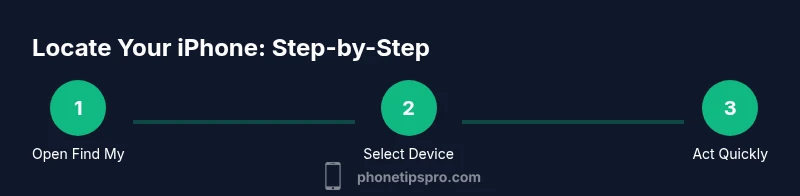
Open Find My app
Launch Find My on your iPhone. If you cannot access it, you can use iCloud.com from any browser and sign in with your Apple ID. This step establishes your first control point for location my iphone.
Tip: If Find My isn’t visible, update iOS and ensure you’re signed into iCloud. - 2
Select your device
In the Devices list, tap the iPhone you want to locate. The map will display the device’s current location if online, or the last known location if offline.
Tip: If the device isn’t listed, confirm Find My iPhone is enabled on that device and signed into the same Apple ID. - 3
Use actions to locate
Choose Play Sound to help you hear the device, Lost Mode to display a message on the screen, or Directions to navigate to its location. These actions require network access.
Tip: Lost Mode locks the device and remotely displays contact information for quick recovery. - 4
Mark as Lost or erase if needed
If you’re worried about data, enable Lost Mode or choose Erase This Device. Erasing is permanent and should be used only when recovery seems unlikely.
Tip: Always try Lost Mode before erasing. Erase should be your last resort. - 5
Verify recovery and security
After taking action, monitor the device’s status. If it reappears, you can unlock and secure it. If you can’t recover it, follow up with Apple Support for next steps.
Tip: Keep your Apple ID secure and update recovery options after recovery. - 6
Cross-check via iCloud.com
If you don’t have the iPhone on hand, log in to iCloud.com and use Find iPhone there as an alternative route to locate or manage the device.
Tip: Use both interfaces for reliability, especially if one is temporarily unavailable.
FAQ
Can I locate a lost iPhone if it’s turned off?
If the device is off, Find My will show the last known location rather than real-time updates. You’ll be able to see it again once the device reconnects to the internet.
If it’s off, you’ll see the last known location until it reconnects to the internet.
What if location isn’t updating after I’ve tried?
Check that Location Services are enabled, the device has internet access, and you’re signed into the correct Apple ID. Refresh the map and try again after a few minutes.
Make sure the device is online and Location Services are on, then try again after a few minutes.
Is it legal to track someone else’s iPhone?
Only track devices you own or have explicit permission to locate. Using Find My to monitor someone without consent can violate privacy laws.
Only track devices you own or have permission to locate.
Can I locate without internet access?
No. Location updates require a network connection, either cellular data or Wi‑Fi, for real-time location to be reported.
You need an internet connection for location updates.
What happens after I erase remotely?
Erasing remotely wipes data and locks the device. You won’t be able to locate the device after erasure.
Erasing removes data and ends tracking.
Watch Video
Quick Summary
- Enable Find My for every iPhone you own.
- Use Find My app and iCloud.com for reliability.
- Lost Mode keeps data safe during a recovery attempt.
- Offline devices show last known location until they reconnect.