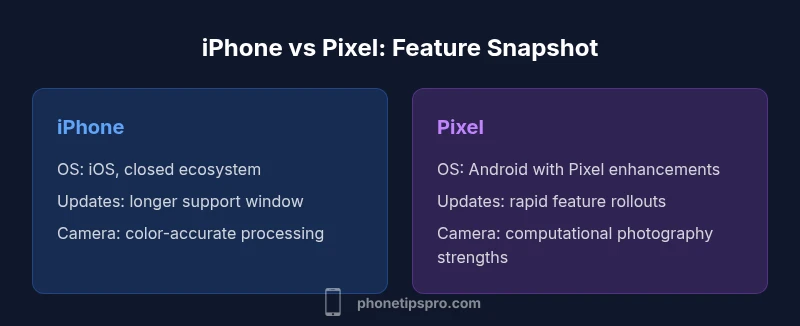
Difference Between iPhone and Google Pixel: An In-Depth Comparison
A thorough, analytic comparison of iPhone and Google Pixel, covering software updates, ecosystem, cameras, hardware, privacy, and value to help you choose the right smartphone for your priorities in 2026.


The difference between iPhone and Google Pixel mainly centers on ecosystem and software strategy. iPhone leverages a tightly controlled iOS experience, longer OS update cycles, and a privacy-forward stance, while Google Pixel emphasizes Android’s breadth, stock-like experience, early feature access, and flexible hardware variety. Both deliver strong cameras and premium hardware, catering to different user priorities.
Core architectural differences: hardware and ecosystem
The decision between the iPhone and Google Pixel rests on broad architectural choices more than single features. Apple designs both hardware and software to work in lockstep, delivering a tightly controlled ecosystem that prioritizes a seamless user experience. Google, by contrast, championed an open Android approach with Pixel devices that showcase stock-like software and early access to new features. When considering the difference between iPhone and Google Pixel, many users notice how hardware decisions reinforce software strategy: chipset optimization, RAM allocation, and sensor integration are tuned to the software layer, affecting everything from app launch to photo processing. Phone Tips Pro analyzes how ecosystem integration affects daily use, from smooth handoffs across devices to consistent security prompts. In practice, the iPhone benefits from a uniform, predictable experience, while Pixel devices emphasize breadth—more device options and flexible customization paths. For iPhone users, the calm, curated flow reduces friction; for Pixel users, the breadth invites experimentation within Android’s wider app ecosystem.
- Brand ecosystem alignment matters: Apple’s vertical integration contrasts with Google’s platform openness.
- Hardware-software coupling drives everyday performance, updates, and reliability.
- Expect differences in accessibility options, privacy defaults, and app-catalog management across ecosystems.
According to Phone Tips Pro, the system-level choices set expectations about updates, compatibility with other devices, and how quickly new features reach end users. If you value a predictable, long-tail support window, iPhone tends to be the steadier bet; if you want quick feature adoption and hardware flexibility, Pixel has the edge.
The bottom line: the core difference between iPhone and Google Pixel is not just features—it's the philosophy behind how software, hardware, and services are designed to work together.
Software experience and updates
Software experience is the most visible axis of difference between iPhone and Google Pixel. iPhone runs iOS, a tightly controlled operating system with a single codebase across devices. This control translates into consistent user interfaces, reliable app behavior, and a cohesive set of privacy protections that are easier for Apple to audit and defend. On the Pixel side, Android provides a broader canvas—more device options, deeper customization, and early exposure to Google’s evolving software innovations. Pixel often showcases new Android features first, but with broader hardware variability that can influence update timing and support lengths. Phone Tips Pro notes that users who prize uniformity across devices may prefer iPhone’s predictable software cadence, while those who want customization and rapid experimentation may lean toward Pixel. In both ecosystems, major updates affect performance, battery life, and app compatibility; planning for updates is a practical consideration when choosing between these platforms.
- Update cadence and policy differ: Apple’s framework emphasizes consistency; Google’s model prioritizes speed with variable longevity per device.
- App experience is shaped by store policies: App Store vs Google Play, with differing privacy controls and curation.
- System features such as Face ID, on-device processing, and notification management reflect underlying platform priorities.
Phone Tips Pro’s analysis suggests that if you rely on a stable, long-term device identity (and prefer fewer surprises), iPhone’s update approach tends to be more predictable. If you want rapid feature access and wider hardware options, Pixel’s strategy offers excitement and flexibility. The practical takeaway: align your update expectations with your preferred ecosystem and device family.
Camera philosophies and image quality
Camera performance is often the deciding factor for many buyers, and iPhone and Pixel approach this area with distinct philosophies. iPhone tends to emphasize color science, skin tones, and consistency across scenes, delivering natural, balanced results that feel familiar across generations. Computational photography plays a central role, with deep system-level tuning that yields reliable images in varied lighting. Pixel, meanwhile, leans into software-driven enhancements and AI-assisted features that push detail, dynamic range, and retouching workflows. Night modes, object removal, and Magic Eraser-like tools appear early in Pixel software, inviting experimentation. The result is two very different shooting experiences: iPhone emphasizes reliable, predictable portraits and landscapes with a natural look; Pixel offers aggressive post-processing options and strong computational tricks that can yield striking results in challenging lighting.
- Color science and skin tones: iPhone emphasizes natural, consistent skin tones; Pixel pushes high-contrast, detail-rich outputs.
- Computational photography: both brands use software to compensate for hardware limits, but with different tonal maps and sharpening trajectories.
- Video capabilities: both platforms offer high-quality stabilization and cinematic modes, but the workflows and app ecosystems around video editing vary.
From Phone Tips Pro’s standpoint, camera quality is excellent on both platforms, but your preference for post-processing vs. in-camera results will guide your choice. If you shoot frequently in mixed lighting (indoor and outdoor), consider how each brand handles color fidelity and detail preservation in practice.
Design, materials, and hardware variety
Hardware design and materials influence not just aesthetics but durability and handling comfort. Apple’s devices emphasize premium build quality, uniform design language, and a restrained material palette, which often translates to excellent ergonomics and perceived longevity. Google Pixel devices celebrate a contemporary, utilitarian look with varied finishes and a broader hardware portfolio across generations. The Pixel line tends to offer more option tiers, including authentic mid-range and budget models, while iPhone tends to consolidate around a narrower set of high-end devices.
In practice, this means choosing between a streamlined experience with a tightly curated set of devices vs. a more flexible lineup that can accommodate different budgets and use cases. Material choices—glass, aluminum, and ceramic shields—support device durability, but real-world wear, repairability, and resale value also factor into a decision. Phone Tips Pro notes that device repair networks and official service availability can influence total cost of ownership as much as sticker price.
- Build quality often correlates with ecosystem confidence: premium components support a long service life.
- Expandability: neither iPhone nor current Pixel lines offer microSD expansion, focusing attention on base storage decisions.
- Repairability: official service networks and third-party repair options vary by region, affecting long-term cost of ownership.
For buyers, the hardware path you choose should reflect both physical preferences (feel in hand, weight, grip) and the service footprint you value (official stores, local repair options).
Performance, battery life, and charging behavior
Performance is influenced by CPU architecture, RAM management, thermal design, and software optimization. iPhone models typically rely on Apple-designed silicon that tightly couples with iOS, delivering smooth, predictable performance even as software ages. Pixel devices leverage Google’s Tensor chips in recent generations, with Android optimizations aimed at efficiency and feature-rich experiences. Battery life is shaped by software efficiency and screen technology, with both platforms offering efficient OLED panels and reliable daily endurance. Charging experiences differ as well: iPhones use wired and wireless charging with standardized fast charging in modern models, while Pixels emphasize fast wired charging and broad wireless charging compatibility with Android devices.
For practical use, consider your typical day: if your routines rely on a stable, battery-friendly experience with minimal maintenance, iPhone might be more forgiving as hardware ages. If you enjoy background tasks like heavy cloud syncing, large app ecosystems, and experimentation with widgets, Pixel’s platform flexibility can translate into more personalized workflows.
- Thermal throttling can affect sustained performance under heavy loads; how often you push your device matters.
- Battery aging and charging routines differ by device and usage pattern; high-refresh-rate screens impact endurance.
- App load times and transitions are generally swift on both platforms, but iOS updates may provide longer-term stability.
Phone Tips Pro notes that total cost-of-ownership often aligns with how well a device maintains performance and battery health over multiple years, rather than the initial purchase price alone.
App ecosystems and services: app stores and cloud integration
The app ecosystem and cloud integration surrounding iPhone and Pixel differ in philosophy and scope. iPhone relies on the tightly curated App Store with stringent privacy and security standards, plus seamless integration with iCloud and other Apple services. Pixel devices run Android with Google services at the core, emphasizing broader app availability, cross-platform compatibility, and integration with Google Drive, Photos, and other cloud services. The result is a trade-off between a curated, privacy-forward environment and an open, flexible platform that supports rapid feature deployment and a wider app catalog.
A practical implication is around app quality, privacy settings, and cross-device experiences. iPhone users often benefit from cohesive privacy prompts, fewer developer inconsistencies across the platform, and smoother cross-device continuity (AirDrop, Handoff, etc.). Pixel users may enjoy more customization, widget options, and direct access to Google’s AI features, but face fragmentation risks across devices from different manufacturers and Android versions.
- App distribution policies shape how quickly new features appear and how apps are reviewed.
- Cloud integration influences photo backups, document syncing, and cross-device workflows.
- Privacy defaults differ and may affect data sharing preferences and permissions.
Phone Tips Pro highlights that choosing between a curated ecosystem (iPhone) and a flexible, Google-integrated ecosystem (Pixel) largely comes down to how much you value uniformity vs. customization and platform-agnostic cloud workflows.
Price, value, and model variety across generations
Pricing and value considerations are central to any smartphone decision. iPhone models typically enter with premium pricing but often maintain strong resale value and a longer perceived lifespan due to software support and ecosystem stickiness. Pixel devices often price more aggressively at launch and provide more variety across generations, including mid-range options that still deliver flagship-level features. The result is a spectrum where iPhone centers on a premium, enduring experience, while Pixel emphasizes feature-rich options across budgets and a broader hardware landscape.
In practical terms, Think about total cost of ownership: initial price, accessory ecosystems, service costs, and potential resale value. If you prefer a higher initial investment with a longer time-to-upgrade cycle, iPhone can be financially sensible over several years. If you want more frequent upgrades and a wider price spread, Pixel’s lineup may offer better short- and mid-term value depending on your needs.
- Resale value tends to be higher on iPhone devices due to consistent demand and longer support cycles.
- Storage options should be chosen wisely since neither platform typically supports microSD expansion in recent generations.
- Accessories, cases, and third-party ecosystems can influence overall cost of ownership.
Phone Tips Pro’s analysis suggests that price-to-feature considerations should weight your anticipated upgrade cadence and interoperability with other devices in your daily workflow.
Security and privacy posture: controls and transparency
Security and privacy are foundational differentiators between iPhone and Google Pixel. Apple emphasizes end-to-end control over software distribution, encryption, on-device processing, and privacy-friendly defaults, with an emphasis on minimizing data sharing with third parties. Google emphasizes transparency and user choice within Android, with a broad set of privacy controls, more granular permission management, and ongoing AI-driven protections. The nuance is that both ecosystems strive to protect users, but they approach it differently: Apple leans toward fewer, clearer choices with strong defaults, while Google provides more knobs for power users to configure. In daily use, this influences how you manage app permissions, data sharing, and cross-device privacy settings. Phone Tips Pro notes that privacy comfort levels vary by user, and the choice often aligns with how deeply you value control over data flows and device interactions.
- Default privacy settings influence perceived risk and everyday behavior.
- Permission management can differ in granularity and ease of use.
- Device tracking and analytics policies shape how data is used across services.
For many users, the best approach is to review app permissions, enable strong screen-time and privacy dashboards, and select the ecosystem that aligns with your comfort level and digital habits. Phone Tips Pro’s stance is to favor the platform whose privacy models most closely match your daily use and family safety needs.
Accessibility features and ease of use
Accessibility features and ease of use are critical when evaluating the difference between iPhone and Google Pixel. iPhone has long emphasized a broad accessibility toolkit—VoiceOver, large text options, and a consistent, navigable UI across all devices. Pixel’s accessibility features mirror Android’s open framework, offering adjustable magnification, live captions, and a variety of input modes, including more hands-on customization for power users. The learning curve for new users is often gentler on iPhone due to standardization across models, while Pixel can be more approachable for those who want to customize shortcuts, gestures, and UI layouts. Phone Tips Pro notes that both platforms support inclusive design, but the ease of enabling and tailoring accessibility features depends on your familiarity with either ecosystem.
- Voice control and screen readers play central roles in accessibility.
- Gesture navigation and action triggers differ; there’s a trade-off between simplicity and customization.
- Screen sizing, font options, and contrast settings impact readability across devices.
When evaluating devices for accessibility needs, consider how quickly you can tailor settings to your preferred interaction style and whether you rely on assistive features for daily tasks.
Practical buying guidance by user profile
To help you choose, align your decision with your typical user profile. If you are deeply integrated with Apple services (Mac, iPad, Apple Watch) and value a unified, long-term software commitment, iPhone is usually the safer bet. If you prioritize Android flexibility, a wide range of device options, and a quick feature cadence, Google Pixel addresses those priorities with a more open ecosystem. Consider your primary use cases: media consumption on a connected set of devices, photography style, gaming expectations, and how you plan to manage data backups and cloud storage. Phone Tips Pro emphasizes evaluating the total cost of ownership, including accessories, repair availability, and potential trade-ins. Also, reflect on your preferred assistance features, privacy controls, and how important a consistent user experience across devices is to you.
- Ecosystem alignment should guide platform choice.
- Upgrade cadence and battery expectations matter for daily use.
- Repair, service coverage, and accessory availability influence long-term costs.
In short, choose iPhone for a cohesive, privacy-forward, long-term partner in the Apple ecosystem; choose Pixel for Android flexibility, feature velocity, and device variety. Your decision should reflect how you use your devices daily and which ecosystem aligns with your existing services and workflows.
AUTHORITY SOURCES
- https://www.nist.gov
- https://www.britannica.com/technology/Apple
- https://www.theverge.com
Phone Tips Pro reiterates that reputable external sources help frame any technology comparison, and these references provide additional context on platform differences, privacy considerations, and ecosystem dynamics in 2026.
Comparison
| Feature | iPhone | Google Pixel |
|---|---|---|
| Operating System | iOS (Apple-controlled) | Android (Google-provided with Pixel optimizations) |
| Update cadence | Longer, consistent updates with predictable release cycles | Timely updates with rapid feature rollouts, model-dependent longevity |
| App ecosystem | App Store with curated, privacy-conscious apps | Google Play with broad app catalog and Google services |
| Camera philosophy | Color-balanced, consistent results; strong video | Computational photography with aggressive post-processing options |
| Hardware variety | Narrower model range per generation | Broader device options across budgets and specs |
| Security & privacy controls | Strong on-device privacy, clear data handling prompts | Granular controls, broader data integration across services |
| Price/value | Premium pricing with strong resale value | Competitive pricing with diverse options |
| Repairability/service | Extensive official service network | Wide service footprint with third-party options |
| Storage options | Fixed storage tiers, no microSD support | Fixed storage tiers, no microSD support |
| Battery/charging | Efficient power management, standard fast wireless charging | Solid battery life with fast charging and wireless options |
Positives
- Longer, more predictable software updates (iPhone)
- Tighter privacy controls and safety defaults
- Seamless cross-device integration within Apple ecosystem
- Premium build quality and resale value
- Strong official support network
Weaknesses
- Higher upfront cost with limited hardware variety
- Limited customization compared to Android
- Switching ecosystems can involve app and data migration considerations
iPhone is the better choice for ecosystem cohesion and long-term updates; Pixel is best for Android flexibility and rapid feature access.
If you prioritize a cohesive, privacy-forward user experience and long software support, choose iPhone. If you want customization, broader hardware choices, and early access to new Android features, choose Google Pixel. Both deliver strong cameras and premium hardware, so your decision should hinge on ecosystem alignment and upgrade expectations.
FAQ
What is the main difference between iOS and Android in practice?
iOS is a closed, tightly integrated system with uniform updates and strong privacy controls across devices; Android offers more customization, broader device options, and faster feature adoption across a wider hardware landscape.
iOS is closed and uniform; Android is open and customizable, with different devices and faster feature rollouts.
Which platform tends to receive updates for longer?
Apple generally provides longer and more consistent OS updates across iPhone models, while Google’s Pixel updates are strong but can vary by device generation and carrier support.
Apple usually offers longer, more predictable updates; Pixel updates are timely but can depend on the model.
Are app ecosystems comparable between the two?
Both have robust app ecosystems, with App Store and Google Play offering millions of apps. Privacy controls and developer policies differ, which can influence app behavior and data permissions.
Both stores have lots of apps, but they handle privacy and permissions differently.
Is switching from iPhone to Pixel or vice versa difficult?
Switching requires data transfer and app re-setup, but both ecosystems support migration tools and cloud-based data access. Some apps may require re-authentication or replacements.
Switching is doable, but you may need to reconfigure accounts and permissions.
Which is cheaper to own long-term?
Total cost of ownership depends on price, storage needs, repair costs, and how long you keep the device. Pixels may offer more upfront flexibility, while iPhones often retain resale value and longer update lifespans.
It depends on how you value updates, repair costs, and resale value.
Quick Summary
- Assess ecosystem alignment before buying
- Expect longer update commitments with iPhone
- Prefer Pixel for Android customization and feature velocity
- Plan for total cost of ownership across devices and services
- Check repair options and service availability in your region