iphone or google pixel: a comprehensive 2026 comparison
A thorough, objective comparison of iPhone vs Google Pixel, analyzing ecosystem, updates, cameras, battery life, pricing, and long-term value for 2026.


Choosing between iphone or google pixel comes down to ecosystem, updates, and how you value camera versus customization. If you want top-tier app quality, long software support, and seamless hardware-software integration, the iPhone is typically the safer bet. If you prefer stock Android, flexible customization, and aggressive pricing, the Google Pixel often delivers a compelling alternative. Phone Tips Pro weighs both sides to guide your choice.
The Core Question: iphone or google pixel?
If you're weighing your options between iphone or google pixel, you're choosing between two of the most active smartphone ecosystems today. The decision goes beyond raw specs and into how you use apps, how updates roll out, and how comfortable you are with a given software philosophy. In 2026, both platforms are mature enough that most features overlap, but the differences still matter for daily life. According to Phone Tips Pro, most users pick one ecosystem as a default and then appreciate the compatibility of a few key apps across platforms. A smaller segment benefits from Android’s openness and the iPhone’s premium hardware, but those advantages are not universal. Your actual choice should hinge on three questions: what matters most to you in day-to-day use, how you handle app purchases and privacy, and whether you anticipate staying within a single ecosystem for several years. This guide compares the two in practical terms, with real-world scenarios to guide the decision.
Quick Ecosystem Fit: iOS vs Android
The iPhone benefits from a tightly controlled ecosystem where hardware and software are designed to work together. This often translates to faster updates, predictable features, and a smoother user experience for people who rely on Apple services like iCloud, Find My, and iMessage. The Google Pixel, by contrast, emphasizes an open Android experience with deep Google service integration and maximum customization for power users. Phone Tips Pro analysis shows that most users value cross-device synchronization and predictable security updates, which commonly favors iPhone for long-term ownership, but the Pixel wins on personalization and immediate access to the latest Android features.
Hardware and Design: Build Quality, Materials, and Ergonomics
Design choices matter as much as specs when you reach for your phone each day. iPhones typically favor premium materials, consistent ergonomics, and bright, color-accurate displays with strong color calibration across models. They also tend to retain resale value well. Pixel devices prioritize clean, minimalist hardware design, sometimes with more accessible repair paths and a emphasis on uniform display quality across the lineup. In practice, both brands use durable glass and aluminum frames, but the perceived premium feel and tactile feedback differ by model, celebration of color accuracy, and software polish. The decision here often comes down to personal touch: a preference for the iPhone’s hand feel and aura of polish versus the Pixel’s straightforward hardware approach and customizable UI.
Camera and Imaging: Photography, Video, and Real-World King Shots
Camera quality remains a decisive factor for many buyers. iPhone cameras are renowned for consistent color science, smooth video capture, and dependable performance in varied lighting. Pixel cameras often excel in computational photography, delivering strong night shots and sharp detail in complex scenes, sometimes prioritizing overall accuracy and dynamic range. Neither brand is “worst” in real-world use, but your photo style matters: if you prioritize cinematic video and a seamless Apple editing workflow, the iPhone shines; if you value software-driven stills, fast post-processing, and a more open photography toolkit, Pixel stands out.
Software, Updates, and Longevity: How Long the Software Supports Your Device
Software support length is a major factor in total cost of ownership. iPhones typically receive multi-year OS updates and security patches, with a high degree of consistency across generations. Pixels also receive timely updates, particularly for security, but the cadence can vary across Google’s hardware lineup. In practice, a well-cared-for iPhone often feels faster for longer thanks to native optimizations and a longer update window. Google’s broader Android ecosystem offers timely features and flexible options, but some devices may see shorter support lifespans depending on the model and carrier constraints. The bottom line is that both platforms have strong support, but the duration and consistency can tilt the decision for long-term owners.
Performance, RAM, and Battery Life: Real-World Behavior and Endurance
Performance benchmarks rarely tell the whole story. Both iPhone models and Pixel devices deliver smooth everyday use, fast app launches, and capable gaming experiences. The iPhone tends to optimize software tightly around the silicon, resulting in consistent, sustained performance with good energy efficiency. Pixel devices focus on balancing background processes and feature-rich software, which can yield excellent daily performance but may feel slightly different under sustained loads. Battery life varies by model and usage, but both ecosystems offer power-saving modes and adaptive brightness that help extend screen-on time in ordinary tasks.
Charging, Accessories, and Everyday Convenience
Charging and accessory ecosystems can influence daily practicality. iPhone models favor MagSafe accessories and a growing—but still proprietary—charging ecosystem that emphasizes wireless convenience. Pixel devices typically ship with USB-C and widely support third-party charging options, with Google’s accessory ecosystem prioritizing cross-brand compatibility. If you value a broad accessory market and universal USB-C charging, Google Pixel has an edge; if you want a refined wireless charging experience and tight integration with your other Apple devices, the iPhone delivers convenience at a premium.
Privacy and Security: Data Protection, App Permissions, and Trust
Privacy and security remain core differentiators. iPhone emphasizes privacy-by-default, with app tracking controls, on-device processing, and strong hardware-backed security features. Pixel devices leverage Google’s security suite and Play Protect, with robust privacy controls that give users more control over data sharing, albeit sometimes at the expense of a perceived simplicity edge. For most users, both platforms offer mature protections, but your comfort with data-sharing and how you manage permissions will guide your preference.
Price, Value, and the Total Cost of Ownership
Price remains a practical consideration. iPhones carry a premium upfront, with strong resale value and long-term software support contributing to cost efficiency over time. Pixels often provide more aggressive launch pricing, frequent deals, and flexible storage options, which can translate to lower initial outlays. The real-world value depends on how long you plan to keep the device, the importance of new features each year, and whether you benefit from trade-in programs. Always consider hidden costs like accessories, extended warranties, and software-subscription services when calculating total cost.
Real-World Scenarios: Who Should Buy Which?
If you live inside the Apple ecosystem, rely on iMessage, AirDrop, and iCloud, the iPhone is typically the most frictionless choice. If you prefer a highly customizable OS, Google services, and a budget-friendly path that prioritizes hardware refresh cadence, the Pixel is a strong alternative. For professional photography or video editing workflows tied to desktop apps, both platforms offer robust pipelines, but the iPhone’s perceived stability makes it a favorite for many creators. And if you want to maximize resale value and a long-term software horizon, Apple’s model lineup remains a compelling option.
Decision Toolkit: How to Choose Quickly
Use this quick checklist to decide in minutes: 1) Do you value a closed, cohesive ecosystem (iPhone) or a flexible Android environment (Pixel)? 2) Is long-term software support a priority? 3) How important is camera performance for your typical shots? 4) Will you benefit from a broad accessory market or seek cross-brand compatibility? 5) What’s your budget, and are trade-in options a deciding factor? Answering these questions helps narrow to one platform with confidence.
Next Steps: How to Try Before You Buy and Finalize Your Choice
Visit a store to hands-on-test both devices, paying attention to feel, weight, and display quality. Compare camera samples under indoor and outdoor lighting, and experiment with OS-specific features you’d actually use, such as app continuity or Google Assistant routines. If possible, borrow a friend’s device to test real-world daily tasks like messaging, photo editing, and app purchases. Finally, use reputable online guides and trial periods to confirm your comfort level with each ecosystem before committing.
Comparison
| Feature | iPhone (Apple) | Google Pixel (Google) |
|---|---|---|
| Ecosystem & platform philosophy | Tightly integrated, privacy-focused, cohesive UX | Open Android experience with broad customization |
| Software updates cadence | Long-term, predictable updates across generations | Timely updates with model-dependent longevity |
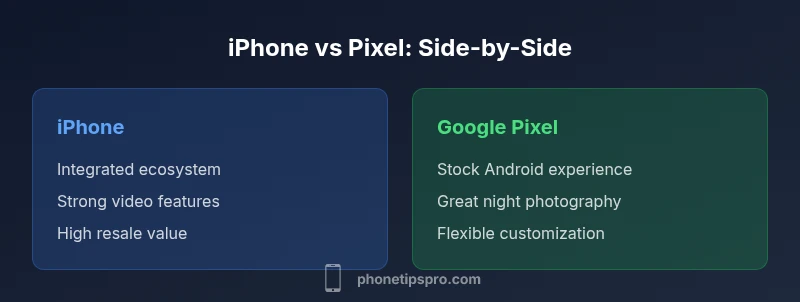
| Camera system emphasis | Consistent color science, strong video features | Computational photography with strong night mode |
| Security & privacy controls | Advanced hardware-backed security, privacy by default | Google security suite with flexible permissions |
| Pricing & value | Premium pricing, high resale value | Competitive pricing with frequent deals |
| Repairability & durability | Iconic build quality with service ecosystem | Accessible parts and repair paths in many models |
| Voice assistant integration | Siri deep in Apple ecosystem | Google Assistant excels across services and devices |
Positives
- Strong, cohesive user experience within the chosen ecosystem
- Excellent long-term software support and security updates
- Resale value remains high for iPhone models
- Pixel offers highly customizable Android experience and competitive pricing
- Broad accessory ecosystem and flexible charging options
Weaknesses
- Premium upfront price on many iPhone models
- Android updates can vary by Pixel model and carrier
- Cross-brand compatibility can introduce fragmentation in some workflows
- iPhone may force you into Apple’s ecosystem for best results
Both smartphones excel in their own right; choose based on ecosystem priorities and feature emphasis.
If you prize a seamless, privacy-focused ecosystem and long software support, iPhone is the safer bet. If you want Android customization, value-driven pricing, and Google service depth, Pixel is a strong alternative with compelling features.
FAQ
Which phone lasts longer on a single charge in typical use?
Both devices offer strong battery performance, but the outcome depends on your use pattern. iPhone models tend to optimize for steady battery life with app efficiency, while Pixel devices emphasize adaptive battery features and consistent background management. If you’re a heavy user on data and cameras, run a real-world test to see which lasts longer for your routine.
In everyday use, both perform well, but battery longevity will depend on your habits. Try a hands-on test to see which one fits your day.
Is the software experience better on iPhone or Pixel?
Software experience depends on preference. iPhone offers a highly polished, consistent interface with tight app integration, while Pixel provides a more flexible, customizable Android experience with quick Google service access. If you value predictability, choose iPhone; if you want customization, choose Pixel.
If you like consistency and Apple’s polish, pick iPhone. If you want customization and Google features, pick Pixel.
Which device gets updates for longer?
iPhones typically receive longer, uninterrupted OS updates across generations, contributing to longer device relevance. Pixels also receive timely security updates, but update longevity can vary by model. Consider planned upgrade cycles when evaluating long-term value.
iPhone generally gets longer support, but Pixel updates are solid too; check the model’s update policy.
Which is better for photography and video?
Both platforms offer strong photography and video tools. iPhone emphasizes color consistency and video features; Pixel emphasizes computational photography and night modes. Your preference for color rendering or post-processing features will guide the choice.
iPhone leans toward polished color and video; Pixel leans toward advanced computational imaging.
How should I think about price vs value?
Price and value hinge on ownership horizon. iPhones carry premium prices but retain resale value and long-term software support, boosting total cost of ownership. Pixel devices often start with lower upfront costs and deal patterns, which can reduce initial expense but may influence long-term costs depending on updates and repairs.
Premium upfront with high resale for iPhone; lower upfront with variable long-term value for Pixel.
Should I switch from iPhone to Pixel or vice versa?
Switching is easiest when you map your current workflows to the target platform. In general, moving to iPhone benefits users deeply invested in Apple services; moving to Pixel benefits those who want Android customization and Google ecosystem features. Test core apps, messaging, and cloud services before committing.
Switch if your daily workflows align with the target ecosystem; try essential apps first.
Quick Summary
- Choose iPhone for ecosystem depth and long-term updates
- Choose Pixel for customization and value-oriented deals
- Camera quality is strong on both; pick based on your shooting style
- Software updates and security are solid on both; plan for ownership horizon
- Test real-world tasks in-store before buying