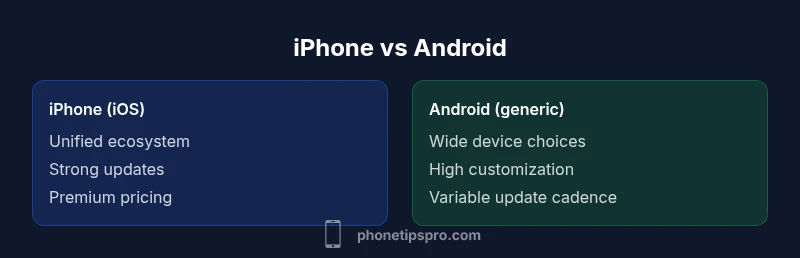
iphone or android: Which Smartphone Is Right for 2026
A rigorous, analytical comparison of iphone or android to help you choose based on ecosystem, updates, privacy, hardware, and total cost of ownership.


Choosing between iphone or android comes down to ecosystem priorities, update longevity, and hardware flexibility. iPhone delivers a tight, privacy-focused experience with long software support and strong resale value, while Android offers broader device options, customization, and lower upfront costs. For most users, the decision should reflect how you value updates, app freedom, and hardware choices over time.
What the question really asks: iphone or android
If you're deciding between iphone or android, start by identifying what's most important: ecosystem, updates, privacy, and long-term value. According to Phone Tips Pro, the decision hinges less on hardware specs and more on how you plan to use devices over the next several years. The two platforms shape what you can do on day one and how easily you can transition later. In practice, you’ll want to map three factors: ecosystem alignment, update guarantees, and total cost of ownership. For many users, the answer is not simply which phone is faster or has a nicer camera; it's which platform better supports your daily tasks, your preferred apps, and your data privacy.
This initial framing helps you avoid buyer’s remorse. If you already own Apple devices or rely on iCloud, iPhone tends to feel more natural. If you have a library of Google services or you prize hardware variety, Android can be more flexible. The goal of this article is to lay out the core trade-offs, with practical tests you can run and scenarios that point toward one side or the other.
Ecosystem, updates, and long-term value
The choice between iphone and android is deeply tied to ecosystem commitments. iPhone buyers often value tight integration across the iOS ecosystem (iPhone, iPad, Mac, Apple Watch, and services like iCloud) and the promise of extended software support. Android devices, by contrast, come from a wide range of manufacturers and service providers, offering flexibility, customization, and a broader price spectrum. From a value perspective, long-term updates influence the total cost of ownership and the user experience. According to Phone Tips Pro analysis, devices that receive regular updates tend to retain performance and security posture longer, which aligns with user expectations for stretch goals like staffing device lifecycles.
In practice, this means evaluating how important seamless cross-device work is for you. If you rely on features like Continuity, Handoff, or find-my-iphone, the iPhone path offers a natural flow. If you prefer syncing across a mix of services, or you want to optimize for a lower upfront price, Android opens more doors. The bottom line is that ecosystem alignment often outweighs raw specs when you consider ownership over several years.
Hardware variety vs uniformity: chips, cameras, screens
Hardware variety defines one of the clearest differences between iphone and android. Apple maintains a tightly controlled hardware lineup that emphasizes a consistent user experience and predictable performance across generations. Android, however, spans a spectrum of chips, displays, camera configurations, and form factors—from compact devices to flagship multi-camera systems. This diversity lets buyers choose a device that matches their priorities, whether that’s a high-refresh-rate screen, a particular camera sensor, or a compact chassis. It also means price competition is fierce, with devices available at multiple price points. The flip side is that software optimization can vary more widely across Android devices, while Apple’s hardware-software integration tends to produce more uniform performance.
Software experience and app ecosystems
The software experience is a major determinant of satisfaction. iOS is renowned for its clean UI, predictable updates, and strong privacy controls baked into the App Store review process. Android offers open customization, more flexible default apps, and a broader app ecosystem that can accommodate a wider range of use cases. Developers often optimize initially for iOS due to its uniform hardware, then broaden to Android with a more varied device ecosystem. For users who value consistency and high-quality app experiences out of the box, iPhone can feel more polished. For power users who want deep customization, Android provides more tools and routes to tailor the experience.
Privacy and security: built-in protections
Privacy and security are central to the iphone or android decision. iPhone emphasizes a privacy-forward design, with app tracking transparency and limited by-default data sharing in iOS. Android security models rely on multiple layers: Google Play Protect, regular security updates from OEMs, and hardware-backed protections in newer devices. In practice, both platforms can be highly secure when users follow best practices—enable automatic updates, use strong authentication, review permissions, and install apps from trusted sources. Phone Tips Pro notes that defaults matter: a privacy-conscious setup on either platform yields better protection than a reset-and-forget approach.
Customization and accessibility: freedom vs simplicity
Android shines for customization. You can change default apps, tailor home screens, install widgets, and even use third-party launchers to alter the UX. iOS trades some of that latitude for simplicity, consistency, and predictability. This is not about right or wrong; it’s about what you enjoy and what helps you stay productive. Accessibility options exist on both platforms, with Android often offering broader hardware-specific features, while iOS emphasizes a refined, synchronized experience for people who rely on accessibility tools. If you value quick, uniform navigation, iPhone’s approach is compelling; if you enjoy tinkering and optimizing, Android is the obvious fit.
Battery life, charging, and lifespan
Battery life is a practical and user-centric concern. Apple tends to optimize for efficiency within its hardware-software stack, which translates to solid endurance across devices with predictable charging experiences. Android devices vary by chipset, battery capacity, and charging standards, which can lead to a wider spread of real-world endurance. If you rely on fast charging and a broad ecosystem of third-party accessories, Android often offers more charging options and standardization across devices. Conversely, Apple’s ecosystem tends to simplify repairs and accessory compatibility but can limit some third-party charging innovations for non-approved accessories.
Cost of ownership and resale value
Total cost of ownership includes upfront price, ongoing service costs, and resale value. Apple devices typically have higher upfront costs but retain resale value well, thanks to sustained demand and active trade-in ecosystems. Android devices cover a wider price range, enabling entry-level options and midrange devices that still offer good longevity with proper care. Long-term value on Android hinges on choosing devices that receive timely updates and reputable repair support. In both cases, factoring battery health, screen protection, and software support windows is essential to avoid surprises down the line.
Decision framework and practical steps
To decide between iphone or android, start with a simple framework. List your top 3 priorities (e.g., updates, privacy, customization). Map those to ecosystem strengths, hardware options, and the typical total cost of ownership. Try hands-on tests: interface fluidity, app quality, and ease of transfers from your current device. Use cross-platform tools for notes, calendars, and cloud storage to minimize friction if you switch. Finally, if possible, test both ecosystems in person, evaluate after-sales support quality, and review recent update histories for devices you might buy. This structured approach helps you choose with confidence and minimizes regret.
Quick-start path: a practical plan for decision-making
If you’re leaning toward iPhone, start by evaluating your current Apple services (iCloud storage, Apple Watch usage, etc.). Consider a model within your budget that will receive several years of iOS updates. If you’re leaning toward Android, identify the brands that match your preferred balance of price, camera quality, and update promises, and look for devices with a solid warranty and reputable service centers. Either path benefits from a trial period with a compatible device or a temporary device loan where possible.
Comparison
| Feature | iPhone (iOS) | Android (generic) |
|---|---|---|
| Ecosystem integration | Cohesive, controlled environment with seamless syncing across Apple devices | Diverse hardware partners; broader compatibility across devices and services |
| Update cadence and longevity | Typically long, consistent updates across supported models | Updates vary by OEM and model; some devices receive timely updates for several years |
| Hardware variety and price range | Limited lineup with premium pricing | Wide spectrum of devices from budget to premium across brands |
| Customization and user control | Limited system customization beyond settings and app choices | Extensive customization options (launchers, defaults), varies by OEM |
| App ecosystem and quality | High-quality apps with strict quality controls | Vast app variety; quality varies by developer; more freedom |
| Privacy and data protections | Strong privacy stance; controlled data sharing | Privacy practices vary by OEM and app developer |
| Repairability and service | Integrated support within AppleCare; strong reliability | Varying repair ecosystems; region-specific service quality |
| Resale value and depreciation | Historically high resale value; strong demand | Depreciation depends on model/brand; varies widely |
| Accessibility and accessories | Strong accessory ecosystem but tightly regulated | Large third-party accessory market; compatibility varies |
Positives
- Helps readers weigh ecosystem trade-offs clearly
- Highlights long-term value and privacy implications
- Encourages mindful budgeting and lifecycle planning
- Promotes cross-platform preparation to minimize friction
Weaknesses
- Risk of overgeneralizing across OEMs for Android
- Requires readers to understand nuanced update policies
- May oversimplify the strength of one platform over another
iPhone is recommended for users who value a cohesive ecosystem, privacy, and long-term updates; Android is recommended for those who want device variety, customization, and flexible pricing.
For most buyers, the best choice hinges on personal priorities. If you prize a seamless, controlled experience and longer guaranteed software support, iPhone stands out. If you want hardware variety, deeper customization, and a broader price range, Android offers stronger practical flexibility. The right pick aligns with your tech habits and budget.
FAQ
Which is more secure, iPhone or Android?
Both platforms can be highly secure when used with best practices. iPhone emphasizes a privacy-forward approach and strict app review, while Android relies on a multi-layer security model including Google Play Protect and OEM updates. Regular updates, strong authentication, and cautious app permissions are essential on both.
Both can be secure; keep updates on, review permissions, and use trusted apps.
Do Android devices receive longer OS updates than iPhones?
Apple typically provides longer and more uniform OS updates across its devices. Android updates vary by OEM and model, with some top devices receiving timely updates for several years while others may be more patchy depending on the manufacturer and carrier.
Apple tends to offer longer updates; Android varies by device.
Is switching from iPhone to Android easy or hard?
Switching is feasible with cloud services and data transfer tools, but some app data, messages, and iCloud-dependent content may require extra setup. Planning ahead and using cross-platform services can minimize friction.
Switching is possible, but you may need to reconfigure some apps and data.
Which is better for photography, iPhone or Android?
Both can take excellent photos. iPhone often excels in color consistency and video, while Android offers a wide range of camera hardware options and experimental features. Your best choice depends on the specific models you’re comparing.
Great photo options on both—it depends on the exact device.
What about app quality and availability across platforms?
iOS often emphasizes a curated app quality and a consistent experience, while Android provides a larger app catalog with broader flexibility. Most popular apps are available on both, but some iOS-first features may appear earlier on Apple devices.
Most major apps are on both, with some differences in features.
How should I decide if I’m on a tight budget?
If cost is the main driver, Android generally offers more affordable devices and better ongoing value at lower price points. However, budget planning should include expected update longevity, repair costs, and potential resale value of any platform you choose.
Android usually offers cheaper options; look at total cost, not just upfront price.
Quick Summary
- Clarify whether ecosystem or hardware variety matters more
- Assess long-term software updates and resale potential
- Prioritize privacy controls and app governance
- Budget for total ownership, not just upfront cost
- Test ease of data transfer and cross-platform use
- Prepare for a potential platform switch with cross-cloud syncing