iPhone vs Android 2025: In-Depth Smartphone Comparison
A data-driven, analytical comparison of iPhone and Android in 2025, covering OS updates, hardware, software ecosystems, privacy, pricing, and user experience to help you choose the right platform.


When comparing iPhone and Android in 2025, your best choice hinges on priorities: IPhones excel in privacy, seamless hardware-software integration, and longer OS support, while Androids shine with customization, device variety, and more flexible pricing. For most users, the decision comes down to ecosystem commitment vs. flexibility and price range.
Context and the 2025 Mobile Landscape
According to Phone Tips Pro, the iphone vs android 2025 conversation reflects a dual trajectory: Apple’s emphasis on privacy, longevity, and a tightly controlled ecosystem contrasts with Android’s strength in customization, broad device range, and competitive pricing. As devices proliferate, the question isn’t simply which is better, but which aligns with your daily workflows, app habits, and hardware preferences. In 2025, both ecosystems have matured: iOS emphasizes unified experiences across a narrower hardware set, while Android emphasizes choice across a wide spectrum. This article will unpack the major levers—updates, hardware strategy, software ecosystems, privacy, and cost—to help you decide which path suits you best, informed by Phone Tips Pro Analysis, 2026.
Methodology and Evaluation Criteria
To deliver a fair, actionable comparison, we benchmark iPhone and Android against a consistent set of criteria: OS updates and security posture, hardware variety and design language, app ecosystem maturity, user experience and accessibility, privacy controls and data governance, pricing dynamics and total cost of ownership, and upgrade/integration opportunities with other devices. We also consider real-world use cases such as work environments, photography needs, gaming, and accessibility. The goal is to present objective differences without oversimplification, so readers can map their priorities to a platform. This framework helps ensure the iphone vs android 2025 analysis stays focused on what matters most to users in 2026 and beyond.
Updates, Security, and Longevity
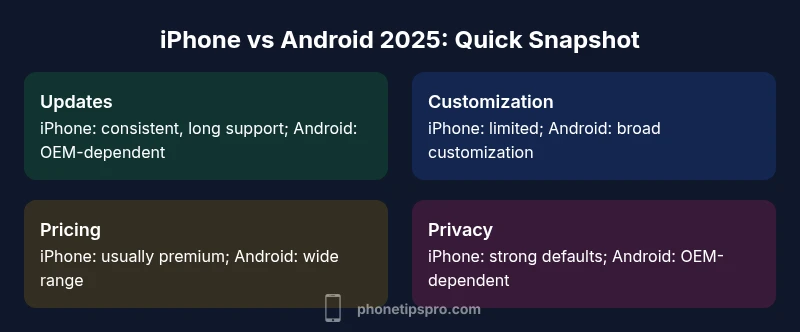
Update cadence and security practices are a central differentiator. iPhones typically benefit from predictable, multi-year software support, with major iOS releases arriving annually and extended back-compatibility for many devices. Android presents a more variable picture: updates can depend on OEMs, carriers, and device tier, though Google’s commitments for Pixel devices and major OEM programs have improved consistency in recent years. For users who prize long-term security, Apple’s model often reduces fragmentation risk, while Android users can opt into a broader set of devices with varying update timelines. In both ecosystems, choosing devices with strong update commitments and timely security patches correlates with longer device lifespans and better resale value.
Hardware Design, Longevity, and Repairability
Hardware strategy shapes daily use in tangible ways. iPhone hardware emphasizes a compact, tactile experience with tight software-hardware integration and high resale value. Android hardware spans a wider range of form factors, screen sizes, and price points, enabling deeper customization but sometimes at the cost of uniformity and repairability. Repairability varies by model and region; Apple’s ecosystem often emphasizes service quality and unified repair channels, while Android devices may offer more third-party repair options and modular accessories. For many users, the decision comes down to whether you value a consistent design language and guaranteed parts availability (iPhone) or the flexibility to mix devices, screens, and components (Android).
Software, Apps, and Ecosystem Maturity
App ecosystems influence everything from everyday tasks to enterprise workflows. iOS apps are typically optimized for a consistent hardware baseline, which can translate to polished, performance-tuned experiences. Android offers broader device compatibility and a vast app catalog, though some apps may vary in performance across devices due to hardware diversity. The ecosystem also influences peripherals, cloud services, and cross-device continuity. If you rely on features like AirDrop, iCloud, or iMessage, Apple’s ecosystem delivers strong cross-device continuity; Android users often leverage Google services and a broad assortment of compatibility options across devices and wearables. Over time, both ecosystems have matured, but the choice often hinges on which app ecosystem aligns with your daily workflows.
Privacy, Data Control, and Trust
Privacy remains a core differentiator. Apple emphasizes privacy by design, with transparent app permissions, on-device processing, and limited data collection practices embedded in iOS. Android’s privacy controls are substantial but can vary by manufacturer and customized UI. For privacy-focused users, the iPhone path often provides more built-in controls and fewer data-sharing defaults; for those who prioritize control and transparency at a granular level, Android offers more explicit customization of permissions and data flows. In 2025, the landscape continues to evolve as regulators scrutinize data practices and OEMs respond with new privacy features and settings.
Pricing, Value, and Total Cost of Ownership
Pricing dynamics influence long-term value. iPhones typically carry a premium upfront and strong resale value, while Android devices span budget to premium tiers, offering wide affordability and frequent promotions. Total cost of ownership compares not only the sticker price but also maintenance, software longevity, and accessory ecosystems. While Android can deliver budget-friendly options, long-term value hinges on software support, durability, and whether you prioritize short-term savings or long-term stability. Readers should weigh upfront cost, device lifespan, and future upgrade plans when evaluating the iphone vs android 2025 decision.
Buyer Personas: Which Path Fits You Best
If you prioritize a seamless, tightly integrated experience with a consistent software journey, the iPhone route often minimizes friction and maximizes reliability. If you value customization, hardware variety, and budget flexibility, Android presents greater latitude to tailor devices to your exact needs. For families, workplaces, or students with specific app or device requirements, mapping your daily tasks to platform strengths helps narrow the choice quickly. In 2025–2026, the best decision remains highly personal and situational, not purely technical.
Comparison
| Feature | iPhone (Apple) 2025 | Android (Google/various) 2025 |
|---|---|---|
| OS updates cadence | Strong, predictable updates with multi-year support | Variable; improvements but depends on OEM/model (3–5 years typical) |
| Price range at launch | Typically premium pricing; higher upfront cost | Wide spectrum from budget to premium across devices |
| Hardware variety | Controlled hardware set; cohesive design | Extensive models, sizes, and specs across brands |
| App ecosystem maturity | Highly polished apps optimized for iOS | Massive catalog; broader device compatibility but occasional fragmentation |
| Privacy controls | Strong, integrated privacy features; on-device processing | Flexible controls; privacy varies by OEM/UI and settings |
| Repairability and longevity | Strong service network; high resale value | Varies by model; many options but repairability differs |
| Upgrade incentives | Trade-in and services ecosystem; seamless integration | Frequent promos; carrier-brand incentives; broad upgrade paths |
Positives
- Strong privacy and long-term OS support on iPhone
- Wide device variety and competitive pricing on Android
- Mature app ecosystems across both platforms
- Excellent cross-device integration for Apple users
- Extensive repair and accessory networks across Android devices
Weaknesses
- Update fragmentation risk on Android depending on device
- Higher upfront cost and stricter app store controls on iPhone
- Android devices can vary in performance and software consistency
- Apple ecosystem lock-in may limit device interoperability with non-Apple products
iPhone prevails for privacy and cohesive ecosystem; Android wins on customization and price flexibility
If privacy, long-term updates, and seamless cross-device experiences matter most, iPhone is the stronger choice. If you want device choice, price variety, and customization freedom, Android offers the better fit. Your decision should align with your daily tasks, app habits, and budget constraints.
FAQ
Which platform has better app availability in 2025?
Both ecosystems host vast app catalogs, but iOS often benefits from more consistent app quality and timely updates due to a unified hardware-software approach. Android has a broader third-party device base, which can lead to wider app availability and sometimes more regional options. Your choice may depend on whether you need niche apps or broad distribution.
Both ecosystems have broad app catalogs, with iOS generally delivering more consistent app quality and updates, while Android offers broader device-wide availability.
Which offers longer software support in 2025?
Apple typically provides longer and more consistent software support across devices, while Android support length varies by OEM and model. If you want a longer horizon before upgrading, iPhone is often the safer bet.
Apple tends to offer longer, more consistent updates across devices, making iPhone a safer long-term bet.
Is price a deciding factor between iPhone and Android in 2025?
Price is a major factor. Android devices cover a wide range of budgets, from affordable to premium, while iPhones generally come with higher upfront costs but strong resale value and long-term software support. Your budget, financing options, and upgrade plans will guide the decision.
Prices vary a lot on Android; iPhones usually cost more upfront but can hold value longer.
How do updates affect battery life on each platform?
Updates can slightly impact battery life as new features roll out, but both ecosystems optimize power efficiency over time. iOS updates tend to run well on Apple hardware, while Android devices may experience variability depending on the OEM UI and software optimizations.
Software updates can affect battery life, but both platforms improve efficiency with newer releases.
Which platform is better for privacy in 2025?
iPhone generally offers stronger default privacy protections and transparent controls, with data minimization baked into the OS. Android privacy depends more on OEM implementation and user settings, but Google has been strengthening privacy features across its lineup.
iPhone usually has stronger built-in privacy controls, though Android lets you customize data usage more freely.
What should a new buyer consider when choosing?
New buyers should map their priorities: privacy and seamless integration vs. customization and price flexibility. Consider existing devices, services, and the apps you rely on, plus long-term upgrade plans and support timelines to pick the best platform.
Think about what matters most: privacy and ease of use, or customization and price flexibility.
Quick Summary
- Choose iPhone for privacy-first design and update longevity
- Choose Android for device variety and price flexibility
- Assess total cost of ownership, not just sticker price
- Prioritize ecosystem alignment with your daily workflows
- Consider future-proofing by evaluating OS update commitments