iPhone vs Android: A Thorough 2026 Comparison
An analytical side-by-side look at iPhone versus Android, evaluating ecosystem, updates, privacy, hardware choices, cost, and user experience for 2026.


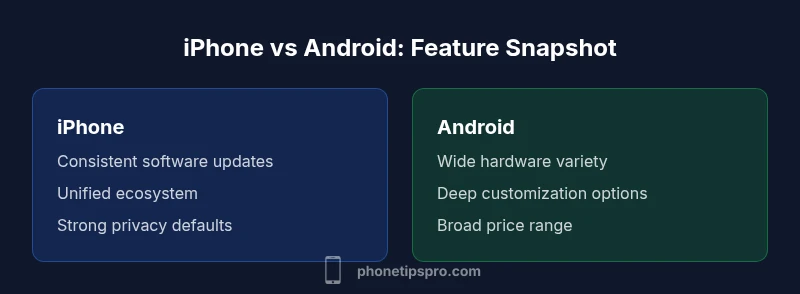
iPhone typically emphasizes privacy, long-term software updates, and a seamless ecosystem, while Android offers broad hardware choices, customization, and price variety. For most users, the choice hinges on ecosystem preference and budget. If you prioritize security, simplicity, and consistent updates, pick iPhone; if you want flexibility, customization, and value across devices, choose Android.
Why the iPhone vs Android debate matters
The decision between iPhone and Android is more than brand loyalty; it shapes daily workflows, app choices, and how you interact with services. In 2026, the landscape reflects two mature philosophies: a tightly controlled, privacy-forward experience versus a highly customizable, hardware-flexible platform. For many users, the right choice depends on how you use notifications, manage devices, and value long-term support. The Phone Tips Pro team notes that a core tension remains between simplicity and versatility, a theme echoed across this article as we compare practical outcomes rather than abstract features. If you search for an objective answer to iphone versus android, the best recommendation is to map your priorities to platform strengths rather than chase broad generalizations. This section frames the context for deeper analysis and sets expectations for the rest of the article.
Core differentiators: ecosystem, updates, privacy
Two pillars decide most owners' satisfaction: ecosystem cohesion and update cadence. iPhone users benefit from a tightly integrated ecosystem where hardware, software, and services coordinate across devices, with yearly major upgrades and consistent security patches. Android players gain freedom: a wide array of devices, price points, and customization options, along with vendor-specific update timelines. The privacy story differs as well: iOS emphasizes unified, centralized controls with transparent data practices; Android provides similar controls but with variability across manufacturers and app designers. Phone Tips Pro's analysis shows that predictable updates and long device lifespans often tilt the balance toward iPhone for non-technical users, while enterprise environments and enthusiasts may lean Android for flexibility and experimentation.
Hardware and design considerations across brands
Device hardware is not an afterthought; it shapes how you interact with software and how long a phone serves your needs. iPhone hardware consistently emphasizes premium materials, uniform build quality, and tight integration with the company’s software. Android hardware spans a wide spectrum: multiple screen sizes, varied processors, different camera modules, and diverse battery strategies. This variety benefits consumers who want a device that fits their preferences for display, weight, and ergonomics, but it can complicate software optimization across models. For most daily tasks, differences in processing power and camera sensor performance matter, but are not decisive for casual use; for enthusiasts and power users, the hardware choice often drives battery life, charging speeds, and durability across the device’s lifespan.
Software experiences: iOS vs Android
The software experience is the day-to-day lens through which users engage with their devices. iOS offers a uniform interface, predictable app behavior, and strong continuity features like Handoff and AirDrop that work best when you own multiple Apple devices. Android emphasizes choice: home screens, default apps, deeper system-level customization, and flexible side loading for developers and power users. The trade-off often comes down to consistency versus control: iPhone provides a polished, curated experience; Android provides unbounded experimentation, widgets, and broader compatibility with third-party hardware.
App ecosystems and store policies
App availability and quality differ by platform. The iOS App Store is renowned for strong curation and consistent user experience, which often translates to higher application quality and uniform security standards. Google Play Store offers a larger catalog with a broader range of device compatibility, sometimes accepting apps that experiment with new features sooner. Both ecosystems host major developers and a wide array of free and paid options, but the path to app approval and update cadence can influence how quickly features appear on your device.
Privacy and security posture
Privacy and security are core differentiators. iPhone’s privacy framework emphasizes consistent, system-wide controls, app privacy labels, and a design that minimizes data leakage by default. Android provides powerful tools for developers and users who want granular control, but a portion of the privacy posture can depend on hardware vendor choices and carrier policies. A practical approach is to review app permissions, review data access, and enable every device-level privacy toggle available. Phone Tips Pro highlights that ongoing security updates and vulnerability patches are essential for both platforms, but the guarantees tend to differ by brand and model.
Customization, accessibility, and personalization
Android excels at customization: home screens, widgets, default apps, and deep system tweaks offer a highly personalized experience. iOS provides personalization within a tighter framework, delivering consistent behavior across devices and simpler accessibility settings. For users who enjoy tailoring their devices or needing specialized accessibility features, Android often wins on control; for those who prefer a consistent, predictable experience, iPhone remains compelling.
Cost of ownership and total value
Cost considerations extend beyond sticker price. Initial purchase price, ongoing app costs, repair expenses, and expected software support determine long-term value. iPhone typically commands a higher upfront price but offers longer guaranteed software support and, in many cases, higher resale value. Android devices vary dramatically in price and repair costs, delivering affordable entry points but potentially less consistent long-term support depending on the model. When calculating total cost of ownership, consider update timelines, service availability, and accessory compatibility across devices.
Camera and media features across devices
Camera systems on iPhone and Android devices are among the most important differentiators for many buyers. iPhone cameras tend to emphasize color accuracy, smooth HDR, and consistent performance across lighting scenarios, paired with reliable video features. Android cameras offer broader sensor choices and versatility across brands, including different pixel sizes, computational photography approaches, and zoom capabilities. For most users, photo quality is excellent on both platforms, but specific preferences for color science, night mode performance, and video features will guide which platform is better for a given use case.
Longevity and resale value
Longevity depends on software support, hardware durability, and market demand. iPhone devices often retain value longer due to established upgrade cycles and strong aftermarket demand. Android devices vary; flagship models from major manufacturers tend to hold value well, while mid-range devices may depreciate more quickly depending on brand and network compatibility. If resale value is a concern, consider models with popularity, robust repair networks, and a track record of timely OS updates.
Real-world usage scenarios: family, professionals, students
Everyday usage shapes the ideal platform differently. Families benefit from ecosystem continuity and parental controls in iOS for a cohesive experience across devices and easier family sharing. Professionals may value the security posture and productivity integrations offered by iPhone, or the hardware flexibility and cross-platform collaboration enabled by Android. Students often prioritize price, device availability on campus networks, and battery performance. In practice, mapping your most common tasks—messaging, navigation, document editing, and multimedia creation—to platform strengths helps clarify which path is best for you.
Migration, data transfer, and getting started on either platform
Migration is typically straightforward but not perfectly painless. iPhone-to-Android transfers (and vice versa) exist, with most data transferable via cloud accounts, transfer apps, or physical backups. The level of friction depends on your current device, app lineup, and account security measures. Prepare by backing up essential data, ensuring two-factor authentication is enabled, and testing key apps on the new device before fully switching. A methodical approach makes the transition smoother and reduces the risk of data loss.
Comparison
| Feature | iPhone | Android devices |
|---|---|---|
| Software updates cadence | Predictable, multi-year updates across devices | Update timing varies by manufacturer/carrier; slower after initial release |
| Hardware variety | Apple-controlled lineup with uniform design | Extensive hardware options across brands, sizes, and price points |
| App ecosystem and quality | Tightly curated apps with strong quality control | Broad ecosystem; software quality varies by vendor and device |
| Privacy controls | Unified privacy controls with transparent practices | Controls exist but can vary by vendor and device customization |
| Price range and ownership value | Higher upfront cost with strong resale value | Lower entry cost; value depends on model and update support |
| Ecosystem integration | Excellent cross-device continuity (iPhone, iPad, Mac, Watch) | Cross-device integration depends on brands/services; often less seamless |
| Repairability and service | Strong official service network; predictable repair experience | Repair options vary by region; often cheaper but less uniform |
Positives
- Strong, cohesive ecosystem across devices
- Long-term software support and security updates
- High app quality and integrated services
- Higher resale value on mainstream models
Weaknesses
- Higher upfront cost and narrower hardware ecosystem
- Update timelines can be slower or inconsistent on some Android devices
- Potential vendor bloat and privacy trade-offs on certain models
Neither platform is universally superior; choose based on your priorities
iPhone suits users who value privacy and long-term updates within a cohesive ecosystem. Android serves those who want hardware variety, customization, and flexible pricing. Phone Tips Pro endorses mapping your needs to platform strengths to decide confidently in 2026.
FAQ
Which platform offers longer software support and why does it matter?
iPhone generally offers longer, more uniform software support across devices, which translates to security updates and new features for many years. Android support length depends on the manufacturer and device; flagship models may receive updates longer than mid-range devices. Consider future-proofing when choosing a device.
iPhone often gets longer, more predictable software updates across devices, while Android support varies by manufacturer. Think about how long you want updates to arrive and which devices will be supported.
Is iPhone privacy stronger by default than Android?
Both platforms offer robust privacy controls, but iPhone standardizes many protections across the system, which can reduce user-initiated data sharing risks. Android provides deep privacy controls but depends on vendor implementation and user configuration. Your protection level hinges on settings and habits on either platform.
Both platforms have strong privacy options, but iPhone tends to apply them uniformly. Android gives more customization, so your routines matter a lot.
Can I switch from iPhone to Android or Android to iPhone easily?
Switching is feasible with official transfer tools and cloud backups, but some app data may not transfer perfectly if apps don’t sync across ecosystems. Plan for a data audit, re-login to apps, and possible media transfer steps. A staged switch reduces risk.
Yes, you can switch, but some app data may not transfer perfectly. Prepare for a little re-setup during the move.
Which platform has more apps and better app quality?
iOS generally features strong curation and high-quality apps due to a controlled ecosystem, while Android offers a larger overall app catalog and broader device compatibility. Most top apps are available on both, though certain exclusives appear first on one platform.
Apps are excellent on both, with iOS often feeling more curated and Android offering a bigger catalog and broader device support.
Is Android cheaper to own in the long run?
You can start with cheaper Android devices, but total ownership depends on repair costs, update longevity, and service quality. Some Android models retain value less than iPhones, while others offer excellent value if you upgrade frequently. Compare total cost of ownership rather than upfront price alone.
Often, Android can be cheaper to start with, but overall costs depend on updates, repairs, and how long you keep the device.
What about security on iPhone and Android for business use?
Both platforms can be secured for business use; iPhone often provides a more uniform security baseline across devices, which simplifies management. Android can be equally secure with proper enterprise controls, device management, and phased updates tailored to the organization.
Both can be secure for business; it largely depends on how you configure management and updates.
Quick Summary
- Define your priority: privacy and updates vs customization and hardware variety
- Assess ecosystem lock-in and future device plans before buying
- Calculate total cost of ownership over 3-5 years
- Expect Android updates to vary by model; plan accordingly
- If possible, test both platforms to confirm comfort and productivity