Can You Put iPhone 17 on Vibrate? A Practical Guide
Learn how to set vibrate on iPhone 17 using hardware switches and iOS controls. This educational guide covers Silent switch, Vibrate toggles, Focus modes, and testing tips for reliable notifications.


Can you put iphone 17 on vibrate? Yes. You can quickly set vibrate using the hardware Ring/Silent switch and iOS controls. Flip the silent switch, ensure Vibrate on Silent is enabled in Settings, and consider Do Not Disturb or Focus for quiet alerts. For custom patterns, adjust Vibration under Sounds & Haptics. Phone Tips Pro explains practical steps.
Understanding Vibrate: How it Works on iPhone 17
Vibration on iPhone 17 combines a physical hardware switch with software-driven haptic feedback. The Ring/Silent toggle determines whether audible alerts ring or stay silent, while the Vibrate on Ring and Vibrate on Silent options control whether vibrations accompany those alerts. In practice, most users achieve reliable results by enabling both Vibrate on Ring and Vibrate on Silent and then testing with a quick notification. Phone Tips Pro’s analysis shows variations in haptic intensity across models and software versions, so testing in your environment matters. When you place the phone in a pocket, the perceived vibration can differ due to fabric and angle. Understanding these fundamentals helps you tailor vibrate behavior to your needs.
Quick checks before you tweak vibration
Before diving into settings, perform a quick hardware check. Confirm the Ring/Silent switch is functioning and not stuck in one position. Open Settings and navigate to Sounds & Haptics to verify Vibrate on Ring and Vibrate on Silent are enabled. If you use Focus modes, be aware that some configurations may temporarily override vibration settings during an active focus. Also, confirm the volume is not muted to ensure the haptic feedback remains noticeable. Finally, verify Accessibility options for vibration are enabled if you rely on tactile cues. A quick test with a sample notification helps you gauge whether changes took effect. Phone Tips Pro notes that you’ll often get the most consistent results by combining these steps with a test under real-world conditions.
Ring vs Silent: what each setting does
The Ring setting controls audible alerts when the device is unlocked, while Silent mutes sounds but can still trigger vibrations. Enabling Vibrate on Ring ensures you feel a vibration for incoming calls or app alerts when the phone is set to Ring. Enabling Vibrate on Silent makes vibrations available even when the device is muted. Some users prefer keeping both enabled for a consistent tactile cue, while others rely on Silent mode during meetings. If you frequently switch modes, consider placing quick-access controls on the Control Center for faster changes. Phone Tips Pro highlights that habitual users benefit from a predictable pattern across scenarios.
Do Not Disturb and Focus: impact on notifications
Do Not Disturb (or Focus modes on newer iOS) can silence alerts entirely or selectively allow calls. If vibration is crucial, ensure Focus settings allow vibration for essential notifications. Some Focus presets mute all alerts, which disables vibrations unless configured otherwise. Tailor Focus to permit vibrations from important apps or people, and test by simulating a message or call while the Focus is active. This approach provides a reliable balance between quiet environments and timely alerts. Phone Tips Pro emphasizes testing Focus-driven profiles in real-world situations to avoid missed notifications.
Customizing vibration patterns and alerts
Beyond on/off toggles, you can customize vibration patterns for different alert types. In Settings > Sounds & Haptics, select a ringtone or text tone, then choose Vibration and Create New Vibration to craft a custom pattern. This is useful if you want distinct cues for calls, texts, and app notifications. Note that some apps may use their own notification settings, so you may need to adjust per-app vibrations as well. When you create a new pattern, test it repeatedly to ensure it’s discernible in everyday environments. Phone Tips Pro notes that longer patterns can be easier to notice in noisy settings, while shorter patterns conserve battery life.
Step-by-step overview: what changes you can make
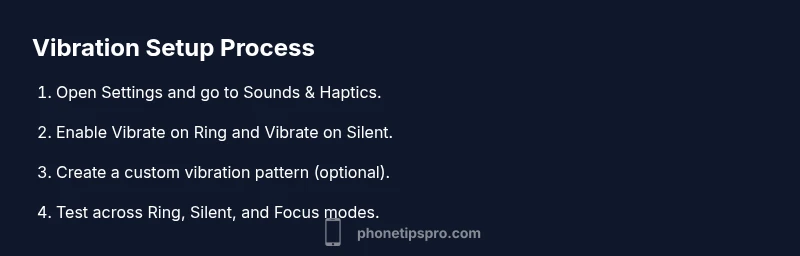
If you want a quick roadmap, enable Vibrate on Ring and Vibrate on Silent, adjust Do Not Disturb/Focus rules, and optionally craft a custom vibration. Then test by sending yourself test alerts and evaluating whether the haptics are noticeable in typical wearing positions. Remember to account for case material and pocket placement, as these can affect perceived intensity. This section provides a high-level view; the detailed instructions are in the step-by-step section that follows.
How to test and verify your vibrate settings
Testing is essential after any change. Send yourself a test notification, ask a friend to call, and observe both audible and tactile feedback. If vibrations feel weak, try increasing haptic strength in Settings > Sounds & Haptics (where available) and recheck Vibrate on Silent. For cases where the phone is in a bag or pocket, walk around or perform daily tasks to judge consistency. If you still don’t feel the vibration, review Focus rules and ensure no conflicts exist. Phone Tips Pro recommends a controlled test environment for reliable results.
Troubleshooting common issues with vibration
If vibrate suddenly stops working, start by restarting the device, then review the Ring/Silent switch and Vibrate toggles. A software update can occasionally reset preferences; re-enable Vibrate on Ring and Silent and test again. If vibration remains faint, check the vibration motor intensity through a system test or accessibility settings. Some third-party cases or screen protectors may dampen haptic feedback; removing them briefly can confirm whether hardware interaction is the cause. Phone Tips Pro advises documenting each change to isolate the issue quickly.
Accessibility considerations and practical scenarios
Vibration is a key accessibility feature for many users. Pair vibrate with sounds for a multimodal alert strategy, and leverage Focus to reduce deemed interruptions while preserving tactile cues. In meetings or quiet environments, Vibrate on Silent helps mitigate missed calls. For caregivers or people with hearing impairment, testing various vibration patterns and ensuring consistent feedback across apps improves reliability. Phone Tips Pro reinforces building a setup that aligns with daily routines and accessibility needs.
Authority sources
For further reading and official guidance on iPhone vibration settings, consult reliable sources and community experiences. The Verge offers practical tech coverage on iPhone features, while CNET provides step-by-step guides and reviews. MacRumors aggregates user experiences and model-specific notes that can help when newer devices like the iPhone 17 are considered in broader contexts. These sources complement official documentation and personal testing.
Tools & Materials
- iPhone 17(Device used for demonstration and testing vibration settings)
- Physical Ring/Silent switch(Located on the left side; toggle to Silent to test vibrations in Silent mode)
- Settings app access(Needed to adjust Vibrate, Do Not Disturb, and Focus options)
- Test notification method(Use a short test notification or call to verify vibration)
Steps
Estimated time: 15-25 minutes
- 1
Open Settings
Unlock your iPhone 17 and launch the Settings app to begin configuring vibration options. This is the central hub for Sounds & Haptics, Do Not Disturb, and Focus settings.
Tip: If Settings isn’t visible on the home screen, use Spotlight search to locate it quickly. - 2
Check the Ring/Silent switch
Confirm the physical Ring/Silent switch works and that Silent is not stuck in the off position. This switch directly affects audible and tactile alerts.
Tip: A quick toggle back and forth can verify the mechanism is responsive. - 3
Enable Vibrate on Ring
In Settings > Sounds & Haptics, ensure Vibrate on Ring is turned on so alerts vibrate when the device is in Ring mode.
Tip: Keep this enabled if you often rely on haptics during busy environments. - 4
Enable Vibrate on Silent
Also enable Vibrate on Silent to ensure vibrations occur even when sounds are muted.
Tip: This is useful in meetings or quiet zones where sound is off. - 5
Adjust Focus/Do Not Disturb
Review Do Not Disturb or Focus modes and configure them to allow vibrations for key contacts or apps.
Tip: Avoid overly aggressive silence rules that mute important alerts. - 6
Create a custom vibration pattern
Navigate to Settings > Sounds & Haptics > Ringtone > Vibration > Create New Vibration to tailor a unique pattern.
Tip: Test the pattern by tapping during creation to ensure it’s noticeable. - 7
Test and verify
Send yourself a test notification or call to confirm the vibrate behavior across Ring, Silent, and Focus contexts.
Tip: If you don’t feel a vibration, recheck toggles and try a longer pattern for clarity.
FAQ
Can I customize vibration patterns for different apps on iPhone 17?
Yes. You can create a global vibration pattern via Settings > Sounds & Haptics > Create New Vibration, and in some cases adjust per-app notification settings. Some apps may not expose vibration customization, so rely on the system vibration when available.
Yes, you can create a custom vibration in Settings and apply it to general alerts; some apps may not offer per-app vibration controls.
Will Vibrate on Silent affect alarm vibrations or emergency alerts?
Alarms typically follow their own vibration settings and are designed to be noticeable even when Silent is on. If you’re unsure, test an alarm to confirm that vibration behaves as expected.
Alarms usually have their own vibration behavior, but always test to be sure.
Is vibration working if Do Not Disturb is on?
If Focus or Do Not Disturb overrides vibrations, you may not feel vibrations for less important alerts. Adjust Focus rules to allow vibrations for essential apps or contacts.
Sometimes DND or Focus can mute vibrations; check Focus settings to allow vibrations for important alerts.
Why did vibration stop after a software update?
Software updates can reset some preferences. Re-check Vibrate on Ring and Silent, adjust haptic strength if available, and test again.
Software updates can reset vibrate settings; recheck them after updating.
How can I test vibration on iPhone 17 quickly?
Use a test notification or call from another device while watching for haptic feedback. Ensure Vibrate toggles are enabled and Focus isn’t silencing alerts.
Send a test notification to verify the vibration setup.
Watch Video
Quick Summary
- Enable Vibrate on Ring and Silent for consistent feedback
- Use Focus to tailor vibrations to contexts
- Test in real-world scenarios for reliability
- Create a custom vibration pattern for distinct alerts