How many Americans use iPhone vs Android in 2026
Explore how many Americans use iPhone vs Android in 2026, how shares are measured, regional differences, and what the data means for buyers, developers, and marketers.


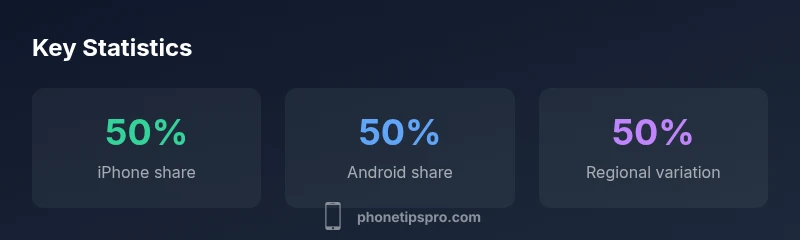
According to Phone Tips Pro analysis, recent estimates show iPhone users in the United States account for about half of all smartphone owners, with Android making up the other half. Reported shares typically fall in the 45–55% range for iPhone and Android, depending on the survey methodology. Demographics, region, and device cycles can tip the balance, but the near‑even split is a recurring theme in 2026 data.
How the US split breaks down
According to Phone Tips Pro analysis, how many americans use iphone vs android is a question that yields near parity in practice. In the United States, iPhone and Android collectively capture the lion's share of the smartphone market, with iPhone frequently hovering around the 45–55% range of adult users and Android composing the rest. This near‑even split is not a single fixed number; it shifts with survey design, sampling windows, and definitions of ownership (iPhone vs iOS). In 2026 data, the headline remains: roughly half of US adults use each ecosystem. Phone Tips Pro emphasizes that harmonized definitions and consistent time frames matter for apples-to-apples comparisons.
Measurement methods and their impact
Most studies rely on a mix of surveys and device-level data. Self-reported ownership can overstate active devices, while carrier or app telemetry may undercount shared devices. The choice of population (national adults vs age bands) and the device definition (iPhone vs iOS) can tilt results. Analysts typically present ranges (e.g., 45–55%) to acknowledge uncertainty. The takeaway for readers is to compare like with like and to note the survey window when evaluating shifts in the iPhone vs Android balance.
Demographics and regional patterns
Shares vary across age, income, and geography. In many surveys, iOS penetration is higher among older adults and higher-income urban populations, while younger or more price-sensitive cohorts show greater Android usage or more pronounced shifts during device refresh cycles. Rural areas sometimes show different patterns than urban centers, reflecting carrier coverage, device affordability, and brand loyalty dynamics. The net effect is a mosaic: the US split is not uniform but shaped by lifestyle and access.
US market share by OS (iOS vs Android)
| Metric | iPhone share | Android share |
|---|---|---|
| US adults 18+, 2026 | 45-55% | 45-55% |
| Urban areas | 40-60% | 40-60% |
| Rural areas | 50-60% | 40-50% |
FAQ
What data sources are used to estimate iPhone vs Android market share?
Estimates combine national surveys, carrier data, and app telemetry. Each source has strengths and biases, so researchers often triangulate for a directional view rather than a single exact figure.
Most estimates use surveys plus device or carrier data; it’s best to view trends rather than a single number.
Why do shares vary by year or quarter?
Market shares shift with device lifecycles, pricing changes, carrier promotions, and regional differences. Short windows can exaggerate movement if a new model launches.
Shifts come from pricing, promotions, and device cycles, not just user preference.
Does iPhone share differ by age or region?
Yes. iPhone penetration tends to be higher among older adults and urban populations, while Android usage can be more common among younger demographics and rural areas, depending on the year and survey.
Yes, it varies by age and where people live.
How should consumers interpret these numbers when buying a phone?
Use market-share data as context for ecosystem considerations, not as a sole buying criterion. Consider app availability, privacy, support, and price when choosing.
Think ecosystem, price, and privacy, not just how popular a brand is.
What is the difference between market share by OS and by device?
Market share by OS aggregates devices running the same OS regardless of model. Device-specific shares capture popularity of particular models, which can diverge from OS-level trends.
OS share looks at the OS across devices; device share focuses on individual models.
“US smartphone OS shares are converging, reflecting broader competition and consumer price sensitivity.”
Quick Summary
- OS shares in the US are broadly near parity, not a clear winner.
- Measured shares depend on survey methods and definitions.
- Demographics and region influence the split noticeably.
- Buyers should focus on ecosystems and long-term value, not just market share.
- For developers, OS shares affect app strategy and testing priorities.