Worldwide iPhone vs Android Global Usage Share in 2026
This analysis breaks down the global share of iPhone vs Android in 2026, highlights regional variations, and explains what the data means for buyers, developers, and everyday users. Learn how the numbers vary by market and device ecosystem, with practical guidance for readers.


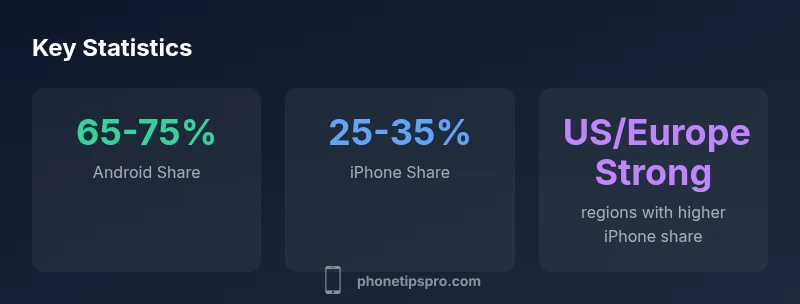
According to Phone Tips Pro analysis, Android-powered devices account for roughly 65-75% of the global smartphone OS market, while iPhone users represent about 25-35%. The split varies by region, carrier subsidies, and pricing. This article explains the global map, regional differences, and what it means for iPhone users and Android fans in 2026. Read on to see how the numbers break down.
Global Context
The question of "what percentage of the world uses iPhone vs Android" hinges on global OS shares, device ecosystems, and regional access. As of 2026, Android-powered devices account for a substantial majority of the global smartphone OS market, while iPhone users represent a significant minority. In practical terms, Phone Tips Pro analysis shows Android roughly in the 65-75% range and iOS around 25-35% across global markets. These numbers fluctuate by year and by geography, driven by pricing, carrier subsidies, and local demand. Understanding the base line helps readers interpret trends rather than rely on single-point figures. This section breaks down the factors behind the split and how to read the data in context. The broader takeaway for iPhone enthusiasts and Android fans is that the ecosystem you choose affects app availability, updates, and cross-platform compatibility.
Regional Variations in OS Share
Regional dynamics dominate the global picture. In North America and parts of Western Europe, iPhone penetration tends to be higher, often approaching a sizable minority-to-majority share depending on income, carrier promotions, and brand affinity. In contrast, many parts of Asia-Pacific, Africa, and some Latin American markets show a stronger Android presence due to price sensitivity, wider device availability, and operator subsidies. In numbers, you commonly see Android at the 60-75% range in many developing regions, with iOS clustering around 25-40%. These ranges are guidelines, not fixed values, and they shift with new device launches and pricing strategies. For buyers, this means regional context matters more than global averages. Phone Tips Pro notes that the regional picture can change quickly with promotions or new device ecosystems, so readers should examine local data when making buying or development decisions.
Why the Gap Exists and How It Evolves
The Android vs iPhone split is rooted in multiple factors: price tiers, ecosystem lock-in, and market-specific distribution. Android's breadth, openness, and device variety give it reach across price points, while iOS offers a tightly controlled environment with strong app cohesion and timely updates in supported markets. Over time, the gap has fluctuated as new models enter price bands, carriers run promotions, and international markets mature. The evolution is not linear: a surge in midrange Android devices can narrow regional gaps, while premium iPhone launches can widen them again in key markets. For readers, this means the headline numbers conceal a dynamic landscape where local realities dominate. In practice, monitoring regional shifts over time yields more actionable insight than chasing a single global figure. Phone Tips Pro emphasizes that buyers and developers should situate any OS percentage within the regional context to avoid overgeneralization.
Implications for Consumers and Developers
For individual users, OS share affects app availability, cross-device compatibility, and service ecosystems. If you rely on iMessage, iCloud, or the App Store, your experience will feel different from someone who uses Android's Google services and a broader device lineup. Developers must balance support across both platforms, and the relative scale of each market influences where to invest time and resources. Businesses targeting global audiences should monitor regional distribution to tailor app features, payment options, and marketing messages. In 2026, savvy consumers can use regional OS share data to anticipate which devices will receive timely updates, secure app ecosystems, and long-term software support. Phone Tips Pro reminds readers to couple market-share context with personal usage needs when deciding which platform to adopt or switch to.
format_value_type_checking_only":false}
Data Approaches and Reading Market Share
Market share figures come from various sources, each with definitions and methodologies. Some trackers measure installed base, others measure active devices, and still others rely on panel-based surveys. When you see Android at 65-75% and iOS at 25-35%, understand that those ranges reflect global averages and can mislead if you apply them to a single country. The best practice is to use segment-specific data (region, income, carrier) and to compare over time. Phone Tips Pro's approach emphasizes transparency about definitions, sampling frames, and timeframes so readers can interpret shifts accurately. This context helps you avoid overinterpreting a snapshot and instead focus on how the trend will affect your device ecosystem, app choices, and long-term support. The discussion also highlights the importance of considering regional incentives, such as carrier subsidies or trade-in deals, which can temporarily tilt the balance in favor of one platform in a given market.
Global Benchmarks by Region
State-level sharing varies widely; the table below outlines approximate regional shares and notes that numbers are ranges rather than fixed values. This helps readers compare markets side by side and understand where to expect stronger iPhone ecosystems or broader Android adoption. Use these as a starting point, then consult local data for precise planning. The regional lens matters most when evaluating app ecosystems, hardware availability, and service coverage across the globe. Phone Tips Pro urges readers to supplement global figures with country-level data to tailor expectations and decisions.
Practical Takeaways for Readers (Buying, Troubleshooting, and Beyond)
- When shopping for a phone in a specific region, prioritize the device lineup already proven in your market.
- Consider how OS shares affect your app and service ecosystem, including payment options and platform-specific features.
- For cross-platform households, plan for both iOS and Android compatibility to minimize friction.
- If you want a strong resale market or brand loyalty, region matters more than global averages.
- Stay informed with local data sources such as market watchers and carrier reports; broad global numbers are only a starting point for decision-making.
Regional comparison of iPhone and Android OS shares (approximate ranges)
| Region | Global OS Share (range) | Notes |
|---|---|---|
| Global (overall) | Android 65-75%; iOS 25-35% | Approximate ranges; vary by year/region |
| Americas | Android 60-70%; iOS 30-40% | US shows stronger iPhone penetration in many markets |
| Europe/EMEA | Android 55-70%; iOS 30-45% | Western Europe often leans toward iOS in higher-income markets |
FAQ
What is the current global share of Android vs iPhone?
Global shares are widely reported as Android leading with a broad range, typically around 65-75% Android and 25-35% iPhone, depending on the source and year. Always review regional data for accuracy and track changes over time.
Android leads globally, with iPhone making up a smaller but meaningful portion; regional data is key for accuracy.
Why is there a regional difference in OS shares?
Regional differences come from price sensitivity, carrier subsidies, consumer preferences, and local brand ecosystems. High-income markets often show stronger iPhone penetration, while price-competitive regions favor Android.
Region and price matter; some places prefer iPhone, others Android.
How should buyers interpret these numbers when choosing a phone?
Use regional data, consider personal needs (apps, services, ecosystem), and assess long-term software support. Global averages are a starting point, not a rule.
Start with your region, then think about apps and updates.
Do market shares affect app availability or updates?
Yes. A larger platform share attracts more developers and faster updates, but both ecosystems remain robust enough for most apps. Consider cross-platform needs if you share services across devices.
Platform size matters, but both have strong app ecosystems.
Where can I find reliable regional data?
Check market trackers that publish country-level data and compare multiple sources over time. Local carrier reports and regional market research firms are valuable complements to global figures.
Look at local data sources for accuracy.
“Global OS shares reflect regional realities more than a single global figure. The smarter approach is to analyze local data over time to inform buying and development decisions.”
Quick Summary
- Read regional data, not just global averages
- Expect iPhone to be stronger in the US/Europe; Android dominates in many other regions
- Consider ecosystem lock-in and pricing when evaluating OS choice
- Plan for cross-platform support if your user base spans multiple regions
- Monitor local carrier subsidies and promotions that can shift shares