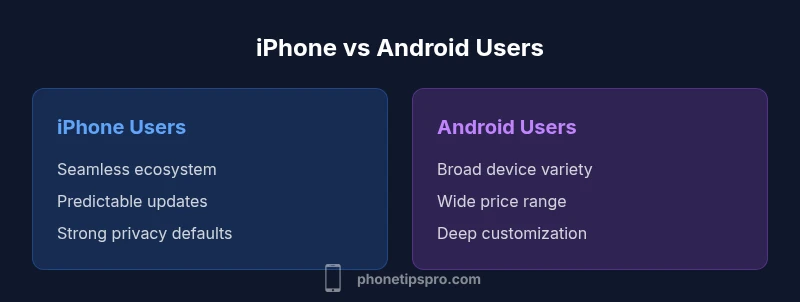
iPhone vs Android Users: An Analytical Comparison
A rigorous analysis of iPhone users vs Android users, comparing ecosystem, customization, price, updates, privacy, and cross-platform interoperability to help readers decide which path fits their lifestyle.


For most users, Android offers price flexibility and broad hardware variety, while iPhone users value a cohesive ecosystem and longer-term software updates. In this comparison, Android wins on customization and device breadth; the iPhone ecosystem shines in seamless integration and predictable software support. The best path depends on your priorities: ecosystem cohesion or customization and hardware choice.
The Landscape of iPhone vs Android Users
The smartphone market is commonly described as having two large camps: iPhone users and Android users. According to Phone Tips Pro, this split reflects more than brand loyalty; it mirrors different workflows, risk tolerances, and daily routines. iPhone users tend to favor a polished, cohesive experience across devices, with predictable software updates and strong privacy defaults. Android users appreciate hardware variety, price diversity, and the freedom to customize system-level behavior. This article dissects those tendencies across practical criteria—updates, security, ecosystem, and everyday usability—so readers can pick the path that minimizes friction in their lives. The focus is on actionable guidance rather than blind allegiance. Phone Tips Pro’s analysis emphasizes that the best choice aligns with how you work, play, and share content with others who may favor a different platform.
Core Philosophies: Ecosystem vs Customization
At the heart of the iPhone vs Android users debate are two distinct philosophies. Apple builds a tightly controlled ecosystem that favors seamless hardware-software harmony, consistent updates, and privacy-preserving defaults. Android champions openness, customization, and choice, letting you tailor almost every aspect of the experience—from home screen layouts to default apps. This difference matters not just for thrill-seekers but for everyday tasks like messaging, file transfer, and media consumption. If you value a predictable, low-effort experience, the iPhone path offers that steadiness. If you prize flexibility and personalization, Android provides more knobs to turn. The trade-offs are real: convenience and consistency on one side, control and variety on the other.
Device Variety and Price Tiers
Android devices span a wide spectrum of hardware capabilities and price points, from budget models to premium flagships. That variety means greater accessibility for first-time smartphone buyers or those needing specialized features. iPhone models tend to cluster around a premium tier, with a narrower price ladder but strong resale values. The tighter lineup translates into easier decision-making for many buyers, but often at higher upfront costs. For many users, total cost of ownership depends on ecosystem benefits, accessory compatibility, and depreciation. Phone Tips Pro notes that price flexibility is a key determinant for Android adopters, while long-term value and resale potential weigh more heavily for iPhone fans.
Software Updates and Longevity
Apple’s update cadence emphasizes long-range support, with many devices receiving multiple years of major iOS updates. This can translate into a smoother user experience and longer hardware life. Android updates depend on OEMs, carriers, and model tiers; some devices receive timely updates, others lag behind or stop receiving upgrades sooner. The practical effect is that Android users who prioritize staying on the latest features should check device-specific update promises, whereas iPhone users often enjoy fewer update cutoffs and more predictable security patches. For the broad public, update predictability is a meaningful factor in choosing a platform.
Privacy, Security, and App Control
Apple places privacy at the system level, with on-device processing, app vetting, and transparent data practices as default behaviors. Android offers robust security features as well, but the degree of control can vary by device maker and app source. The difference becomes visible in practice when you weigh permissions, data-sharing prompts, and app-store policies. If privacy posture and consistent security updates are priorities, the iPhone path tends to deliver a lower-friction experience. If you want more granular control over data collection, device settings, and app behaviors, Android provides more knobs to twist—though with greater responsibility on the user to manage those settings thoughtfully.
App Ecosystem and Compatibility
The iOS App Store and Google Play Store reflect two different approach philosophies. iOS emphasizes curated app quality and strict privacy and security checks, which can reduce the risk of shady apps but sometimes limits fringe features. Android’s broader app ecosystem supports wider experimentation and more flexible app configurations, but may introduce variability in app behavior across devices. For users who rely on cross-platform apps, most major services are available on both platforms; however, certain platform-exclusive features—such as iMessage or some carrier-optimized experiences—may require workaround or compromise.
User Experience: Hardware-Software Synergy
From tactile feedback to system animations, hardware-software integration shapes everyday use. iPhone hardware is designed to complement iOS software, delivering consistent performance and polished user experiences. Android devices leverage diverse hardware combinations and OEM customizations, which can yield more rapid hardware innovation but sometimes at the cost of consistency. If you value predictability and a unified feel, the iPhone approach reduces cognitive load and learning curves. If you want faster feature iteration and hardware-specific perks (like innovative camera modules or large display options), Android hardware variations can offer a more exciting range to choose from.
Communication and Interoperability Across Platforms
Cross-platform communication experiences differ noticeably. iMessage is a central pillar for iPhone users, delivering seamless messaging with other Apple devices but limited parity on non-Apple platforms. Android users may lean on cross-platform tools like WhatsApp, Telegram, or Google Messages, which work across ecosystems but may lack some native features exclusive to a single platform. Interoperability is improving for many services, though some platforms remain inherently more insular. If cross-device messaging and unified media sharing matter, evaluate which ecosystem aligns best with your social and professional networks.
Camera, Media, and Content Creation Expectations
Camera quality remains a top differentiator for many buyers. iPhone cameras emphasize color accuracy, software-based stabilization, and consistent results across lighting conditions, paired with strong video capabilities. Android devices offer a broad range of camera systems, from high-resolution sensors to versatile computational modes, enabling a wider set of creative options. Your content workflow—whether you edit on a desktop, cloud, or mobile—will influence the choice. For creators who want predictability and easy workflow, iPhone tends to deliver fewer friction points; for those who crave flexibility and experimentation, Android offers more hardware and software experimentation paths.
Transitioning Between Platforms: What to Expect
Moving from one platform to another can involve data transfer challenges and workflow adjustments. Moving from Android to iPhone may require migrating messages, contacts, media, and app data, with some apps offering direct transfer tools. The reverse path can be more involved, depending on data formats and service availability. Expect differences in default apps and navigation conventions, and be prepared to reconfigure notifications and privacy permissions. A deliberate, staged transition—backed by cloud sync and official transfer tools—limits friction and preserves essential data.
Buying Guidance: Which Path Fits You?
Deciding between iPhone and Android starts with aligning priorities: ecosystem cohesion, device variety, price sensitivity, and update expectations. If your top priority is seamless integration with other devices, predictable software updates, and privacy-forward defaults, the iPhone path is likely best. If you prioritize hardware diversity, price flexibility, and deep customization, Android offers a compelling argument. Consider your social network, work tools, and preferred services; compatibility with colleagues, family, and essential apps often tips the balance. Finally, project specific needs—such as accessory ecosystems, repair options, and resale value—can solidify your choice. A practical approach is to shortlist models, compare total cost of ownership, and test both platforms in a test-drive period if possible.
Trends Shaping the iPhone vs Android Users Debate
Looking ahead, platform strategies continue to diverge. Apple is likely to emphasize privacy, ecosystem continuity, and augmented reality readiness, while Android supporters expect greater customization options, more rapid hardware innovation across brands, and evolving AI-powered features across devices. Cross-platform interoperability will improve but will always reflect foundational differences in app ecosystems and policy controls. For readers, staying informed about updates, device policies, and service-level agreements helps ensure your choice remains aligned with evolving needs and preferences. The landscape will continue to evolve as new hardware innovations, software bundles, and privacy protections roll out.
Closing Reflections on the iPhone vs Android User Experience
In the end, the decision between iPhone and Android is not about one being inherently better; it is about which approach minimizes friction for you. The most successful choice hinges on how well the ecosystem supports your work, communication patterns, and media habits. By analyzing the trade-offs across updates, security, customization, and interoperability, readers gain clarity on which path is likely to sustain their daily routines with minimal disruption. The Phone Tips Pro team emphasizes that the best option exists where your preferences and real-world usage converge.
Practical Decision Checklist
To help readers decide quickly, here is compact guidance: (1) List your must-have features (e.g., updates, messaging apps, cloud services). (2) Consider your social and professional networks and which devices they predominantly use. (3) Compare total cost of ownership for a 2-3 year horizon. (4) Try to test both platforms in a low-stakes setting before committing. This approach yields a pragmatic conclusion tailored to your lifestyle.
Comparison
| Feature | iPhone Users | Android Users |
|---|---|---|
| Customization options | Limited customization, cohesive UI | Extensive customization, flexible defaults |
| Hardware variety | Narrow model range within Apple lineup | Wide model range across brands and price points |
| Software updates longevity | Long-term, regular updates for supported devices | Update cadence varies by device and OEM; some devices see slower promotion to new versions |
| App store policies | Strict, controlled by Apple | Open, more storefronts and varied app policies |
| Privacy controls | Robust defaults and on-device processing | Privacy features exist but depend on device and app choices |
| Price and value | Higher upfront cost with strong resale value | Lower entry price options, broader price spectrum |
| Ecosystem interoperability | Best with other Apple devices | Interoperability depends on services and cross-brand support |
| Support and repairs | Unified premium support across devices | Extensive service networks with regional variation |
Positives
- Helps readers align platform choice with priorities
- Shows ecosystem advantages and trade-offs clearly
- Highlights price-to-value considerations for long-term ownership
- Illustrates cross-platform friction points and workarounds
Weaknesses
- Subjectivity of user preferences may color outcomes
- No universal best choice without context
- Rapid Android fragmentation can complicate updates and support
- Brand-specific features may bias perceived value
Neither platform is universally superior; choose based on priorities and ecosystem alignment.
If you value seamless cross-device work and privacy, the iPhone path is likely best. If you prize customization, hardware variety, and price flexibility, Android merits serious consideration. Your social network and key apps should drive the final decision.
FAQ
Which platform offers better value for most users?
Value depends on priorities. Android often provides lower entry prices and more hardware options, while iPhone can yield higher resale value and longer update cycles. For many readers, long-term cost of ownership hinges on ecosystem benefits and service availability.
Value depends on what you value most: price variety or ecosystem longevity.
How do OS updates compare between iPhone and Android devices?
Apple tends to push regular, long-term updates to supported devices, offering a predictable update path. Android updates vary by device and OEM, so some models receive updates faster than others. Check the update policy for any model you consider.
Apple devices usually get more predictable updates; Android varies by maker.
Can I use apps across platforms without limitations?
Most major apps are available on both platforms, but feature parity can differ. Some platform-exclusive features may be unavailable on the other side. In general, you won’t be blocked from essential services, but a few experiences may be more seamless on one platform.
Most apps are on both platforms, with some features different.
Is transferring data from Android to iPhone straightforward?
Apple provides transfer tools that help migrate contacts, photos, and messages from Android to iPhone, though some app data may require manual steps. If moving the other direction, you may need to reconnect services and reconfigure preferences.
Data transfer tools exist, but some app data may require extra steps.
Do privacy and security features differ significantly?
Both platforms offer strong security foundations, but Apple emphasizes privacy defaults and on-device processing, while Android security varies by device and vendor. Your experience depends on how you configure protections and which services you trust.
Both are secure, but Apple leans toward stronger default privacy controls.
Quick Summary
- Identify your top priorities before choosing a platform
- Ecosystem cohesion benefits daily workflows and privacy
- Hardware variety expands choice and price options
- Consider total cost of ownership over 2-3 years
- Test both ecosystems if possible to reduce regret