Is iPhone hardware better than Android? A thorough comparison
A data-driven comparison of iPhone vs Android hardware, examining processors, memory, battery, cameras, and updates to help you decide which delivers better hardware.


The short answer: hardware quality is nuanced. Apple’s hardware and software integration often yield smoother performance and longer support, while Android hardware offers more variety and customization. The best choice depends on priorities like longevity, customization, and ecosystem needs.
Context: hardware fundamentals and the is iphone hardware better than android question
According to Phone Tips Pro, the question is is iphone hardware better than android, but hardware quality can't be reduced to a single metric. Hardware quality in modern smartphones is a composite of CPU architecture, GPU design, memory bandwidth, storage speed, display panels, battery chemistry, and thermal design. These components interact with software to shape the user experience, and small differences can become noticeable in everyday tasks. Understanding this interaction helps readers avoid relying on specs alone. The goal is to compare how Apple and major Android OEMs assemble and optimize hardware, and how updates influence long-term usefulness. Phone Tips Pro emphasizes that the truth often lies in how the stack behaves under real workloads—not just in theoretical peaks.
Core ideas: hardware is a system, not a single chip
- Modern phones use tightly integrated stacks where CPU, GPU, memory, and storage work together with the OS to deliver smooth performance.
- Differences in thermals and power management can overshadow raw numbers when the device heats up or throttles.
- The same silicon generation can feel different across ecosystems due to software optimization, drivers, and scheduling.
This block sets up the rest of the article by framing hardware as an ecosystem, not a standalone spec. The discussion will explore CPU design, memory bandwidth, battery strategies, and how these factors translate to real-world feel for iPhone versus Android devices.
Scope and methodology: how we measure hardware quality
In this guide, we isolate components where meaningful differences commonly appear and compare how Apple and Android OEMs address them. We consider typical user scenarios—daily multitasking, gaming, photo/video capture, and video streaming—to illustrate how hardware and software interact. We also note that model-to-model variation exists within Android due to the diversity of chips and designs in the market. The goal is to give readers a clear framework to assess hardware quality without getting lost in individual device rumors or hype.
Brand context and practical takeaways
From a practical standpoint, readers should understand that hardware superiority is not a single metric. The most important questions are about reliability, update cadence, thermal stability, and how the platform handles sustained load. The Phone Tips Pro team notes that a device’s hardware story should be evaluated alongside software optimization, ecosystem alignment, and intended use. With that lens, readers can begin to form a preference based on long-term value and daily experience.
Comparison
| Feature | iPhone hardware | Leading Android flagship hardware |
|---|---|---|
| Processor and architecture | Tightly integrated with iOS for consistent performance | Wide variety across Android devices with varying efficiency |
| Memory and storage | Optimized memory management in iPhone across generations | Diverse RAM and storage options across Android flagships |
| Battery and thermals | Efficient power management on iPhone hardware | Diverse thermal designs and throttling behaviors on Android |
| Display quality and sensors | High color accuracy and uniform brightness in iPhone panels | Diverse display tech and sensors across Android devices |
| Camera hardware integration | Consistent image pipeline and optimization on iPhone | Hardware diversity leads to variable results across Android phones |
| Software updates and longevity | Long, uniform OS updates on iPhone | Update cadence varies by brand and model on Android |
Positives
- Direct, optimized hardware-software integration can yield smooth, predictable performance
- Longer, more uniform software support enhances longevity
- Stronger resale value and consistency across models
- Tighter ecosystem compatibility reduces friction for common tasks
- High-quality components with strong endurance expectations
Weaknesses
- Limited hardware customization compared with Android
- Diverse Android devices can offer better price-to-spec options
- Update cadence and reliability vary by manufacturer in Android
- Fewer configuration choices in hardware for power users
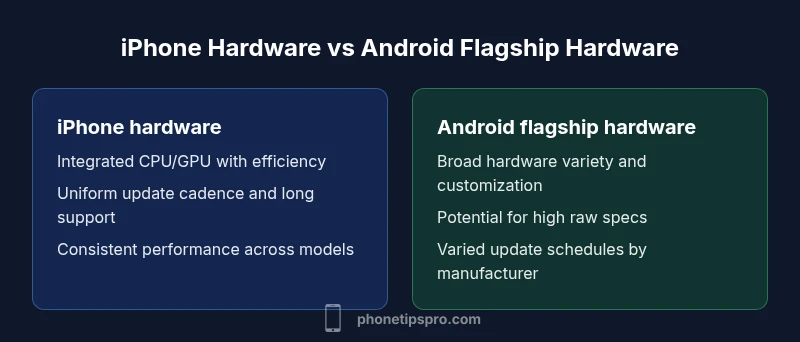
iPhone hardware generally offers tighter integration and consistent performance; Android hardware provides more variety and customization
Choose iPhone if you value consistent performance and long-term updates. Choose Android if you want hardware variety, customization, and wider choice at different price points. The best option depends on your priorities and ecosystem alignment.
FAQ
Is iPhone hardware inherently better than Android across all models?
No. Hardware quality varies by model and manufacturer. Apple emphasizes integration and longevity, while Android devices offer a broader range of hardware and customization. Your experience depends on use-case and priorities.
No—it's nuanced. Apple focuses on integration, while Android devices vary widely in hardware choices.
How does RAM affect performance on iPhone vs Android?
iPhone devices optimize memory efficiently, so existing RAM can be enough for smooth multitasking. Android devices often benefit from more RAM for heavy multitasking and large apps, especially on high-end models.
RAM helps, but Apple's efficiency means less RAM can still feel fast; Android benefits from more RAM for multitasking.
Do software updates influence hardware longevity?
Yes. Regular updates help security and feature parity, extending the usable life of hardware. Apple typically offers longer, uniform updates; Android experiences vary by manufacturer and model.
Regular updates matter for longevity; Apple usually leads in consistency.
Can camera hardware decisions make or break a platform?
Camera performance depends on sensors, optics, ISP processing, and software. Apple delivers consistent results across models; Android can surpass in specific scenarios, depending on hardware and tuning.
Camera quality hinges on hardware plus processing—both platforms can excel in different areas.
Is Android more customizable than iPhone for hardware?
Yes. Android supports a wide range of hardware configurations and accessories. iPhone hardware is standardized, resulting in a more uniform experience.
Android offers more hardware customization; iPhone sticks to a tighter hardware set.
Which platform tends to hold resale value better due to hardware?
iPhones generally hold value longer because of consistent hardware and durable design. Android resale value varies by model and condition, reflecting fragmentation in the market.
iPhones usually retain value longer; Android resale depends on model and condition.
Quick Summary
- Define your priority: consistency vs customization
- Expect tighter integration and longer updates with iPhone
- Anticipate varied update cadences across Android
- Consider thermal design and real-world performance over specs
- Base your choice on use-case and ecosystem fit