Is iPhone More Complicated Than Android? A Practical Analysis
A rigorous, balanced comparison of iPhone vs Android complexity, exploring usability, customization, updates, privacy controls, and troubleshooting to guide smarter buying decisions.


Is is iphone more complicated than android? The quick takeaway is nuanced: both platforms are designed to be approachable, but they optimize for different goals. iPhone emphasizes a consistent, streamlined experience with centralized updates, while Android favors customization and device variety that can add steps for newcomers. In short, the perceived complexity depends on what you value—predictable day-to-day use or deeper control—and Phone Tips Pro’s framework helps you weigh those trade-offs.
Defining Complexity Across Mobile Platforms
Is iphone more complicated than android? To answer this, we must define what 'complexity' means in a modern smartphone. Complexity can refer to how many steps a user must take to complete common tasks, how consistent the experience remains across devices, the depth of settings, and how often problems require troubleshooting. According to Phone Tips Pro, complexity in mobile platforms should be judged across four axes: usability, customization, updates, and troubleshooting. This lens helps avoid conflating 'jam-packed features' with actual cognitive load. In practice, newcomers often judge simplicity by how quickly they can accomplish a task; power users weigh configurability and control. By anchoring the discussion in these axes, we can compare iPhone and Android without getting trapped in stereotypes. The phrase is: is iphone more complicated than android? The conclusion you reach depends on which dimension you value most: quick, consistent tasks or flexible, device-specific options. The Phone Tips Pro team emphasizes clarity over surprises when guiding readers toward a decision.
Core Areas People Notice
Most readers first gauge complexity by the tasks they perform daily: messaging, calls, photos, apps, and settings. The perceived difficulty of a platform often depends on how predictable actions are, how much you can customize the interface, and how many steps are needed to reach a goal. Across both ecosystems, there is a core tension between simplicity and flexibility. In this section we map the four dimensions that commonly affect perceived complexity: navigation design, feature discoverability, configuration depth, and cross-device consistency. We'll also note how each platform helps or hinders users when performing routine activities, like setting up a new device, installing apps, or managing permissions. Across sessions, many users feel more confident when the interface offers clear defaults and when advanced options are discoverable but not overwhelming.
iPhone's Approach: Simplicity through Consistency
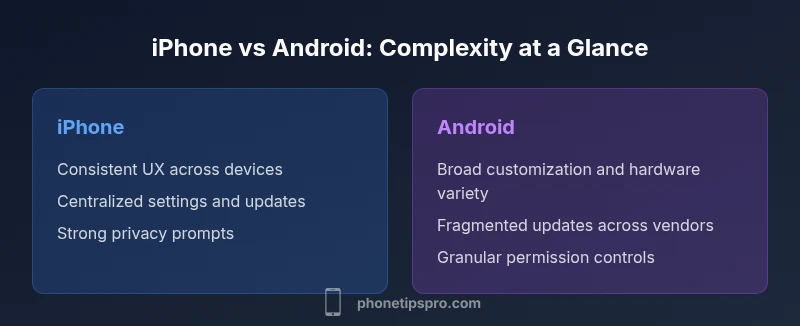
Apple's iPhone prioritizes a consistent user experience across devices and apps. The system-wide design language reduces decision fatigue by offering a single path for common tasks, a curated app ecosystem, and centralized updates through iOS. For new users, that uniformity translates into faster onboarding and fewer surprises. For power users, it can feel restrictive because many preferences are tucked behind layers of settings, labeled with Apple-specific terminology, or not available system-wide. The result is a lower cognitive load on day-to-day operations, but a potential trade-off in customization. When you weigh whether is iphone more complicated than android, consider whether you value predictability above personalization.
Android's Approach: Customization and Variability
Android embraces customization, freedom, and device diversity. From home-screen layouts to default apps and per-app permissions, Android lets users tailor the experience to fit their workflow. That flexibility comes with its own complexity: different device makers layer their own skins, push different updates, and expose settings in different places. This can increase the learning curve, especially for users juggling multiple devices or transitioning from iPhone. However, for enthusiasts and professionals who need to optimize performance, accessibility, or specific workflows, Android often delivers deeper control and broader hardware choices. When evaluating is iphone more complicated than android, the answer shifts with your appetite for control versus standardization.
Updates, Security, and Support: How Recency Matters
Update cadence and how security features are rolled out influence perceived complexity more than you might expect. iPhone users typically benefit from a centralized, predictable update schedule, with uniform security fixes across supported devices. Android users may see variation in timing due to OEM and carrier involvement, which can complicate when features arrive and how protections are enforced. This is not inherently negative; it can allow rapid adoption of innovations in some devices, while delaying others. Phone Tips Pro analysis suggests that for many everyday tasks, the impact on usability is modest, but the moment you need the latest security controls, centralized updates matter.
App Ecosystems, Permissions, and Privacy Controls
Both platforms offer comparable core privacy tools, but their design philosophies differ. iOS emphasizes privacy by default, with simpler prompts and fewer surprises in app permissions. Android provides granular controls and a broader range of customization for how apps access data, but that granularity can be overwhelming for new users. The practical upshot is that learning to navigate permissions on iPhone tends to be faster, while Android users may need to invest time to configure settings across apps and devices. If privacy and predictable behavior are high priorities, iPhone has an edge in reducing cognitive load; if you want precise control for specific tasks, Android offers more knobs to turn.
Practical Scenarios: Who Benefits from Each Approach
Consider your typical day. If you value a phone that works out of the box with minimal setup, iPhone will likely feel simpler and more approachable. If you want to customize your home screen, default apps, or accessibility features for a highly specialized workflow, Android will shine. Students, professionals, or families sharing devices might experience different levels of complexity depending on how they divide responsibilities and adopt ecosystem services. In short, the 'best' choice is not a universal winner; it's the one that aligns with your priorities for simplicity, power-user features, privacy, and long-term maintenance. Phone Tips Pro notes that user expectations matter as much as the platform features themselves.
Practical Tips to Manage Perceived Complexity
To reduce cognitive load, tailor your setup to your goals and remove friction points early. Start with a clean, task-focused baseline: disable unneeded features, turn on essential automations, and confine notifications to what truly matters. Use consistent app behavior: prefer stock apps where possible and learn the key settings that control privacy and security. Create a simple mental model of how the OS handles updates and permissions, and use that model to guide future choices. While the dialogue around is iphone more complicated than android can be helpful, your actual daily use should determine what feels easier.
Industry Trends and The Realities of Hardware Diversity
Industry trends remind us that hardware and software are interdependent. On Android, hardware diversity means that some devices can run features differently or more efficiently than others, affecting perceived complexity. On iPhone, the tight integration of hardware and software reduces micro-variations but creates a more uniform path that can feel rigid to those who crave broader customization. The net effect is that as the market evolves, user education and support resources become crucial to maintaining a sense of control and ease across devices. The bottom line is that complexity is not an inherent property of a platform, but a experience shaped by the combination of software, hardware, and user goals.
No One-Size-Fits-All: Choosing Based on Your Priorities
When deciding between iPhone and Android, start by listing your top priorities: simplicity, customization, device variety, and update cadence. If your priority is a calm, predictable experience with fewer decisions, an iPhone likely offers a smoother path. If you value flexibility, hardware choice, and deeper control over settings, Android may be the better fit. Use this framework to benchmark real tasks you perform daily: sending messages, managing photos, configuring permissions, and applying privacy settings. Your final choice should reflect how you want to interact with technology, not how trends dictate you should feel about complexity.
What to Expect in the Next Generation of Mobile OS
Forecasts suggest that both ecosystems will continue to balance simplicity with power. We can anticipate more guided onboarding, smarter permission prompts, and improved cross-device continuity on both sides. For iPhone, expect incremental refinements that preserve a consistent experience while adding targeted customization options. For Android, expect expanded customization with better, standardized privacy controls across devices and vendors. The overarching theme is that future updates will aim to reduce friction while expanding capability, enabling users to choose their preferred balance of control and convenience.
Quick-start Checklist for Deciding Today
- List your top daily tasks and rate how much you value simplicity vs customization.
- Try a hands-on trial with a friend’s device if possible, focusing on core actions like calling, messaging, camera, and app permissions.
- Compare update cadence: does your environment benefit from synchronized updates or dynamic innovations?
- Review your privacy priorities and whether you prefer centralized prompts or granular controls.
- Consider ecosystem investments (services, apps, and compatibility) you already rely on.
- Decide on the baseline you want to start with and set a two-week test period.
Comparison
| Feature | iPhone | Android |
|---|---|---|
| Learning curve | Generally easier for beginners due to uniform UX | Can be steeper due to device fragmentation and skins |
| Customization depth | Limited system-wide customization | Extensive customization across devices and skins |
| Software updates cadence | Tightly controlled by Apple, predictable schedule | Fragmented by OEMs/carriers, varying timing |
| Privacy controls | Centralized and simpler prompts | Granular controls with varied prompts across devices |
| Ecosystem consistency | High consistency across apps and services | Diverse experiences and potential inconsistencies |
| Support and troubleshooting | Unified support and documentation | Fragmented support across brands and carriers |
| Device variability | Fewer hardware SKUs, stable expectations | Wide hardware variance across models and specs |
Positives
- Helps buyers pick an ecosystem matching their tech comfort level
- Highlights where UX consistency reduces cognitive load
- Encourages mindful decision-making about customization vs simplicity
- Supports informed maintenance and troubleshooting expectations
Weaknesses
- Vast device and OS variability can still overwhelm users
- Biased perceptions may favor one platform due to ecosystem lock-in
- Overemphasis on 'simplicity' can ignore hidden complexities like permissions
- Exact complexity can vary by carrier or region
Neither platform is universally more complex; your priorities decide which ecosystem feels easier.
iPhone tends to be simpler for daily tasks due to consistency, while Android appeals to power users who want deeper control. The best choice depends on whether you value out-of-the-box ease or customization and flexibility.
FAQ
Is iPhone generally easier to learn than Android?
In general, iPhone offers a uniform UI, which can shorten the learning curve for new users. Android's branching features may increase the learning curve if you compare multiple devices.
Usually yes, because of the uniform experience, but it depends on what you want to do.
Does Android require more time to troubleshoot due to device variety?
Yes, troubleshooting can vary by device, OS version, and carrier, which adds steps to diagnose issues.
Yes—device variety means more device-specific steps.
Can iPhone updates cause less disruption than Android updates?
Apple's updates are typically centralized and consistent across supported devices, which reduces disruption.
Apple updates tend to come more uniformly.
Is customization the main reason people choose Android?
For many users, customization is a key driver; for others, ecosystem simplicity suffices.
Customization is a major draw for Android.
How do privacy controls differ between iPhone and Android?
Both offer strong tools; iPhone emphasizes privacy-by-default with simpler prompts, while Android offers granular controls that vary by vendor.
Both have privacy controls; iPhone tends to be more streamlined.
If I already own Apple devices, is iPhone simpler?
Yes, cohesion across Apple devices often reduces setup time and cognitive load when you are already in the ecosystem.
Yes, if you already use Apple, it often feels easier.
Quick Summary
- Define your priority: simplicity vs customization
- iPhone offers a predictable path; Android offers flexibility
- Updates and privacy controls shape long-term usability
- Consider ecosystem investments before choosing
- Test real tasks to validate perceived complexity