Why iPhone Beats Samsung: A Clear Side-by-Side Comparison
An analytical, data-informed comparison of iPhone vs Samsung that examines ecosystem, updates, privacy, hardware, and value to help readers decide which device aligns with their priorities.


In practical terms, the quick answer is that iPhone generally offers a more cohesive ecosystem, longer software support, and stronger privacy protections, which many users value for a smoother, more reliable daily experience. Samsung excels with hardware variety, customization, and upfront value, making it a compelling option for power users who want choice and feature-rich devices. For most buyers, the decision hinges on ecosystem preference and long-term ownership goals.
The central question and framing: why are iphone better than samsung in everyday use
The question why are iphone better than samsung is often framed around how people use their devices day to day. From a practical standpoint, iPhone tends to deliver a cohesive experience that feels designed to work together, not merely side-by-side. According to Phone Tips Pro, the typical ownership arc favors devices that minimize friction, preserve data across devices, and deliver predictable software behavior. In this section we set the expectations: the bottom line is about consistency, longevity, and ease of use rather than chasing every possible feature. We’ll explore how ecosystem, software cadence, privacy controls, hardware durability, and resale value shape real-world outcomes. Throughout, we’ll compare iPhone and Samsung on the dimensions that most influence satisfaction, including update cadence, cross-device continuity, and the reliability of apps and services. This groundwork helps readers understand that the ideal choice is often about alignment with personal workflows and priorities rather than a single metric.
This framing also acknowledges that why are iphone better than samsung is not an absolute verdict; it depends on what you value most—seamless integration or maximum customization. The Phone Tips Pro team emphasizes that the best decision is the one that reduces daily compromise. With that in mind, we’ll move through the practical dimensions that most influence a long-term ownership experience, from software updates to device resilience, and finally to decision criteria you can apply in your own shopping process.
Ecosystem efficiency and software cadence
When weighing why are iphone better than samsung, the most consistent advantage cited by users is ecosystem efficiency. iPhone devices connect with iPad, Mac, Apple Watch, and AirPods in a way that feels intentional—features like Continuity, Handoff, AirDrop, and Universal Clipboard minimize the steps you take to perform common tasks. In contrast, Samsung’s ecosystem has evolved rapidly, but its integrations can vary by device line and software version. The result is a powerful set of options that may require more manual configuration and occasional workarounds. Software cadence is another critical factor: Apple typically provides multi-year OS updates for supported devices, which translates into longer usable lifespans and better app compatibility over time. Samsung’s commitment to updates has improved, yet the frequency and extent of updates can depend on model, carrier, and region. For many users, this means that the perceived value of “one seamless experience” remains higher on iPhone due to stronger cross-device cohesion and longer predictable support. The practical takeaway: if you prioritize minimal setup, predictable updates, and a unified ecosystem, why are iphone better than samsung often points to the simplicity and longevity of Apple’s software approach.
Beyond updates, user experience consistency matters. iPhone apps and services are designed with a common set of UI guidelines, which reduces the friction when switching between apps. This often translates into fewer surprises and a smoother daily rhythm, especially for users juggling work, personal life, and family devices. Phone Tips Pro’s analysis highlights that ongoing compatibility with key apps and services is a strong predictor of long-term satisfaction, particularly for users who rely on cloud-based workflows and family sharing features.
Privacy, security, and data handling
Privacy and security are a defining axis in any why are iphone better than samsung discussion. Apple emphasizes device-level encryption, strict app review processes, and a privacy-forward design philosophy. This combination aims to minimize unnecessary data collection and increase user control over data sharing. Samsung, meanwhile, offers robust security features and enterprise-focused protections, but the broader Android ecosystem can present more vectors for data exposure depending on app choices and synchronization settings. A practical outcome is that iPhone users often encounter fewer unexpected prompts to share data, fewer third-party permissions surprises, and a more consistent privacy experience across apps. It’s important to note that while both platforms offer strong protections, the way privacy is presented and enforced can shape user behavior and trust over time. The conclusion many readers draw when considering why are iphone better than samsung in this domain is that Apple’s model fosters a privacy-centric default, which reduces decision fatigue and exposure risk for non-technical users.
From a security perspective, iPhone’s Secure Enclave, regular security updates, and sandboxed app environments create a robust baseline. Samsung devices bring competitive hardware security features and Knox security solutions, but the effectiveness of those tools depends on timely updates and user adherence to best practices. For the average consumer, the takeaway is that while both platforms can be secure, the default posture of iPhone reduces incidental risk and simplifies secure usage without constant tweaks or specialized knowledge.
Hardware design, durability, and repairability
Hardware quality and design philosophy are central to any comparison of why are iphone better than samsung. iPhone designs emphasize premium materials, consistent build quality, and a longevity mindset—devices are engineered to feel durable, and the software experience is tuned to run smoothly on that hardware. Samsung offers a broad hardware spectrum, from compact to large-screen choices with high-end displays and cutting-edge camera systems. This breadth gives buyers strong upfront value and device variety, yet can also mean variability in durability and long-term performance across models. In practice, this translates into two narratives: Apple’s insistence on uniform quality and predictable longevity, versus Samsung’s portfolio approach that trades some uniformity for more options and faster adoption of new hardware advances. For many users, durability is about how a device ages and how repairable it remains. Apple’s ecosystem and service network can make repairs and battery replacements more predictable, while Samsung models often benefit from modular repair options and widely available third-party parts. When you factor in resale value, the iPhone often maintains higher resale prices over time due to consistent performance, duration of updates, and brand perception. However, this is not a universal rule; specific models and market conditions can produce different outcomes. The core message remains: hardware philosophy shapes daily experiences, and your choice should align with how you want to use and maintain your device over years.
Camera systems, media, and everyday performance
Camera capabilities and media performance are frequent flashpoints in why are iphone better than samsung debates. iPhone’s camera pipeline emphasizes color science, consistent exposure, reliable autofocus, and smooth integration with editing tools in the Photos app. This can lead to reliable results across a variety of lighting conditions without requiring extensive post-processing knowledge. Samsung, by contrast, often emphasizes versatility and feature-rich modes, high resolution sensors, and flexible shooting options that can appeal to enthusiasts who want more control and experimentation. In day-to-day use, the iPhone’s emphasis on consistency translates to fewer uncertain photos and a more intuitive editing flow, while Samsung’s approach can deliver more dramatic or customizable results for those who enjoy tweaking settings. Beyond stills, video performance, stabilization, and integration with your preferred editing workflow matter for creators and casual users alike. For many readers, the deciding factor in why are iphone better than samsung for camera use comes down to how comfortable you are with post-processing, the value you place on consistent results, and whether you want a system that “just works” out of the box or a platform that invites experimentation and optimization.
Value, pricing, and total cost of ownership
Pricing and ownership costs are central to a practical comparison of why are iphone better than samsung for most buyers. Apple tends to price devices with a premium, which can translate into higher upfront costs but often yields longer software support, robust resale value, and a stable ownership curve. Samsung often offers more aggressive entry points, more frequent trade-in programs, and a wider range of devices at different price points. The trade-off is that some Samsung models may require more frequent refresh cycles or additional accessory investments to achieve the same level of ecosystem integration and long-term software support found in the iPhone experience. In practical budgeting terms, readers should consider not only the sticker price but also the total cost of ownership, including potential battery replacements, repair costs, and the resale value at the end of use. While there is no one-size-fits-all answer, the general pattern is clear: if you prioritize long-term value, predictable software support, and stronger resale potential, why are iphone better than samsung in ownership terms often points toward iPhone. If you value upfront affordability, a broader feature set at diverse price points, and the flexibility to mix and match devices across ecosystems, Samsung can be the more economical and flexible option over a shorter horizon.
Accessibility, support, and long-term viability
Accessibility features, customer support, and long-term viability are essential considerations in any practical why are iphone better than samsung analysis. Apple’s built-in accessibility tools are widely regarded for their breadth and ease of use, benefiting a broad range of users, including those with specific vision, hearing, or motor requirements. The AppleCare and authorized service network contribute to a perception of reliability and predictable service outcomes, especially for users who depend on device uptime for work or study. Samsung provides a strong support framework as well, with extensive regional coverage, service centers, and online resources. The variability in regional service quality can influence the real-world experience, particularly for users who travel or reside outside major markets. The overarching theme is that long-term viability hinges on consistent support, timely updates, and the user ecosystem’s ability to adapt as needs change. For readers weighing why are iphone better than samsung, consider your location, your reliance on cloud-based workflows, and your tolerance for potential gaps in service in less-covered regions. Phone Tips Pro’s guidance emphasizes that reliable support is a practical differentiator that often influences long-term satisfaction more than a device’s raw specs.
Decision framework: how to choose based on priorities
To answer the question why are iphone better than samsung for you personally, adopt a decision framework that centers on your priorities. Start with ecosystem: do you already use a Mac, iPad, or Apple Watch? If yes, the continuity benefits are substantial. Next, weigh updates and longevity: if you want a device that stays current without frequent replacements, iPhone tends to perform well over time due to steady software cadence. Consider privacy: if you prioritize default privacy protections and minimal data-sharing prompts, iPhone offers a straightforward path. Finally, reflect on budget and resale: if upfront price matters more or you want a wide price range, Samsung provides compelling options. A practical method is to map your daily tasks to three to five core features—photo/video quality, messaging experience, app consistency, cross-device work, and device uptime—and assess which platform best handles those tasks after a realistic two-year period. By grounding the decision in your real-world needs rather than a theoretical edge, you’ll arrive at a conclusion that aligns with your priorities. The bottom line remains: the best choice depends on whether you value cohesion and longevity (iPhone) or flexibility and upfront value (Samsung).
Practical tone and usage guidance
Across all sections, the practical takeaway is to move from abstract claims to concrete usage scenarios. If you rely on a single ecosystem for work, education, and personal life, the iPhone’s compatibility and cross-device features will matter more. If you enjoy experimentation, customization, and a broad hardware catalog, Samsung’s approach will likely serve you better. The key is to test both platforms in your daily routine, paying close attention to how updates, security prompts, and app behavior affect your routines. Phone Tips Pro’s final note is that while preferences vary, informed choices lead to higher satisfaction and fewer surprises after purchase.
Comparison
| Feature | iPhone | Samsung Galaxy |
|---|---|---|
| OS updates & longevity | Long-term, predictable updates | Varies by model; updates improving but more fragmented across devices |
| Ecosystem integration | Tightly integrated across iOS/macOS/iPadOS/watchOS | Broad ecosystem with more device variety; integration is strong but can be inconsistent |
| Privacy controls | Strong default privacy protections and controls | Competent protections, but more user-configurable sharing settings |
| Hardware variety & options | Limited device variety but optimized for consistency | Wide range of devices, sizes, and features; more choice but potentially less uniformity |
| Camera & video | Consistent color science and reliability | Strong versatility and modes; more pixel-level control for enthusiasts |
| Price & total cost | Higher upfront price with strong resale value | Broad price ladder; upfront cost can be lower but resale value varies |
| Repairability & support | Strong official support and predictable service network | Solid support with broad parts availability but can vary by region |
Positives
- Stable, cohesive user experience across devices
- Strong privacy defaults reduce data-sharing frictions
- Excellent resale value and long-term software support
- High-quality build and premium materials
Weaknesses
- Higher upfront cost compared to some Android options
- Less hardware variety and customization out of the box
- Some advanced features require other Apple devices (lock-in)
- Regional differences in service availability can occur
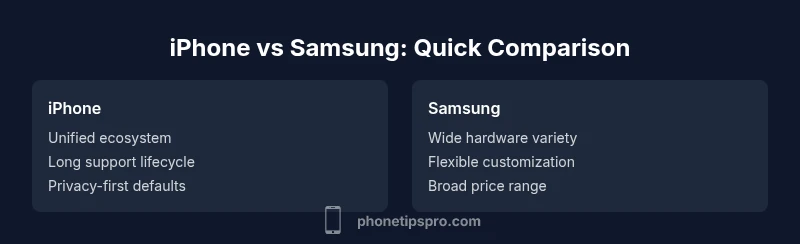
iPhone generally offers stronger long-term value and cohesiveness; Samsung delivers broader hardware choices and upfront flexibility
Choose iPhone if you want a unified ecosystem, long software support, and straightforward privacy. Choose Samsung if you prioritize hardware variety, customization, and upfront affordability.
FAQ
What is the main advantage of iPhone over Samsung?
The main advantage for many users is the cohesive ecosystem and long-term software support that reduces daily friction and extends device usefulness. This translates into a more predictable experience and higher resale value over time.
The main advantage is the cohesive ecosystem and long-term software support, which reduce daily friction and boost resale value.
Does Samsung offer better hardware variety?
Yes, Samsung provides a wider range of devices with different sizes, processors, and feature sets. This gives buyers more options to match budgets and preferences, though it can complicate finding uniform software expectations across the lineup.
Yes, Samsung offers more hardware variety, which means more choices but possibly less uniform software across devices.
How important are OS updates for longevity?
OS updates are a major factor for longevity because they bring new features, security patches, and compatibility with apps. Apple has historically provided longer, standardized updates for supported devices, while Android updates vary by device and carrier.
Updates matter for longevity; Apple generally provides longer, consistent updates, while Android updates vary more by device.
Which is better for privacy by default?
iPhone tends to emphasize privacy by default with fewer prompts for data sharing and tighter app controls. Samsung offers strong protections too, but the default posture on iPhone often reduces data exposure with minimal setup.
iPhone generally emphasizes privacy by default, reducing data sharing prompts right out of the box.
Is price a deciding factor between the two?
Price matters, but total cost of ownership often depends on updates, resale value, and repair costs. Samsung can be more affordable upfront, while iPhone tends to retain value and deliver longer software support.
Price matters, but consider total ownership: updates, resale, and repairs—iPhone often wins on long-term value.
Who should consider Samsung over iPhone?
Those who want maximum hardware variety, flexibility in customization, or a lower upfront price should consider Samsung. If you value ecosystem cohesion and long-term support, iPhone may be a better fit.
If you want hardware variety and customization, Samsung is compelling; if you want ecosystem cohesion, pick iPhone.
How do updates affect app compatibility?
Consistent updates help ensure apps stay compatible. iPhone’s cadence minimizes disruption for most users, while Samsung devices may see more variability depending on the model and region.
Updates help apps stay compatible; iPhone tends to have fewer disruption risks, Samsung can vary by model.
What’s the best way to compare these devices in your own life?
Identify your top tasks (communication, photography, work apps, and media). Test devices with those tasks, consider ecosystem reliance, and evaluate total cost of ownership over a two-year horizon.
Test your top tasks on both devices and consider the total cost over two years.
Quick Summary
- Prioritize ecosystem if you want seamless cross-device use
- Value long-term updates over initial feature breadth
- Consider privacy defaults as a core factor
- Factor resale value into total ownership cost
- Test devices in real-world tasks before buying